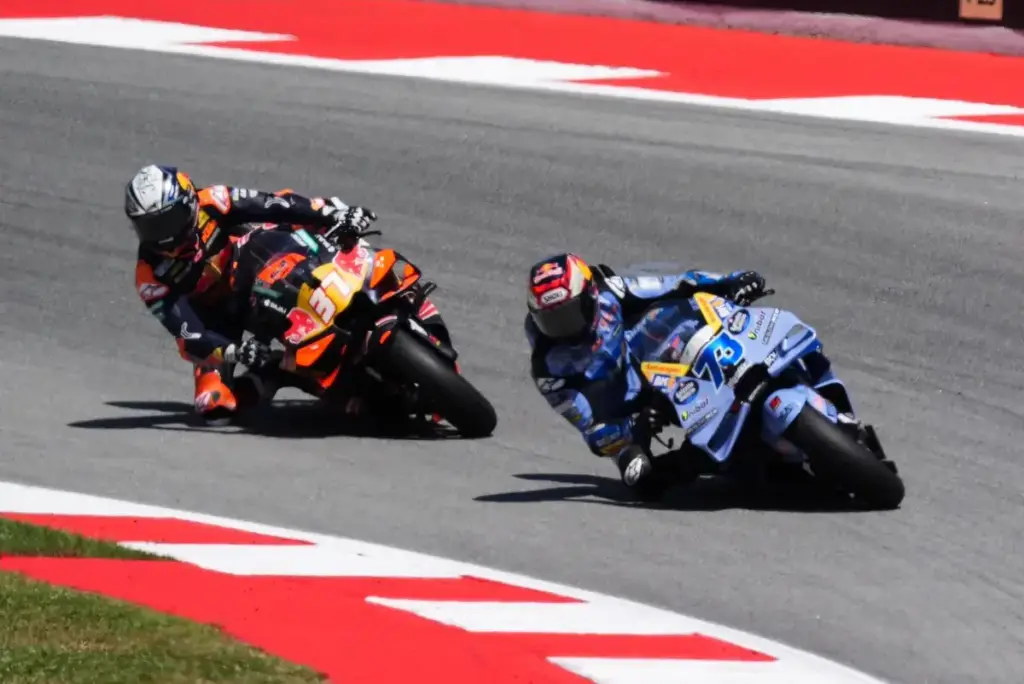

- MotoGP strips front holeshot devices from all bikes starting this weekend at Assen.
- Grid rows expand from nine metres to 12 across all classes from Sachsenring.
- Zarco, Marquez and five others hospitalised or sidelined in back-to-back incidents.
The Grand Prix Commission confirmed on 22 June that front ride height devices, known across the paddock as holeshot devices, will be stripped from all MotoGP machines starting this weekend at the Dutch Grand Prix in Assen.
Grid spacing will widen across all classes from the German Grand Prix at Sachsenring in mid-July. A cap of six bikes per manufacturer takes effect from 2028.
These are not routine regulatory tweaks. They follow a stretch of first-corner violence that hospitalised riders, wiped out championship contenders and left a paddock united on very little except the feeling that something had to change.
The crashes that broke the patience
Acosta’s KTM lost its electronics on the back straight at Catalunya during lap 12, the bike slowing suddenly with the pack still at full speed behind him. Alex Marquez had no time and no space.
He clipped the rear end of the KTM, and the impact launched him into a vicious high-speed crash that sent his Gresini Ducati cartwheeling through the gravel, scattering debris across the track and collecting di Giannantonio, Fernandez and Zarco along the way.
Marquez broke his collarbone and fractured a vertebra. He would not race again until Brno, five weeks later. Race direction red-flagged the race and ordered a restart. Given what had just happened, Bagnaia expected the field to approach the first corner with caution. They did not.
Zarco braked earlier than those around him on the run into Turn 1, but his bike would not slow as expected. Bagnaia swept past on the outside while Marini rode directly ahead.
Before Zarco could correct, he clipped Marini’s rear wheel and tumbled into Bagnaia’s machine, his left leg jamming into the gap between wheel, seat and exhaust as both bikes slid through the gravel together.
That was 17 May. More than a month later, Zarco still has not had surgery. The burns on his leg need to heal before doctors can repair the torn ligaments in his knee.
“I was sucked in by Marini and couldn’t stop in time to avoid him,” Zarco told L’Equipe afterwards. “I was stuck in the gravel trap, screaming out of pain, my leg was starting to burn, and everyone who gathered around me was afraid of touching me, lest they made my injuries worse.”
Bagnaia believed Zarco had done nothing wrong. “He started braking earlier, but he wasn’t able to stop it,” the Ducati rider said. “Something must have happened. When I saw his leg caught, it was a hard blow for me.”
Two races later at Balaton Park in Hungary, Turn 1 claimed another group of riders. Jorge Martin lost control while braking into the opening right-hander and crashed directly into Aprilia team-mate and championship leader Marco Bezzecchi.
The collision swept up di Giannantonio, Aldeguer and Fernandez. Five riders went down in a single moment. None broke bones, but both Martin and Bezzecchi walked away with zero points while Marc Marquez rode to his 100th career grand prix victory.
Jack Miller of Pramac Yamaha pointed straight at the holeshot devices. He told reporters that Martin appeared to be fighting to disengage his device when the bike jumped and became uncontrollable on the newly resurfaced tarmac.
“I’ve been saying all along, since Barcelona, since we saw two crashes at the first corner, the same sort of thing: take them off,” Miller said. “We’re making an unnatural braking manoeuvre. Everybody’s even without the device.”
Aprilia CEO Massimo Rivola called it a braking error from Martin. But the wider argument had already moved past individual blame. Di Giannantonio, who remounted his battered Ducati to fight back to 10th in Hungary, captured the mood of the grid in plain terms.
“We are risking to put the lives of all the riders in danger,” he said. He admitted he now prays before Turn 1 at the start of every race.
How a clever piece of engineering became a safety concern
A front holeshot device is a mechanical system the rider activates on the starting grid.
They compress the front forks using their body weight, then turn a lever on the triple clamp to lock the suspension in that lowered position. The squat holds the front wheel planted under hard acceleration and stops the bike from lifting into a wheelie.
Ducati brought these systems into MotoGP late in the 2018 season, and every manufacturer followed within a couple of years. The concept evolved quickly from a simple start aid into a broader category of ride-height systems.
Rear devices that lowered the bike under acceleration to improve corner-exit drive became a significant performance tool during races, not just at the launch.
Full front ride-height devices that operated while the bike was moving were outlawed from 2023. Start-only front devices stayed legal. But the danger with those devices always lived at the braking end.
To release the locked forks, the rider has to brake hard enough to shift weight forward and free the mechanism. That violent, forced braking manoeuvre happens in a tight pack of 22 riders approaching the first corner, often on cold tyres, often on unfamiliar tarmac.
The Grand Prix Commission had already scheduled a complete ban on all ride-height systems for 2027 under a new set of technical regulations. The crashes at Catalunya and Balaton Park made it impossible to wait that long.
Riders trialled device-free starts during practice at Brno last Friday, and the commission moved the timeline forward after describing those tests as successful.
From this weekend at Assen, only rear ride-height devices remain legal. They too will disappear when the 2027 rules take effect.
Wider rows, a manufacturer cap and an open question
The grid layout changes from the German Grand Prix on 10-12 July. Spacing between riders increases from three metres to four, stretching the distance between each three-rider row from nine metres to 12. The adjustment applies across MotoGP, Moto2 and Moto3.
Riders were offered a two-by-two format similar to Formula 1. They turned it down. Three per row stays, with more room to breathe.
Di Giannantonio backed the logic after Hungary. “If we arrive with much more distance between us, you risk a lot for just two places, maybe it doesn’t feel worth it, and maybe you don’t do it,” he said.
The six-bike manufacturer cap from 2028 is less urgent but structurally important. It means a manufacturer can supply its factory team plus a maximum of two satellite squads.
Ducati is the only marque currently at that ceiling, fielding bikes through its factory operation, Gresini and VR46. The rule only applies if five manufacturers remain on the grid, a condition locked in through 2031 under the new Concorde Agreement.
Not everyone agrees this is the right move
Opinions split sharply when riders tested the launch without the front device at Brno last Friday.
Bagnaia loved it. “It was fantastic, so I hope that they can remove it from this GP, because I felt very good starting without the front device,” the Ducati rider said.
Marini felt the same. Joan Mir said arriving at the first corner with full front suspension travel meant he could finally react if something went wrong ahead of him.
Others saw risk in the half-measure. Yamaha’s Alex Rins warned that starting with only the rear device active made disengagement far harder. Acosta wanted a clean sweep. “Everything or nothing,” the KTM rider said.
“If I took them off, I would take them both off. It’s the most unnatural thing you can put on the bike.”
Bezzecchi called for more testing time before his Brno weekend fell apart after a race ban for striking a marshal. “It’s not a safe solution to immediately remove it,” the championship leader said on Friday.
“It’s better to try it a couple of times more. At least one or two weekends more, to really understand.”
The commission chose not to wait. The consensus after Brno was that the change was either an improvement or made no meaningful difference. That was enough.
Assen arrives with the championship at A boiling point. Bezzecchi leads Martin by eight points. Marquez has won the last two races and is closing fast. Di Giannantonio sits six points clear of Acosta.
Every team now has four days to rework how their bike leaves the grid at one of the most demanding circuits in the sport.
The wider grid rows from Sachsenring suggest the commission sees these changes as a first step, not a final answer. Whether device-free starts and extra spacing will keep riders from wiping each other out at the first corner is something the rest of 2026 will have to prove.
What the footage from Barcelona and Budapest made undeniable is that MotoGP had run out of room to keep waiting.
Comments.
Loading comments…