
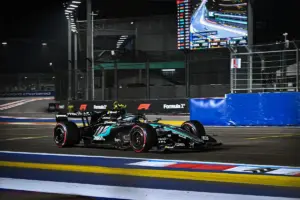
Fernando Alonso’s Aston Martin was faster through the non-full-throttle sections of the lap than the pole-setting car at both Sepang and Singapore, according to GPS analysis which highlights the scale of the team’s straight-line deficit.
Aston Martin have struggled near the back during the first season of Formula 1’s new regulations, but the figures suggest Adrian Newey’s revised AMR26 chassis is performing considerably better than its qualifying positions indicate. Analysis by The Race found Alonso qualified 2.090 seconds behind Max Verstappen at Sepang despite losing an estimated 2.238sec to the Red Bull through the full-throttle sections.
On a simple subtraction, that made Alonso 0.148sec quicker through the remainder of the lap.
Aston Martin numbers stand out in Singapore
The pattern was even more striking one week later at Marina Bay. Alonso’s qualifying time was 2.85sec slower than Verstappen’s pole lap, while his estimated deficit in the full-throttle sections was 3.22sec. That calculation leaves the Aston Martin 0.370sec quicker over the rest of the lap.
It does not mean Alonso would automatically have been on pole with a different power unit. GPS comparisons are affected by factors including track evolution, tyre use and the different drag and downforce characteristics of each car.
What the analysis does show is how sharply Aston Martin’s performance changes when the full-throttle sections are separated from the rest of the lap. The team’s only major aerodynamic update of the season arrived in Hungary, with Newey overseeing a substantial revision of the AMR26 after a difficult opening half of the campaign. Honda has also introduced power-unit upgrades, but straight-line performance and energy deployment remain problems.
Alonso was convinced he had suffered a turbo failure during the Singapore weekend and Aston Martin changed the component before the race. Honda said its data showed no failure but agreed to the change following the Spaniard’s feedback and continued investigating the issue.
The GPS analysis suggests Aston Martin’s cornering performance has improved substantially since Hungary, with Sepang and Singapore producing the clearest numbers yet.
Whether that would translate into genuine pole contention with power-unit parity is impossible to establish from GPS data alone.
For the latest Formula 1 news and analysis, visit Read Motorsport.







Comments.
Loading comments…