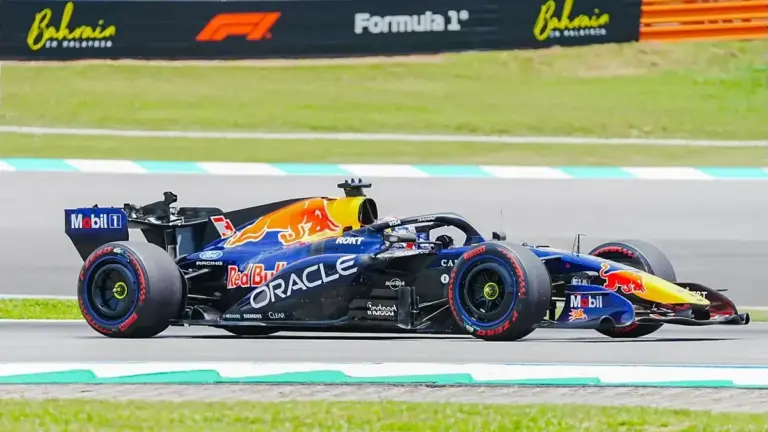
Formula 1’s first ADUO ruling has already moved from a technical equalisation measure into a credibility test for the FIA.
The governing body is reviewing its initial 2026 power-unit performance findings after Red Bull questioned why its new Red Bull-Ford engine has been ranked as the benchmark internal combustion engine. Under the FIA’s Additional Development and Upgrade Opportunities system, that ranking would leave Red Bull without an extra upgrade while Mercedes, Ferrari, Audi and Honda receive varying levels of additional development freedom.
Sky Sports has reported that the FIA is holding discussions with teams and manufacturers before confirming the findings, while Motorsport.com reported Laurent Mekies’ insistence that Red Bull has not seen data showing it holds an ICE advantage over Mercedes.
Why the ADUO argument matters
The FIA’s own explanation of ADUO makes clear that the system is not a full power-unit ranking. It focuses on ICE performance, not the electrical side of the 2026 hybrid package, even though the ERS contribution is central to overall lap time.
That distinction is now the heart of the tension. Red Bull’s objection is not simply that it wants the same development allowance as its rivals. The bigger point is whether a limited measurement can fairly decide who gets to alter a homologated power unit in a season when the new regulations have already created unusual competitive patterns.
Readmotorsport previously covered how Red Bull’s surprise FIA engine ranking put the paddock on alert, and this review has only sharpened the problem. If the result stands, Mercedes would be allowed one upgrade despite leading the championship picture, while Ferrari, Audi and Honda would receive two.
Austria gives the debate a sharper edge
The timing is awkward for F1. The Austrian Grand Prix is already being framed around development momentum, with Red Bull preparing a home-race upgrade and Ferrari’s engine and fuel work also becoming a major part of the title conversation.
That makes the ADUO decision more than a background technical procedure. Red Bull is trying to recover ground in a season where its car has not translated power-unit reputation into consistent front-running form, while Mercedes and Ferrari are fighting with different kinds of advantage.
There is also a political layer F1 cannot ignore. Toto Wolff has previously warned that ADUO must not become a leapfrog device, a point explored in Readmotorsport’s earlier look at Mercedes’ concerns over the mechanism. The first real application of the rule is now testing exactly that fear from the opposite direction.
The FIA needs clarity, not just a final number
The FIA can still land this cleanly, but only if the final explanation is as important as the final ranking. Teams can live with a tough verdict more easily than with a process they cannot understand.
F1 created ADUO to stop a manufacturer being buried by the first version of a new engine. The danger now is that the mechanism becomes a fresh source of mistrust before the season has even reached its summer stretch.
If the FIA wants ADUO to work, Austria cannot arrive with half the paddock wondering whether the first ruling has measured the right thing.