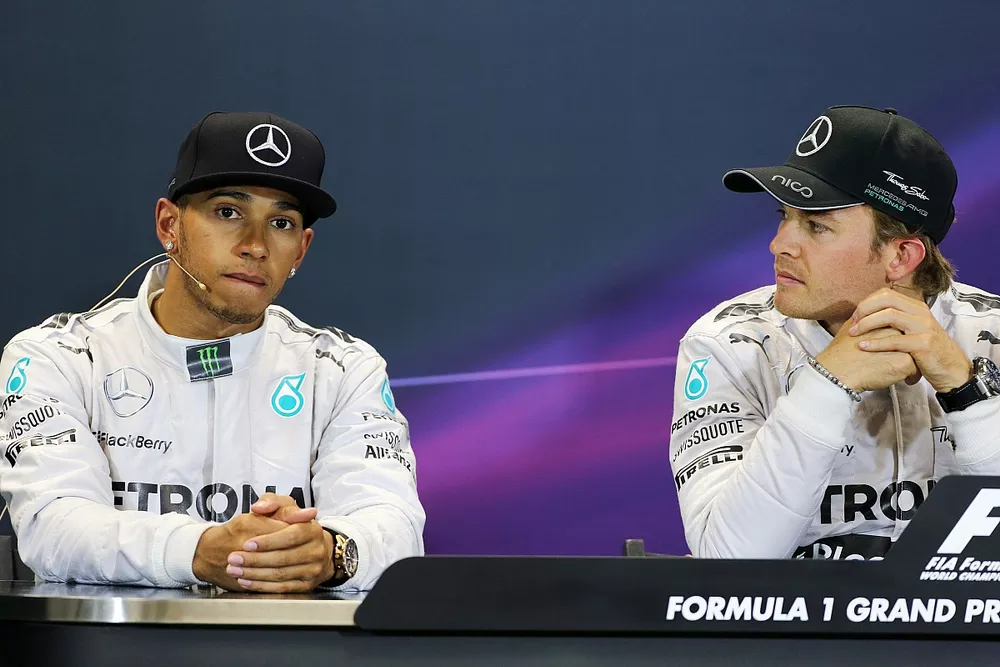

Nico Rosberg has revealed how removing paint from his helmet, giving up cycling and undergoing intensive psychological training helped him beat Lewis Hamilton to the 2016 Formula 1 world championship.
The former Mercedes driver has described the lengths he went to in pursuit of his only world title, admitting he believed Hamilton possessed greater natural ability and that meticulous preparation offered his best chance of beating his team-mate.
Speaking on Formula 1’s Beyond The Grid podcast, Rosberg explained how he examined his physical conditioning and equipment in search of small performance gains.
“My superpower was preparation,” Rosberg said, describing Hamilton as the greatest driver in terms of natural ability.
Rosberg reveals extreme measures to beat Hamilton
Rosberg estimated that reducing his body weight by one kilogram could improve his lap time by approximately three-hundredths of a second, potentially saving around two seconds over a Grand Prix distance. His attention extended to his equipment, with the German removing the paint from his helmet after discovering it added approximately 80 grams. He also stopped cycling, despite it being his favourite endurance exercise, to reduce muscle mass in his legs.
Rosberg claimed the change saved another 600 grams, contributing to the marginal gains he believed were essential to competing against Hamilton. The German pointed to the 2016 Japanese Grand Prix as an example of those small improvements making a difference. He secured pole position at Suzuka by just 0.013 seconds before winning the race, extending his championship advantage to 33 points.
Although the precise contribution of his weight-saving measures cannot be established, Rosberg believes his meticulous preparation helped him gain an advantage over his rival.
Mental preparation proved equally important
Rosberg also revealed that he undertook two hours of psychological training every other day, working with a specialist on meditation, visualisation and techniques designed to improve concentration under pressure. He described the sessions as more demanding than his physical training, particularly when confronting the fear of making mistakes during important races.
The German also deliberately avoided discussing the world championship in media interviews, believing that focusing on the title could distract him from his immediate objectives. Instead, he concentrated on preparing for individual races, maintaining that approach even as the championship battle approached its conclusion in Abu Dhabi.
How Rosberg finally beat Hamilton
Rosberg’s victory ended Hamilton’s run of consecutive championships in 2014 and 2015, following a season in which their increasingly strained rivalry produced several controversial incidents. Hamilton won 10 races compared with Rosberg’s nine, but the German’s consistency helped him secure the championship by five points.
The title was decided at the Abu Dhabi Grand Prix, where Rosberg finished second behind Hamilton to become world champion. Five days later, aged 31, he announced his retirement from Formula 1, having achieved his ambition of winning the title.
A decade on, Rosberg’s account offers an insight into the preparation required to challenge Hamilton during Mercedes’ dominant years, and why he believes the smallest details helped determine the outcome.
For all the latest Formula 1 updates, motorsport news, reports and analysis, visit the Read Motorsport news hub.

Comments.
Loading comments…