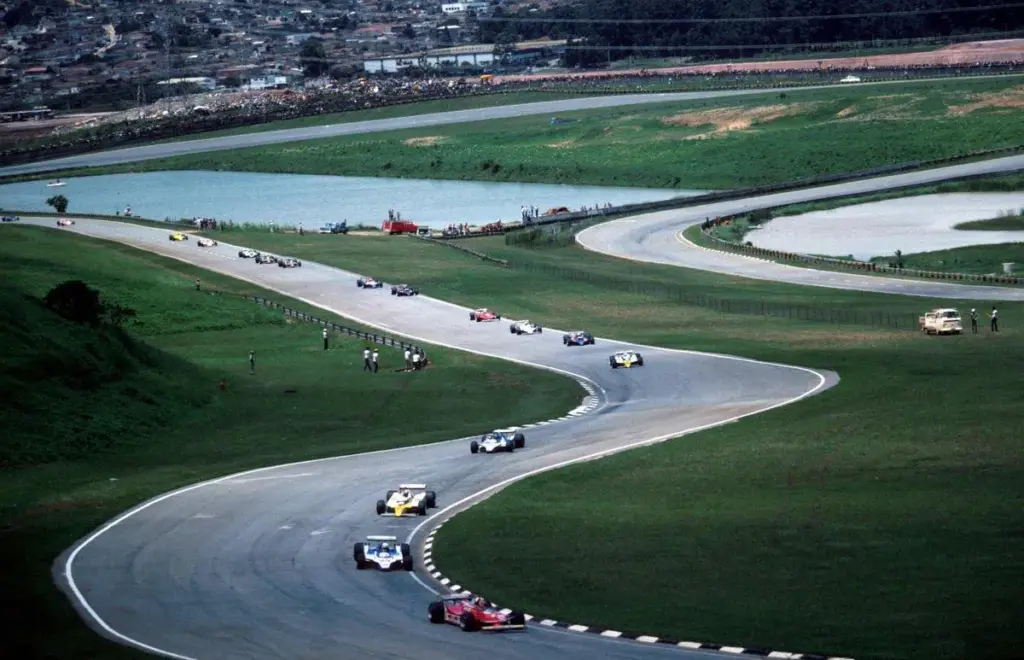

From Ayrton Senna’s emotional home victories to Lewis Hamilton’s last-gasp world championship triumph, Interlagos has witnessed some of Formula 1’s greatest moments. Ahead of this weekend’s Sao Paulo Grand Prix, we look back at the history of Brazil’s most famous racing circuit.
Few circuits have played a greater part in Formula 1 history than Interlagos, where world championships have been decided, home heroes celebrated, and some of the sport’s most remarkable races have unfolded.
The Sao Paulo venue has been part of the world championship for more than half a century, earning a reputation for unpredictable weather, demanding corners and dramatic racing. Its steep climbs, sweeping bends and passionate Brazilian crowds have helped establish it among Formula 1’s most celebrated circuits.
Officially known as the Autódromo José Carlos Pace, Interlagos has changed considerably since opening in 1940, but its character has survived. Ahead of this weekend’s Sao Paulo Grand Prix, its history provides a reminder of why the circuit remains such an important part of the Formula 1 calendar.
From São Paulo landmark to Formula 1 venue
Interlagos opened on 12 May 1940, more than a decade before the Formula 1 World Championship began. Built on the outskirts of São Paulo, its name translates as ‘between lakes’, reflecting its location between the Guarapiranga and Billings reservoirs.
As the official history published by São Paulo’s city authorities explains, the original circuit measured approximately eight kilometres, with long, sweeping corners and considerable elevation changes. Its layout followed the natural contours of the surrounding landscape, creating a demanding test for drivers at a time when motor racing safety standards were very different from those of today.
Formula 1 first visited in 1972 for a non-championship race won by Argentina’s Carlos Reutemann. The following year, Interlagos joined the world championship calendar, with reigning champion Emerson Fittipaldi giving Brazilian supporters the perfect introduction by winning for Lotus.
Fittipaldi repeated his success in 1974 before fellow Brazilian José Carlos Pace claimed his only Formula 1 victory at the circuit in 1975. Following Pace’s death in an aircraft accident in 1977, the venue was officially renamed the Autódromo José Carlos Pace in 1985.
Why Formula 1 left Interlagos
Despite its popularity, the original Interlagos struggled to meet Formula 1’s changing requirements as the championship developed during the 1970s. Its ageing facilities, rough surface and demanding layout prompted concerns among drivers and organisers, contributing to the Brazilian Grand Prix’s eventual departure from São Paulo.
After a one-year move to Rio de Janeiro in 1978, Interlagos hosted the event again in 1979 and 1980 before Jacarepaguá became its permanent home for the remainder of the decade.
Formula 1 returned to São Paulo in 1990 following extensive redevelopment. The circuit was shortened to approximately 4.3 kilometres, with a new infield section replacing much of the original layout while preserving several of its best-known corners and elevation changes.
The redesigned track retained much of the character that had made Interlagos popular with drivers. Its opening Senna S leads downhill into Curva do Sol and the long Reta Oposta straight, before a twisting middle sector gives way to the steep climb towards the finish line.
Running anti-clockwise, the circuit also places unusual physical demands on drivers, particularly through its longer corners. Despite being one of the shorter tracks on the Formula 1 calendar, Interlagos remains a challenging combination of high-speed commitment and technical precision.
Ayrton Senna’s greatest home triumph
Few moments in the circuit’s history carry greater significance than Ayrton Senna’s victory in the 1991 Brazilian Grand Prix. Already a double world champion, Senna had never won his home race, despite having established himself as one of Formula 1’s outstanding drivers.
Driving for McLaren, the Brazilian appeared on course for a comfortable victory until gearbox problems developed during the closing stages. With only sixth gear functioning, Senna was forced to nurse his car towards the finish while Riccardo Patrese closed the gap behind him.
The physical effort was extraordinary, with Senna suffering severe muscle cramps as he struggled to control the car. He nevertheless held on to secure his first victory in Brazil, producing scenes of celebration that remain among the most memorable of his career.
Exhausted after the race, Senna struggled to climb from his McLaren and could barely lift the winner’s trophy. His achievement carried enormous significance for Brazilian supporters, who had waited years to see their national hero triumph at Interlagos.
Senna won again at the circuit in 1993, mastering difficult weather conditions to defeat Alain Prost’s Williams. Those two victories helped establish an enduring connection between the three-time world champion and the São Paulo venue, with Formula 1’s retrospective on the circuit’s greatest moments recognising his 1991 triumph as one of its defining races.
The afternoon Hamilton broke Brazilian hearts
If Senna’s 1991 victory provided one of Interlagos’s most emotional celebrations, the 2008 Brazilian Grand Prix delivered one of Formula 1’s most dramatic championship conclusions.
Felipe Massa arrived at his home race needing victory and a favourable result elsewhere to beat Lewis Hamilton to the world title. The Ferrari driver fulfilled his part of the equation, controlling the race and crossing the finish line believing he had secured the championship.
Behind him, however, Hamilton was fighting to recover the fifth place he needed in increasingly wet conditions. The McLaren driver had slipped to sixth late in the race, leaving Massa on course to become Brazil’s first world champion since Senna in 1991.
Everything changed at the penultimate corner of the final lap, when Hamilton overtook Timo Glock’s Toyota, which was struggling on dry-weather tyres. The move restored Hamilton to fifth and handed him the championship by a single point.
Celebrations in the Ferrari garage turned to disbelief as the significance of Hamilton’s overtake became clear. Massa had produced the performance required to win the title, only to lose it in the final moments of the season.
The 2008 finale remains one of the defining races in Formula 1 history, illustrating how quickly fortunes can change at Interlagos.
Interlagos and the championship deciders
Hamilton’s triumph was far from the only world championship settled at Interlagos. The circuit became a regular venue for season finales during the 2000s, producing several title battles that remained unresolved until the final race.
In 2007, Kimi Räikkönen overturned a seven-point deficit in the standings to secure the championship for Ferrari. His victory in Brazil left him one point ahead of McLaren rivals Hamilton and Fernando Alonso, completing a remarkable turnaround in the final two races.
Two years later, Jenson Button secured the 2009 world championship for Brawn GP with fifth place at Interlagos. His achievement completed an extraordinary season for a team that had emerged from the remains of Honda’s Formula 1 operation.
Another dramatic title decider followed in 2012, when Sebastian Vettel recovered from an opening-lap collision and spin to finish sixth in difficult conditions. Jenson Button won the race for McLaren, but Vettel’s recovery was enough to secure his third consecutive world championship, beating Alonso by three points.
Those races strengthened Interlagos’s reputation as a venue capable of producing championship drama, particularly when changing weather conditions complicated strategy and placed additional pressure on drivers.
Rain, overtaking and modern classics
Interlagos has continued to produce memorable racing even when the world championship has not been at stake. Its unpredictable weather has frequently played a decisive role, turning apparently straightforward races into contests shaped by strategy, mistakes and remarkable recoveries.
The chaotic 2003 Brazilian Grand Prix was interrupted by heavy rain and a series of accidents, eventually resulting in victory being awarded to Giancarlo Fisichella for Jordan. Kimi Räikkönen was initially declared the winner before a review of the results established that Fisichella had been leading at the relevant point before the race was stopped.
In 2016, Max Verstappen produced an outstanding wet-weather performance for Red Bull, recovering from a late pit stop to finish third. Hamilton took victory for Mercedes, but Verstappen’s overtaking and car control in treacherous conditions attracted widespread praise.
Hamilton returned to the spotlight in 2021, delivering another exceptional performance during a difficult weekend. After being disqualified from Friday’s qualifying session, he recovered through the sprint before winning Sunday’s Grand Prix from 10th on the grid.
George Russell claimed his maiden Formula 1 victory at Interlagos in 2022, leading a Mercedes one-two ahead of Hamilton. Verstappen then produced another memorable recovery in 2024, winning from 17th on the grid in heavy rain, while Lando Norris added his name to the circuit’s winners in 2025 with victory for McLaren.
What makes Interlagos different?
The modern Interlagos circuit measures 4.309 kilometres, with the Sao Paulo Grand Prix contested over 71 laps. Although relatively short by Formula 1 standards, its combination of fast corners, elevation changes and technical sections provides little opportunity for drivers to relax.
The opening Senna S offers an overtaking opportunity at the end of the start-finish straight, while the long run towards Turn Four provides another chance to attack. The slower middle sector demands precision and good traction before drivers begin the steep climb back towards the finish line.
Weather is another important factor, with São Paulo’s changing conditions capable of producing rain on one part of the circuit while another remains comparatively dry. Teams must often make difficult tyre decisions with limited information, adding another element of uncertainty to race strategy.
The atmosphere also distinguishes Interlagos from many other venues. Brazilian supporters have celebrated home victories by Fittipaldi, Pace, Senna and Massa, establishing a strong connection between the circuit and the country’s motorsport heritage.
Michael Schumacher remains the most successful Formula 1 driver at Interlagos, with four victories. Hamilton and Verstappen have each won three times at the circuit, placing them within reach of the German’s record.
The official Formula 1 circuit guide provides further details of the layout, its challenging corners and the demands facing drivers over a full race distance.
Another chapter awaits in Sao Paulo
This weekend’s São Paulo Grand Prix will be the 43rd Formula 1 World Championship race staged at Interlagos, continuing a history that stretches back to the early years of the championship.
The 2026 event will also give Brazilian supporters two home drivers to follow, with Gabriel Bortoleto joined by Formula 1 debutant Rafael Câmara. Their presence adds further local interest to a weekend at a circuit where Brazilian drivers have produced some of the country’s greatest sporting moments.
Although the drivers’ championship has already been decided, important positions remain at stake in both championships. Interlagos has repeatedly demonstrated that qualifying results and championship form offer little guarantee of what will happen once racing begins.
From Senna’s exhausting victory in 1991 to Hamilton’s extraordinary championship escape in 2008, the circuit has provided some of Formula 1’s most enduring images. Its history is one of remarkable performances, unexpected results and races that have remained in the memory long after the chequered flag.
With Formula 1 confirming that the São Paulo Grand Prix will remain at Interlagos until at least 2030, the circuit’s place in the championship’s future is secure.
More than eight decades after opening, Interlagos continues to occupy a special place in Formula 1. This weekend offers another opportunity to add to that history.
For all the latest Formula 1 updates, motorsport news, reports and analysis, visit the Read Motorsport news hub.


Comments.
Loading comments…