
- Formula 1 measures only half the power unit under ADUO, raising questions about its fairness.
- Red Bull Racing sits 173 points behind Mercedes yet holds the engine benchmark title.
- FIA agrees to review its methodology after Red Bull requests urgent clarification.
Red Bull Ford Powertrains has formally challenged the FIA’s first assessment under the new Additional Development and Upgrade Opportunities system, known as ADUO, after the governing body declared the team’s maiden power unit the strongest internal combustion engine on the grid.
The finding, covering the opening six races of the 2026 season, locks Red Bull out of all development assistance while Mercedes, Ferrari, Audi and Honda receive upgrade tokens and cost cap relief.
Ironically, Red Bull sits fourth in the constructors’ championship, 173 points behind Mercedes, and has not won a single race.
The ADUO system was introduced alongside the 2026 power unit regulations to prevent any one manufacturer from falling hopelessly behind and staying there.
The FIA measures engine performance at set intervals during the season. Any manufacturer more than 2% behind the benchmark receives one extra homologation token per year. Those more than 4% behind receive two. Red Bull, as the benchmark holder, receives none.
The problem is what the FIA chose to measure, and what it chose to ignore.
The verdict nobody expected
The FIA delivered its findings privately to all five manufacturers during the Monaco Grand Prix weekend. The assessment covered the period from the season opener through to the Canadian Grand Prix.
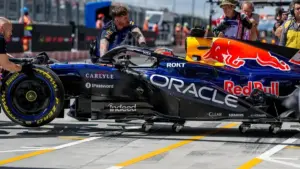
Red Bull’s DM01 unit, built from scratch under technical director Ben Hodgkinson and named internally in honour of the late Dietrich Mateschitz, was judged the strongest combustion engine in the field.
Mercedes was found to be more than 2% behind and receives one token for 2026 and one for 2027. Ferrari, Audi and Honda were all judged more than 4% adrift, and each receive two tokens this year and two next year.
Lewis Hamilton, speaking to Sky Sports F1 after finishing second in Monaco, confirmed the findings plainly.
“I think the news came out either yesterday or today that Red Bull have the most powerful engine, Mercedes second, and then we’re behind,” he said.
“So, we’ve now got these tokens to try and develop and close the gap. But that’s like an eight-to-10-month project, so it’s not something we can just do next week.”
The measurement problem at the core of ADUO
The ADUO system does not measure total power unit performance. It measures only the internal combustion engine. It does not account for the electrical motor, the battery, or any part of the energy recovery system.
The 2026 regulations were specifically designed so that the ICE and the MGU-K each contribute roughly half of the total power output. The FIA has acknowledged this gap in its own framework.
The official Formula 1 explainer states that the ADUO assessment “focuses on the ICE alone” and “is not representative of full power unit performance, given that the ERS also plays a crucial role in overall power output.”
The contradiction is difficult to ignore. The FIA created ADUO precisely because the 2026 formula introduced a radical new hybrid architecture. Then it built the assessment tool for that formula around only half of the hybrid system.
There is a further complication. Once a manufacturer qualifies for ADUO assistance, the upgrades it can introduce are not limited to the combustion engine.
The regulations permit development across the entire power unit, including the ERS, MGU-K, battery, turbocharger, cooling systems and control electronics. The FIA, therefore, measures half the power source to decide who needs help, then allows the recipients to improve all of it.
Mercedes is the clearest example of why this matters. The team’s dominance this season has been built on superior energy deployment and overall power unit integration.
Its combustion engine is slightly weaker in isolation, which qualifies it for ADUO assistance. That assistance now gives it the regulatory room and partial cost cap relief to develop the very electrical systems that were already making it untouchable.
Red Bull’s on-track reality vs. its on-paper status
After seven rounds, including Barcelona, Max Verstappen sits seventh in the drivers’ standings with 55 points. Red Bull has 89 points in the constructors’ table. The gap to Mercedes is 173 points.
Verstappen was careful in Barcelona when asked about the ruling. “I think we were all a little bit surprised with that news,” he said.
“I guess that’s why we’re talking to the FIA now, to see what happened there, how they came to that conclusion. There’s not much more to say right now.”
His mechanical retirement in Monaco added another entry to a reliability record that has made the season painful for Milton Keynes.
His teammate Isack Hadjar was less measured. “I mean, I was checking if we won the first six races of the year, you know, and we didn’t, so…” he said.
Red Bull sporting executive Oliver Mintzlaff and team principal Laurent Mekies met privately with FIA president Mohammed Ben Sulayem to raise their concerns and seek clarification on the methodology.
The FIA responded by agreeing to review its measurement process and committed to sharing a detailed breakdown of its calculations with all five manufacturers within ten days of the Barcelona weekend.
Sources close to the process, however, say there is little expectation that the rankings themselves will change.
What’s the bigger picture
The structural problem with the ADUO is not subtle. The 2026 regulations made the power unit 50% electric by design. The assessment tool that governs competitive development ignores 50% of that design.
Expanding the ADUO measurement to include full power unit performance, not just the combustion engine, is the logical correction.
Measuring total electrical performance across a season is genuinely complex. Battery deployment changes by circuit, by condition and by driver. Energy management interacts with tyre strategy, aerodynamic choices and lap-by-lap decisions in ways that resist simple comparison.
But the FIA understood this complexity when it drafted the 2026 rules. It cannot write a formula where electrical performance is half the equation and then exclude it from the tool designed to keep that formula competitive.
The review the FIA has committed to will conclude before the next round. If it produces only a clearer explanation of how the existing numbers were reached, and no commitment to a broader methodology, the underlying problem carries forward.
The second ADUO assessment window runs until the end of the Hungarian Grand Prix in late July. Red Bull would face the same situation again, armed with more data and fewer options.
The ADUO system was designed to stop manufacturers suffering the way Honda did in 2017. Seven races into its first season of use, it has produced a world in which the team winning every race qualifies for a development boost, and the team that has not won a single one is told it needs no help.


Comments.
Loading comments…