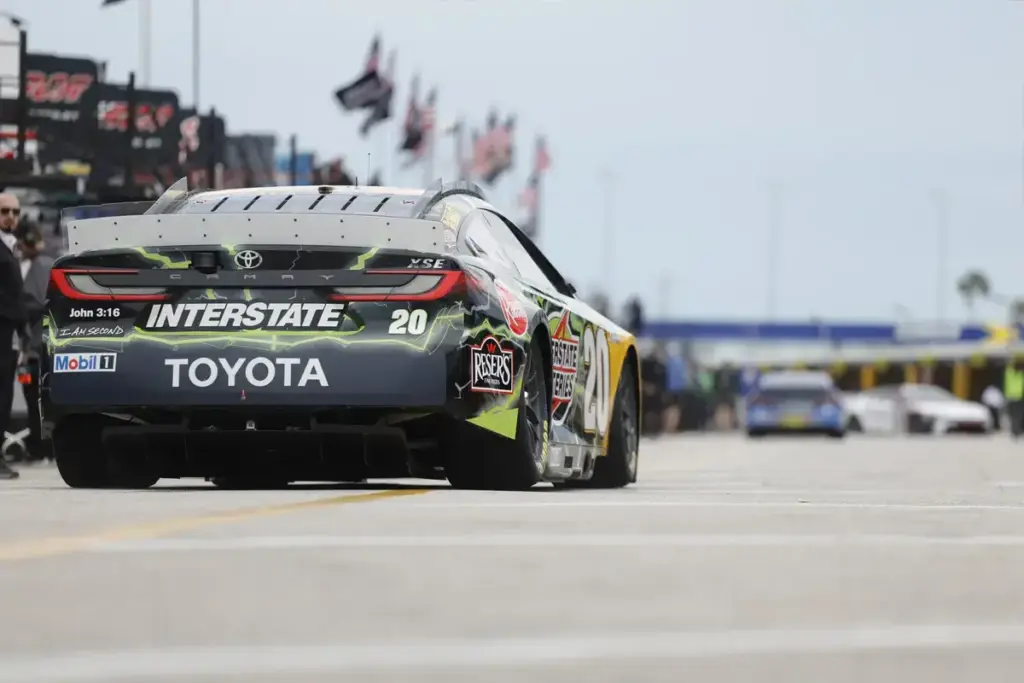

- Christopher Bell fractured his left wrist in a huge Michigan crash.
- The Joe Gibbs Racing driver has been cleared to race at Pocono.
- His return highlights NASCAR’s complicated relationship with toughness.
There are crashes that make you wince. Then there are crashes that make the whole room go quiet.
Christopher Bell’s impact at Michigan belonged firmly in the second category.
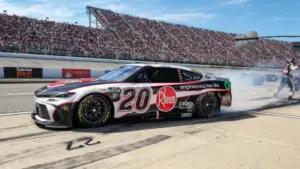
Collected after Chase Elliott got loose, Bell was sent hard into the wall in the sort of accident that instantly cuts through all the usual noise of a NASCAR race. The speed, the angle, the violence of it. None of it made for comfortable viewing.
So, when Bell climbed out of the car, the first feeling was simple enough.
Relief.
Not analysis. Not blame. Not championship permutations.
Just relief.
Then came the update. A fractured left wrist. Painful, awkward and exactly the sort of injury that would keep most athletes away from competition for a little while.
Bell, however, is not most athletes.
He has been medically cleared to race at Pocono.
Which is remarkable, admirable and, if we’re being honest, slightly uncomfortable.
The old racing instinct
Motorsport has always had a strange relationship with pain.
Drivers are expected to be brave. Of course they are. It is part of the job description, tucked somewhere between reaction speed, car control and an apparently limited sense of self-preservation.
But there is a difference between admiring toughness and treating it as the only acceptable response.
That is where Bell’s return becomes interesting.
This is not about questioning his character. Quite the opposite. Bell’s desire to race says everything about the mentality that gets drivers to this level in the first place.
Nor is it about questioning NASCAR’s medical clearance. If he has been passed fit, then he has been passed fit.
But still. A fractured wrist is not nothing. And Pocono is not exactly a Sunday drive to the supermarket.
NASCAR’s balancing act
The modern Cup car is safer than what came before. Medical systems are better. Barriers are better. The sport has learned hard lessons over many years.
Yet the driver mentality has barely changed. If there is a seat available, they want to be in it. If there is a race to run, they want to run it.
That is why fans admire them. It is also why stories like this always carry a slight edge.
Because NASCAR celebrates resilience, but it also has to protect drivers from themselves. That is the balance every racing series has to strike.
Bell’s weekend at Pocono will now be watched through that lens.
If he runs well, it will be framed as another example of a racer gritting his teeth and getting on with it. If he struggles, the questions will come quickly.
Either way, the wider point remains. Christopher Bell’s wrist will heal.
NASCAR’s fascination with drivers racing through pain is likely to last rather longer.
Comments.
Loading comments…