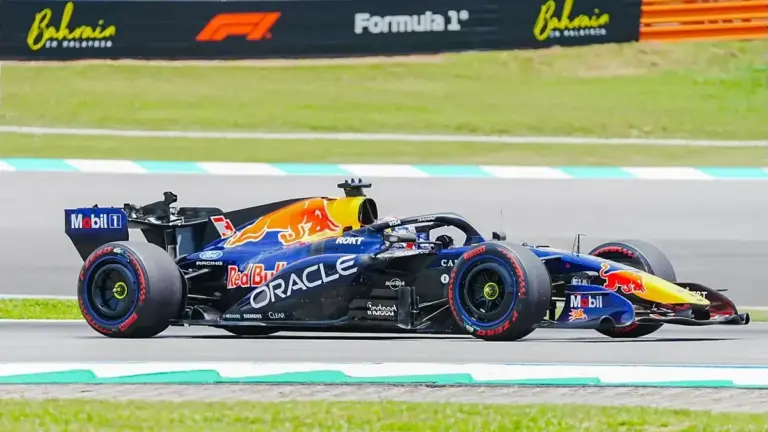
- Red Bull Racing holds the most powerful engine on the 2026 Formula One grid.
- FIA rankings confirm Mercedes, Ferrari and Honda are all trailing Red Bull Powertrains.
- Verstappen sits seventh in the drivers’ standings despite his team’s engine advantage.
Red Bull Powertrains has built the most powerful internal combustion engine on the 2026 Formula 1 grid. Its reward is fourth place in the constructors’ standings, 172 points behind Mercedes.
The FIA’s provisional power unit rankings under the Additional Development and Upgrade Opportunities system, known as ADUO, place Red Bull at the top.
Mercedes sits more than two per cent behind, somewhere between 12 and 24 horsepower adrift. Ferrari, Audi and Honda trail by more than four per cent each.
Lewis Hamilton confirmed the order publicly after the Monaco Grand Prix. Speaking to Sky Sports F1, the seven-time champion said Red Bull have “the most powerful engine, Mercedes second, and then we [Ferrari] are behind.”
What the benchmark actually says
Red Bull’s position at the top of the ADUO rankings carries an immediate consequence.
Because it sets the benchmark, it receives no development tokens. Mercedes gets one token this year and one in 2027. Ferrari, Audi and Honda each receive two.
This is a first-year manufacturer that has outperformed decades of combined hybrid expertise from its rivals.
Red Bull Powertrains built its own engine after splitting with Honda ahead of the new regulations. Mercedes team principal Toto Wolff had previously compared the challenge to climbing Everest.
Wolff spent much of 2025 positioning Mercedes as the likely engine leader under the new rules. He told reporters before the season that Mercedes were “in a very good position for 2026” and that manufacturers would “hold the key” to the pecking order.
After pre-season testing in Bahrain, he reversed that position, conceding that Verstappen and Red Bull looked like “the early benchmark” and that Mercedes had to “get our act together.”
Why power stopped being the story
Red Bull Racing has 72 points in the constructors’ standings. Mercedes leads on 244. Ferrari sits on 165, McLaren on 118.
Max Verstappen is seventh in the drivers’ championship on 43 points. He trails both McLaren drivers and drivers powered by Ferrari engines. His teammate, Isack Hadjar, out-scored him in Monaco with a podium finish.
Verstappen’s race in Monaco ended on the opening lap with a power unit failure. Team principal Laurent Mekies said afterwards that the team had already planned to replace that engine after Monaco, regardless.
Despite having the best engine, Red Bull has suffered from some reliability issues in the six races so far, with Verstappen having to retire on two separate occasions.
After Monaco, the Dutchman kept it measured. “If I had been leading the championship, this would have been very painful,” he said. “Now it’s less painful, but still very annoying.”
Hamilton pointed clearly at where Ferrari was losing time in Monaco. He did not mention the engine. “Obviously, on power, here the power is not such an issue,” he said. “It’s just downforce.”
On corner exit traction, he said the Mercedes was “night and day” quicker.
The picture that emerges is direct. Mercedes is winning with the second-best engine because its car and energy deployment are better. Ferrari’s deficit is mostly in the power itself, as they have been said to have the best chassis in 2026.
Red Bull’s deficit is that its class-leading engine sits inside a chassis and aerodynamics package that cannot use it properly.
Mercedes driver Kimi Antonelli has five consecutive wins and a 66-point lead in the drivers’ championship. The 2026 regulations are half-electric, and peak combustion output measures only one side of that equation.
How a team harvests and deploys energy across an entire lap is where the formula is actually being decided. And that is where Red Bull seems to be really lacking.
The paradox Red Bull cannot upgrade away
The ADUO system offers Red Bull nothing. Its rivals will receive tokens to develop their engines over the next two seasons. Red Bull, frozen at the top of the benchmark, must fix its chassis instead.
Hamilton cautioned that Ferrari’s engine development gains are “an eight-to-ten-month project,” so the closing will be gradual. But it will come. Red Bull will watch that gap narrow while spending its resources on the harder problem.
Red Bull’s engine achievement is real. Producing the strongest power unit on the grid on the first attempt is a significant engineering outcome. But the 2026 season has exposed the limits of that achievement.
The formula turned out to reward chassis and energy integration, not peak combustion output. Red Bull built world-class evidence for the wrong half of the car.