
- NASCAR’s effort to curb fuel-saving at Talladega falls flat.
- Drivers point out that track position carried the most weight during the race.
- Teams worked stage lengths to their advantage and adjusted fuel strategies.
NASCAR experimented with changes to stage lengths to limit fuel saving, banking on a longer opening stage to take that card out of play in the closing laps. At the same time, Stage 1 was expected to open the door for teams to mix up pit strategy around fuel stops. Instead, the race did not play out as planned.
Drivers, too, were left with more questions than answers as Talladega served up a race shaped by the new format. The Next Gen car’s drag-heavy build and limits in clean air meant drivers could not make moves without help, leading to a stalemate where track position ruled the roost.
Drivers point out why stage length changes at Talladega failed to curb fuel saving
NASCAR altered the race by stretching Stage 1 to 98 laps and trimming Stages 2 and 3 to 45 laps each, hoping to take pit stops out of the equation in the closing stages. Teams, however, read between the lines and shifted their fuel-saving playbook to the opening half.
The car’s drag profile means a driver cannot step out of line to form a new lane without a “pusher” right on cue. Any driver who tries to go it alone is swallowed by the pack and shuffled to the back, turning track position into a numbers game built around fuel mileage rather than skill behind the wheel.
Teams made the most of the 98-lap opening stage by running at close to 70% throttle, saving up to 2.5 gallons of fuel per stint to cut down time on pit road. The result was what many called a “high-speed parade,” with cars locked in line and little room to break ranks.
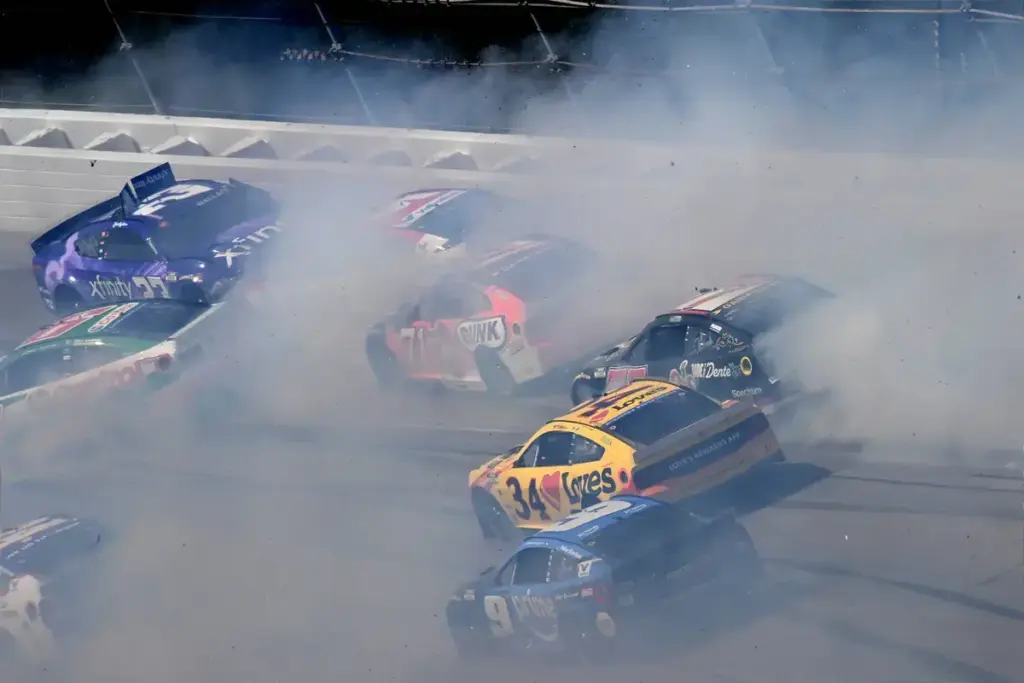
When the field finally stopped saving fuel in the closing stage, the tempo picked up, but the cars proved hard to handle when pushed in the corners, leading to a 26-car pileup that brought the field to a halt.
Boxed in…
Ryan Blaney summed up the situation, noting that drivers were either saving fuel or running over each other, because that is how the car behaves. He said, “You’re just running through, and it’s however hard you can push someone, and the cars are so unstable in the back that they get ping ponging and can’t take it.”
For example, Carson Hocevar and Chris Buescher lined up on the front row for the final stage and held sway from that point to the finish, showing how much the track position mattered. Drivers from the second row back were boxed in, as any move out of line meant dropping to the tail end of the field. Alex Bowman, who pushed Hocevar to the win, said there was little he could do to change his own outcome.
“Really, the only thing is push (Hocevar) out far enough to feel like he needed to defend the top lane and playing both sides. Once he starts moving, there might be an opportunity to get clear, but that didn’t happen.
“I don’t think there was an opportunity for me to move up, and I don’t think I would have, statistically, because these races are mostly won from the bottom. It’s hard to say if I could have done anything differently,” Bowman said.
NASCAR stuck in awkward middle ground
Bowman added that solving the issue would take a sweeping change to the car. Maybe it’s too much downforce, maybe not enough horsepower, maybe the drag is the main villain, maybe the tires are part of it.
If NASCAR reduces drag too much to help cars make moves, speeds shoot up. And not just a little. We’re talking dangerously fast, like 220 mph fast, which opens a whole new can of problems nobody wants. So NASCAR is stuck in this awkward middle ground, trying to balance speed, safety, and racing quality without breaking something else in the process.
Every solution creates a new problem. By fixing passing, the sanctioning body risks safety, and if they try to control speed, they will hurt racing.
But given that he finished third, personally, his day was just fine. He’s not losing sleep over it. But Bowman can clearly see that the media and fans aren’t thrilled with what they’re watching, and he basically shrugged and said, “yeah… I get it.”
Fuel saving was going to find a way, despite NASCAR’s clever strategy
Fuel saving was once rare at drafting tracks during the Gen 6 era and before, but it is now part of superspeedway racing at Daytona and Talladega with the current Cup Series car.
Changing stage lengths was not enough to stamp it out. NASCAR counted on teams to play it straight and load enough fuel under stage cautions to cover at least 45 laps. Teams, however, had other plans, choosing to short-fill tanks because track position is king.
During the race, Ty Dillon came to pit road on Lap 40, and by Lap 41, a line of drivers followed, including Denny Hamlin, Chase Briscoe, Ty Gibbs, John Hunter Nemechek, Kyle Busch, AJ Allmendinger, Cody Ware, and Austin Dillon.
By Lap 48, every team had made its first stop, showing how the strategy played out in real time. As the green flag pit cycle came to an end, Ty Gibbs led ahead of John Hunter Nemechek and Kyle Busch.
Fuel load conundrums…
Racing at superspeedways such as Talladega often boils down to two freight trains of cars locked together, each pushing the car ahead, and that holds at Talladega, where handling plays a smaller role than at Daytona.
In these races, the front of the field is the place to be, and teams tend to experiment with fuel loads to hold that track position. If they fall short on fuel, they can back the pack up, slow the pace, and nurse the car to the stage end or the finish.
Hence, until the Next Gen car allows drivers to move around, make passes, and build runs, the problem will remain. In that light, mandatory four-tire stops may be the only lever left to pull, because NASCAR’s tweak to stage lengths, while aimed at solving the issue, was picked apart and used to the teams’ advantage once again.

Comments.
Loading comments…