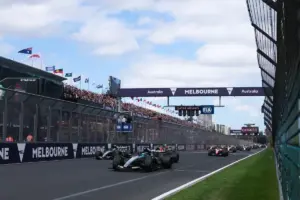
- Albert Park’s pit to undergo major rebuild tied to Melbourne’s Formula 1 future.
- Project will replace the existing facility with one that is larger and more modern.
- Infrastructure costs for the Melbourne project site have recently climbed sharply.
Demolition of the Albert Park pit building will begin on March 27, starting a major rebuild that will reshape the home of the F1 Australian Grand Prix in Melbourne. The work marks the end of the 1995 structure that has served the event since Melbourne took over hosting duties in 1996.
The project is expected to run through to 2028, with crews set to work around the clock from Monday to Saturday during parts of the demolition and remediation program.
The old building sits at the heart of Albert Park’s paddock. For three decades, it has housed the garages, race control, media spaces and parts of the event’s back-of-house operation.
Now, under Melbourne’s hosting agreement with Formula One Management, organisers must replace it with a new facility that meets modern F1 standards.
The push to rebuild comes down to age, size and function. The current garages are small. Hospitality space is limited. Key areas, including race control and media rooms, no longer fit the needs of a modern Formula 1 event.
The Paddock Club has also had to operate from a separate structure near the paddock entry and the end of Melbourne Walk, rather than inside the main pit complex.
The asbestos discovery that blew out the budget
The project did not stay a simple upgrade for long. PlanetF1 recently reported that the original construction budget was set at $200 million. That figure rose sharply after workers found asbestos inside the existing pit building.
The discovery added $80 million to budgeted costs and pushed the headline construction figure to $280 million.
AUStadiums has reported that Victoria’s auditor-general put the total cost, including full asbestos removal, as high as $395 million. The final budget has not yet been confirmed.
According to grandprix.com, Victorian Treasurer Jaclyn Symes said the government had no real choice once asbestos was found. Speaking to ABC Melbourne Radio, she said, “Unfortunately, there’s not much you can do apart from deal with asbestos when you find it to ensure that you’re providing a safe workplace and a safe building going forward.”
The next stage of work includes tearing down the current building, putting in-ground services in place, digging out contaminated soil and starting construction of the new complex.
Further contaminated soil treatment is due to continue until late July. Those works will also run 24 hours a day during the working week.
What the new facility will look like
The new Albert Park structure will serve two jobs. During Grand Prix week, it will act as the pit complex for Formula 1. For the rest of the year, it will work as a community sports venue.
AUStadiums reported that the race-week setup will include 14 team garages, a new race control centre, and upgraded race administration and media spaces. The design also adds more room for corporate hospitality, reflecting Formula 1’s growing demand for premium guest areas.
According to AUStadiums, government images show the venue will also include seven indoor multi-purpose courts with change rooms. That is two more courts than the current facility offers.
The wider project is being delivered through a partnership involving Development Victoria, the Australian Grand Prix Corporation, Parks Victoria, the State Sport Centres Trust, and the Department of Jobs, Skills, Industry and Regions.
Head contractor Icon is leading the build alongside Woods Bagot and AECOM. Icon VIC Director Al Munro said the contract was a proud moment for the company and pointed to the project’s value for both racing fans and the wider public.
Timeline and race continuity
Organisers say the Australian Grand Prix will continue while the site changes around it. The pit building will be under construction between the 2026 and 2028 races. Work is expected to continue through 2026 and into the 2027 event period.
For the 2027 Australian Grand Prix, the site will use a mix of existing, new and temporary facilities. New garages will be built for that race. A temporary Paddock Club with room for 2,500 guests will also be put in place.
The full new Albert Park pit building is expected to be ready for the 2028 Formula 1 Australian GP. Speedcafe reported that piling works for the new foundations are scheduled between late April and late July. Those works are expected to run from 7 a.m. to 10 p.m. on weekdays and 7 a.m. to 4 p.m. on Saturdays.
The bigger picture: Melbourne’s commitment to F1
The scale of the rebuild shows how much Victoria values the Australian Grand Prix. Melbourne is locked in as host until 2037 under a contract extension signed in 2022. That deal also gave the city the right to stage Formula 1’s opening round four times during that period.
The government argues the event earns that backing. A 2023 economic report said the Grand Prix added $188 million to Victoria’s visitor economy and supported more than 1,100 full-time jobs.
The 2026 event drew a record four-day crowd of 483,934, underlining the race’s place as one of the state’s biggest tourism events.
Victorian Minister for Tourism, Sport and Major Events Steve Dimopoulos said the rebuild is about more than one weekend of racing. He said, “We’re investing in the future of the Australian Grand Prix so Melbourne can continue hosting this world-class event and showcasing Victoria to millions around the globe.”
The demolition at Albert Park closes a long chapter in Melbourne’s Formula 1 story. The old pit building helped carry the race from its first year in the city to its current place on the sport’s calendar.
What comes next will be bigger, more modern and far more expensive, with the final price still under watch as work begins.