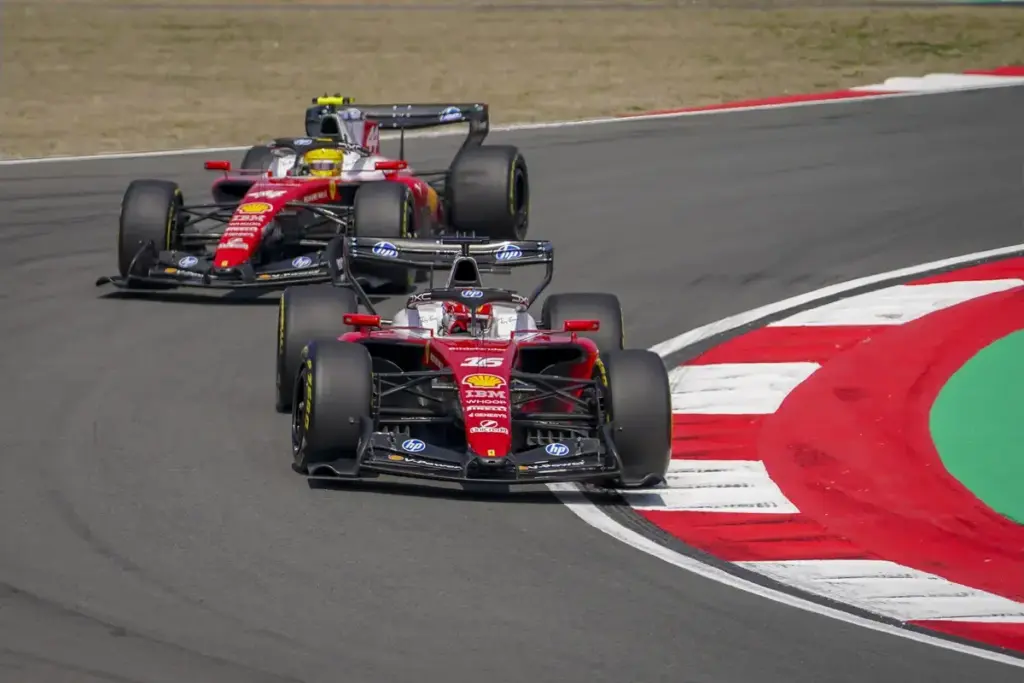

- Hamilton says qualifying gap to Mercedes narrowed from eight-tenths to six-tenths.
- Leclerc lost half a second from a cockpit toggle button malfunction.
- Ferrari shelved its experimental ‘Macarena’ rear wing over reliability concerns.
Lewis Hamilton and Charles Leclerc confirmed during Sprint Qualifying at the Chinese Grand Prix that Ferrari is losing around half a second to Mercedes on Shanghai’s long straights.
Both drivers pointed to energy deployment as the primary cause, and Leclerc disclosed a specific cockpit malfunction that worsened his own session.
George Russell took Sprint pole for Mercedes on Friday with a 1:31.520, locking out the front row alongside team-mate Kimi Antonelli. Hamilton qualified fourth, 0.641s off the pace. Leclerc was sixth, more than a second adrift. The gap confirmed what Melbourne’s opening round had suggested: the SF-26 is fast in the corners but exposed whenever the cars hit full power on a long straight.
The deficit is shrinking. Hamilton said the qualifying gap has come down from roughly eight-tenths in Melbourne to six-tenths in Shanghai. In race trim, though, he estimated the Mercedes W17 still holds a half-second-per-lap advantage in clear air.
The Ferrari de-rating conundrum
“It seems mostly on straight, so I think it would be at the moment everywhere on the straights,” Hamilton said. “It seems more so when they open up the ESM, that’s when they take a huge step, so whatever’s going in that phase is an area we need to understand.”
ESM refers to the energy system management phase of power delivery under the 2026 regulations, where the internal combustion engine and the MGU-K combine to determine how long a car can sustain full electrical assistance down a straight.
Hamilton’s comment points to a gap in how efficiently Ferrari deploys that energy compared with Mercedes.
“They seem to have a little bit more deployment, so less de-rating at the end of the straights than some of us,” Hamilton said. “So we’ve just got to work on trying to see how we can eke out more from our engine.”
De-rating, in simple terms, is the drop-off in electrical power that occurs when the battery runs low during a straight. Ferrari appears to be hitting that limit sooner than Mercedes, which means the SF-26 loses speed in the final part of Shanghai’s 1.2 km back straight, when the timing difference compounds.
Leclerc’s toggle malfunction
Leclerc’s session was complicated further by a problem unrelated to the broader deployment gap. He disclosed that a malfunctioning cockpit toggle button caused erroneous power deployment during the closing stages of Sprint Qualifying, costing him approximately half a second on top of Ferrari’s existing straight-line weakness.
That helps explain the gulf between his result and Hamilton’s: while both cars carried the same underlying deficit, Leclerc’s lap was damaged by a specific system error.
Before the session, Leclerc had tempered expectations. “In qualifying, I don’t expect us to be at the level just yet,” he said. “For sure, we’ll be closer because in Melbourne we did many things that we haven’t optimised and there was quite a bit of lap time in that, but we are definitely not on their level.”
He added that the team is starting to piece together their wider cause-and-effect picture. “We start to understand what effect is caused by what, on what we see in the race traces of Mercedes in qualifying,” Leclerc said.
Why Ferrari shelved the experimental rear wing
Ferrari arrived in Shanghai with their innovative rotating rear wing system, nicknamed the Macarena wing, designed to improve the car’s active aerodynamic transitions. The component was removed between the initial practice session and Sprint Qualifying due to reliability concerns after what the team acknowledged was a rushed introduction.
The decision was precautionary. Ferrari reverted to a known rear-wing configuration to ensure it could complete the session without risk. But the move left the SF-26 without a component that was expected to deliver its greatest benefit on exactly the kind of long straights where Mercedes is pulling away.
According to analysis by Autosport, Mercedes’ advantage extends beyond raw engine power. The W17’s energy strategy appears to prioritise aggressive recharging at up to 250 kW with the rear wing open, allowing it to arrive at braking zones with more speed. Ferrari, by contrast, relies more on lift-and-coast phases to recover energy, a less efficient approach under the 2026 regulations’ 7 MJ energy limit.
What comes next in Shanghai
Ferrari’s cornering advantage was visible in the telemetry. Telemetry from Melbourne showed the SF-26 carrying higher minimum speeds than the Mercedes through high-load corners, and that pattern appeared to hold in Shanghai’s technical sections.
The question for tomorrow’s Sprint race and Sunday’s Grand Prix is whether that advantage through corners 3, 11, and 14 can offset what they lose every time the cars open up on the back straight.
Hamilton’s trajectory from Melbourne to Shanghai suggests Ferrari is finding small gains. Whether the rate of improvement is fast enough to challenge Mercedes before the European swing remains unclear.







Comments.
Loading comments…