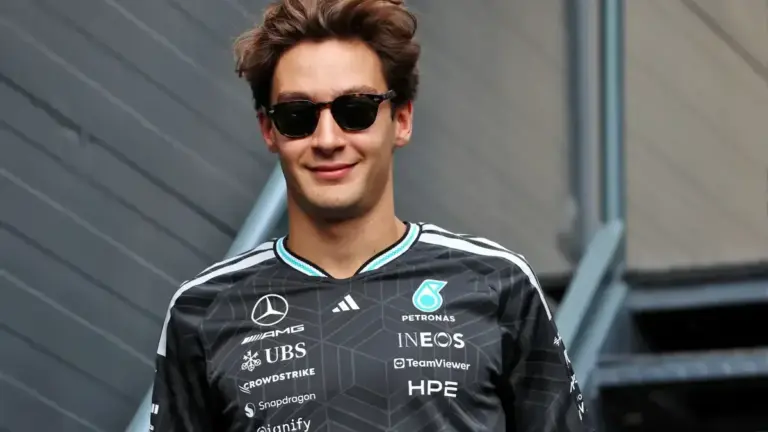
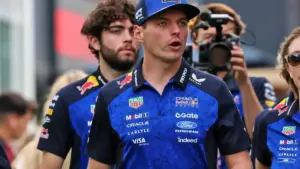
George Russell held off Max Verstappen by the smallest of margins at the finish line in Baku, and for a few laps it looked as though Red Bull might snatch a win from nowhere. The Verstappen Baku finish gap set social media alight within minutes, replayed from every angle as the two cars crossed the line almost as one.
Verstappen was quick to play the moment down once he climbed out of the car. Russell had led for most of the afternoon and looked comfortable until a late yellow flag changed the picture. By the time it flew, the gap had shrunk to almost nothing, and on paper it read as the tightest finish of the season so far.
“Max almost got me at the line. That would have been a real shame, but all in all, it’s been an incredible weekend,” Russell said afterwards. His words captured how tense it felt from the cockpit, even if the story behind that gap turned out to be a little different.
Behind the Dramatic Baku Finish Line Photo Finish
Russell’s win looked routine for most of the race. He had the pace to control things from the front, and Verstappen’s recovery drive was eating into the gap gradually rather than dramatically. Then came the moment that made the finish look so tight on the timing screens.
A late safety car period compressed the field, and the closing laps turned into a straight fight between two cars separated by almost nothing. Neither driver expected it to end quite that close, and both said as much once the cars were parked.
How Boost Lag Turned One Second Into Deciseconds
The yellow flag came out for Valtteri Bottas, who crashed late in the race and brought marshals onto the circuit. Every driver had to lift off the throttle to respect it, and that simple rule proved costly for Russell at exactly the wrong moment.
Verstappen didn’t think the finish line told the real story. “Of course, it looked close on the line, but I think that was more because George suffered from a little bit of boost lag in Turn 15 with the yellow flag,” he said. It sounds small. Boost lag happens when a turbocharged engine loses pressure after the throttle shuts, so power doesn’t return the instant the driver gets back on it. On a street track like Baku, where every metre out of a corner counts, that delay costs real time.
Russell backed up the explanation without needing to be asked twice. “When the yellow flag came out, I lifted off the power and when I went back on, I had no turbo, so then I had no power,” he said. It gave Verstappen, already flying through the final stint, a chance to eat into a gap that should have stayed comfortable.
Verstappen was clear about what the honest number actually was. “So if you look at the last stint, it was always one second, so that’s probably also where we would have finished,” he said. Take away that one moment of bad luck for Russell, and Mercedes was still a second up the road; not the photo finish the timing screens suggested.
Stint Lap Times and the Reality of P8 Recovery
None of this happens without Verstappen’s recovery from P8. Red Bull’s Friday session in Baku fell apart when an engine problem meant Verstappen never got a clean qualifying lap in, leaving him to fight through the field rather than race for the win from the front. We covered his qualifying engine failure in detail at the time, and it left Red Bull working from a serious deficit before the race had even started.
From there, Verstappen simply drove through the field all afternoon. Finishing right on Russell’s gearbox from eighth on the grid says plenty about the pace Red Bull actually found once the lights went out, well before the late yellow flag played its part. Our earlier report on that qualifying disaster looked at how costly the Friday problem could have been, and Sunday’s drive went a long way toward answering it.
Verstappen wasn’t dwelling on the near miss afterwards either, joking about how hard he pushed in the closing laps. “That last stint was fun. I kissed a few walls as well, but that was just to leave my mark here in Baku!” It’s the kind of line that tells you plenty about how close he actually felt the race was, walls and all.
Red Bull’s Real Pace Ahead of the Next Grand Prix
That honest picture is what Red Bull carries into the next grand prix. Verstappen was asked directly whether starting further up, even second on the grid, would have changed anything. “I mean, that’s what happened yesterday. You have a problem and that means that you have to start from P8. But I think even if I started second, I think with the pace of George, it would have been very hard to pass,” he said. It’s a rare bit of honesty from a driver who rarely talks down his own car.
Russell had already flagged Verstappen as a genuine threat before a wheel was turned in Baku, something we picked up in our piece on his warnings about Verstappen’s threat, and the finish did nothing to change that respect between the two of them. The Verstappen Baku finish gap will be remembered as one of the tightest of the year, but Verstappen’s own words point to Mercedes still holding a real edge over a full stint.
For neutral fans it was a thriller. Judged on Motorsport.com’s reporting and confirmed by Autosport’s coverage of the same interviews, it was proof that Red Bull’s fight with Mercedes is still not as close as one Baku finish line made it look.