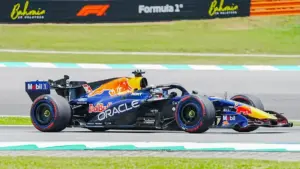
Max Verstappen qualified eighth for Saturday’s Azerbaijan Grand Prix after an internal combustion engine failure hit Red Bull during qualifying in Baku. The Max Verstappen Baku engine problem cost him at least half a second a lap compared with his team-mate from Q1 onwards, and it only got worse as the session went on.
Verstappen had looked capable of a front-row spot on pure pace earlier in the weekend. Instead he was left explaining a mechanical fault that spread through the car and wrecked his final runs, leaving Red Bull to sort out the cause before Saturday’s race.
Verstappen Qualifies Eighth in Baku Following Combustion Engine Failure
Speaking to Dutch media in the paddock after qualifying, Verstappen was blunt about how early the trouble started and how much it cost him. “Throughout qualifying, already from Q1, I had a problem with the engine, which meant I was losing at least half a second compared to my team-mate. And it only got worse. In Q2 and Q3 it was a complete disaster, so I think we clearly have a problem with the engine,” he said.
That gap proved decisive on a track where a tenth here or there separates the front of the grid from the midfield. Eighth on the grid leaves Verstappen with plenty of work to do if Red Bull want a strong result on Saturday.
Red Bull Driver Confirms ICE Fault Caused Q3 Battery and Speed Issues
Asked directly whether the issue was electrical, tied to how the car deploys its hybrid power, Verstappen ruled that out. “No, not on the electrical side. In Q1, we immediately saw a problem. Of course, at that point you still think, ‘What could it be? Is the engine too cold or actually too hot?’ All of that is possible, because it is all very sensitive nowadays. But later it became clear that we really did have a problem with the ICE. It only got worse and in Q3 that engine was no longer working properly at all,” he explained.
He then detailed how the fault spread through the car’s systems in Q3. “The top speed just became less and less. On that second lap in Q3, my battery wasn’t charging either, but that was obviously because the combustion engine had a problem. That causes a lot of misfires and a lot of other problems, and it confuses the system completely,” Verstappen said.
His account makes clear the Max Verstappen Baku engine problem began with the combustion engine itself, and everything else, the misfires, the falling top speed and the battery that would not charge, followed from that single fault rather than a separate hybrid-system fault.
Engine Swap Options Avoid Immediate Baku Penalty for Red Bull
With the ICE clearly compromised, Red Bull face a decision on whether to change it before Saturday’s race. Verstappen confirmed the team has a way to do that without dropping down the grid. “Well, if there are still question marks, we have to replace the engine. But we still have another engine available in the pool,” he said.
Using a fresh unit from within his existing allocation means Red Bull can fit a healthy engine ahead of the race without triggering the grid penalties that come with using components beyond a driver’s season allowance. It gives the team a genuine option to protect Verstappen’s result in Baku while the faulty unit is investigated back at the factory.
Upcoming Race Timeline and Inevitable Grid Penalty Later in Season
The relief is only temporary. Verstappen was direct when asked whether a grid penalty would eventually follow once the engine allocation runs out. “Yeah, there definitely has to be a penalty at some point,” he said, accepting that Red Bull cannot keep making swaps without consequence forever.
For now, the focus is on Saturday’s race in Baku, where Verstappen starts eighth with a fresh engine and a genuine chance to recover ground through the field. The bigger reckoning, a grid drop at a race still to be decided, will come later in the season once the pool of available units is exhausted.
Fans who followed his charge through traffic at recent rounds will know he has the racecraft for the job; our piece on lessons learned from watching Verstappen covers exactly that skill. He has also been vocal recently about how the calendar itself is shaping up, including Verstappen’s reaction to future sprint calendar changes.
Full detail on his qualifying explanation can be found in Max Verstappen’s post-qualifying interview, with further detail available in the Baku paddock technical report.