Lando Norris looked set to win the inaugural Spanish Grand Prix at the new Madring circuit, right up until Lance Stroll’s brakes failed and left his car stranded on track. That single mechanical failure turned a comfortable lead into nothing, and it has left David Coulthard asking hard questions about how quickly Formula 1’s race control actually reacts.
Madring Pit-Stop Lottery Robs Norris of Spanish Victory
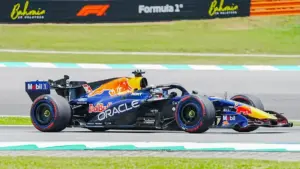
Norris had built a lead that looked, on paper, close to unassailable. Then Stroll stopped on track with brake failure, and the timing of what followed decided the entire afternoon. Norris had already passed the pit entry line by the moment the virtual safety car was actually deployed.
That timing gap mattered more than anything else in the race. Drivers who were still behind the pit entry when the VSC came out could dive in and take a near-free pit stop. Norris, just metres too far down the road, could not. He had to complete another full lap at racing speed before he got his own chance to pit.
Kimi Antonelli made the most of it. He pitted cheaply under the VSC, rejoined ahead of Norris, and went on to claim his eighth win of the 2026 season. It’s the kind of outcome that will sting Norris and McLaren long after the numbers are forgotten, because nothing he did on track cost him that race. A few seconds of timing did.
Coulthard Questions FIA Lags in Safety Car Deployments
Speaking on the Up To Speed podcast, David Coulthard didn’t hold back on where he thinks the problem lies. For our readers who followed Coulthard’s previous media commentary, this is a familiar voice on the podcast circuit, and he used it here to press the FIA directly on process rather than personnel.
“One thing I would question again is the time it takes between an incident and either a virtual, a safety or a red flag. I think that can be tidied up,” Coulthard said, according to a Motorsport.com report on the podcast episode.
That’s not a small point for Norris and McLaren. A quicker call from race control on the Stroll incident could easily have caught Norris on the correct side of the pit entry line, and the entire complexion of the grand prix might have looked different. Coulthard was careful not to accuse anyone of dragging their feet deliberately. His argument was about the system, not about blame. Even a small reduction in reaction time, he suggested, would remove some of the worst outcomes drivers currently have to live with.
Coulthard didn’t stop at Madring for his example. He pointed to Monza as a case where the delay was, in his view, obvious. “Some of them are absolutely clear-cut, like Monza. It took a little while before the red flag when it’s absolutely clear we’ve had a major accident at Parabolica. So that should be as quick as a yellow flag comes out, the red flag should be out. So room for improvement,” he said.
Statistical Context and Buxton’s Analysis of Neutralisation Luck
Coulthard’s co-host Will Buxton offered a different angle on the same problem, and it’s arguably the more uncomfortable one for fans to hear. Buxton’s point wasn’t really about speed at all. It was about the basic unfairness built into how safety cars and virtual safety cars work, no matter how fast the FIA reacts.
“But the thing with safety cars, virtual safety cars, whether you close the pits or you don’t, when a virtual comes out or doesn’t, when a full safety car comes out or doesn’t, it’s luck of the draw. You’re going to be on one side of the coin or the other. You’re either going to land on the side that has worked out brilliantly, or you’re going to be on the side of the coin that has completely screwed your day. And there’s no real midpoint. It’s one or the other,” Buxton said.
That framing lines up exactly with what happened to Norris. He wasn’t unlucky because of a slow decision alone; he was unlucky because the whole mechanism of a VSC creates winners and losers based on where cars happen to be on the circuit at the moment it triggers. Buxton pushed the point further still. “How do you legislate to make a moment that is by its very nature inherently unfair? You can’t make that fair,” he said.
It’s a fair challenge back at anyone calling for reform. Speeding up the decision helps at the margins, certainly, and it would have given Norris a better chance at Madring. But it doesn’t remove the coin toss altogether. Somebody is always going to be on the wrong side of the timing line, however sharp race control becomes.
Future Implications for FIA Race Control Procedures
Coulthard didn’t pretend there’s a perfect fix waiting to be found, but he was clear that the current gap between incident and intervention leaves too much to chance. “There’s room for improvement, and we touched on it right at the top. The time it takes between an incident and a decision,” he said.
None of this amounts to a claim that the FIA acted deliberately to shape the result at Madring. Coulthard’s argument is about process, not motive, and the brief here is about tightening reaction times rather than rewriting the rulebook overnight. Even so, Norris’s lost win gives the debate real weight heading into the rest of the season.
For McLaren fans, the result at Madring will sit somewhere between frustrating and infuriating. Norris did the hard part, building and holding a lead that should have been enough. What cost him was a matter of seconds and a line on the track, not pace or a mistake behind the wheel. We’ve covered plenty of these fine-margin moments this year in our recent F1 talking points, and Madring fits right into that pattern. Whether the FIA moves to close that gap remains to be seen, but the conversation Coulthard and Buxton have started is unlikely to go quiet any time soon.