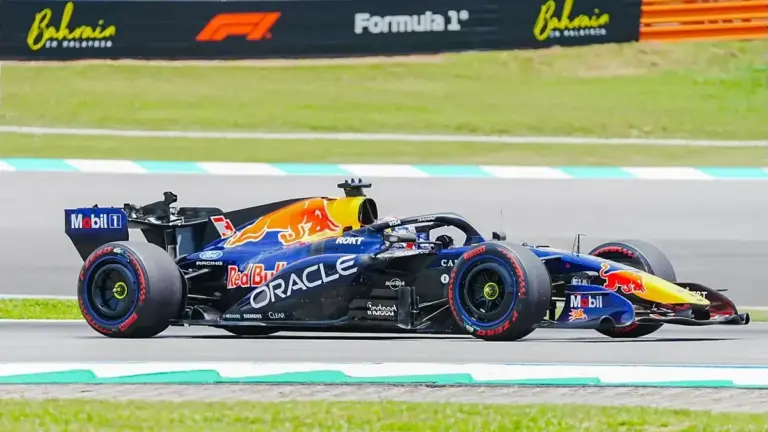
Max Verstappen’s British Grand Prix weekend has tilted from threat to damage limitation after Red Bull’s Silverstone pace issue followed him from the Sprint into qualifying.
The Dutchman had already described Red Bull as short of high-speed cornering performance after dropping from third to sixth in Saturday’s Sprint. Hours later, the problem carried a heavier cost: Verstappen qualified seventh for Sunday’s Grand Prix, behind the Mercedes-Ferrari lead group and the McLaren of Lando Norris.
Formula 1 reported that Verstappen pointed to a “double whammy” after qualifying, with the RB22 lacking both top speed and the stability needed through Silverstone’s loaded corners. The result looked especially stark because the front of the grid was tightly defined: the FIA confirmed Kimi Antonelli’s 1:28.111 pole lap, with Charles Leclerc second and Lewis Hamilton third.
Why Red Bull’s race now changes
Red Bull’s issue is not simply grid position. Silverstone punishes cars that cannot lean on aero load through Copse, Maggotts and Becketts, and Verstappen’s Saturday evidence suggests he will need either clean air, strategy disruption or weather volatility to climb.
That also sharpens the contrast with Mercedes. Antonelli has already converted Sprint momentum into Grand Prix pole, a theme ReadMotorSport analysed in its Mercedes title-control piece. Verstappen, by comparison, starts with a recovery brief rather than a victory platform.