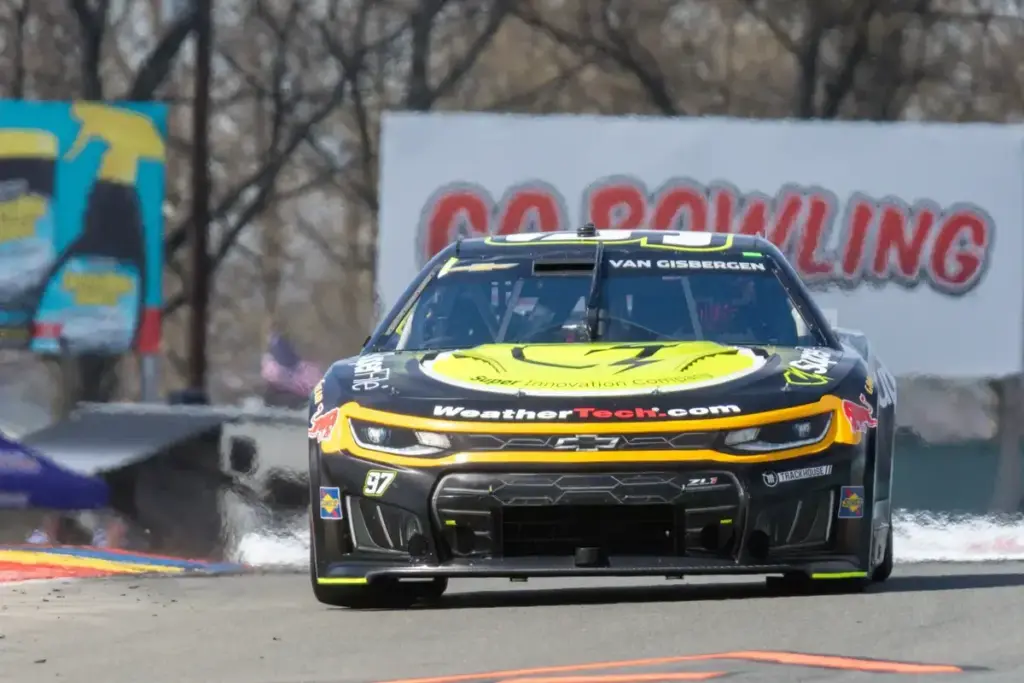

- Earnhardt Jr. reveals secret behind success of van Gisbergen on road course.
- Junior points out SVG’s cluth usage technique as the factor.
- SVG aims to reach the playoffs by improving on ovals.
When Shane van Gisbergen arrived in NASCAR for the Chicago Street Race under the banner of the Trackhouse Racing project known as Project 91, he turned heads across the garage by winning on debut.
While much of the field spent the day wrestling with rain, sliding tires, missed corners, and bent sheet metal, SVG sliced through the street course as though he had the map stitched into his hands. Given his background in Supercars, where road-course combat is part of the bread and butter, the layout suited him.
Additionally, the similarity between NASCAR’s Next Gen car and the Supercars machines powered by V8 engines also played into his hands. SVG did not need to start from scratch or spend months trying to decode how the machinery worked. He climbed in, understood the rhythm, and let the results speak for themselves. But now, Dale Earnhardt Jr. has pulled back the curtain and explained the technical side of why SVG continues to put the field far behind in his rear-view mirror on road courses. In doing so, he may have let the cat out of the bag for the rest of the Cup garage.
Dale Earnhardt Jr. points to Shane van Gisbergen’s clutch technique as the key behind his road-course dominance
Just last weekend, Shane van Gisbergen beat the field at Watkins Glen by 7.288 seconds. Now, Dale Jr. has explained what separates SVG from the rest of the garage. On a recent episode of The Dale Jr. Download podcast, Junior broke down what happens when a stock car dives into a heavy braking zone on a road course.
Most NASCAR drivers attack those corners by standing on the brakes, banging through downshifts, and allowing engine braking to slow the car. The moment the transmission drops into a lower gear, the drivetrain drags the rear tires down abruptly. When that load spikes, the rear tires can begin hopping and bouncing as the car fights itself under braking.
Cup drivers usually live with that instability as part of the corner. SVG, however, found another road through the woods.
Junior explained that SVG uses the clutch pedal almost like a scalpel while entering braking zones. Instead of dumping the clutch during downshifts, he modulates it with precision, easing the load on the drivetrain so the rear tires remain planted and calmer under braking. The move smooths the transition and prevents wheel hop. On top of that, SVG also uses the clutch to help rotate or pitch the car deeper into the corner while still on the brakes.
Junior explained, “We were at the Chicago race. SVG is looking like he might win this freaking thing. And I start getting text messages from my friends in Australia. He’s kicking these guys ass because of how he uses the clutch in the braking zone. This ain’t sh*t NASCAR guys do. We don’t use the clutch to control wheel hop or any of that bull. At a road course, if you’re driving wide ass open into a deep braking zone, you lift off the gas, you pop the revs to downshift.”
“As soon as you put the car into the lower gear, it tries to drag the rear tires. It’s called engine braking. You’re desailing in a high RPM. Sometimes in bad cases can induce wheel hop. The rear tires just start bouncing. When he starts to feel the rear tires trying to drag the rear tire or even induce some wheel hop, he will modulate the clutch just slightly to dampen the load on the drivetrain. Another thing that he does is modulate the clutch and pitch the car in the middle of the corner down deep in the braking zone.”
Junior also revealed that, as the season moved on, SVG did not want foot cameras mounted in the cockpit, likely because he had no interest in handing rivals a free blueprint to his strategy. However, according to Dale Jr., the technique is not something the current NASCAR Cup field can simply pick up overnight. Drivers may understand the theory, but turning theory into muscle memory at race pace is another mountain entirely.
SVG arrived carrying a technical toolbox that the NASCAR field simply was not prepared for. While other drivers can study the method frame by frame, reproducing it during the actual race, while fighting traffic and tire wear is another story altogether.
How has SVG performed so far this season?
Last weekend’s Watkins Glen win marked SVG’s first win of the season. Yet beyond road courses, he has also started finding his footing on ovals. On the left and right turns tracks, he has looked nearly untouchable, winning six of the last seven races held on road and street courses.
So far this season, Shane van Gisbergen has recorded two top-five finishes and three top-10 results. Both top-five runs came on road courses, but one of his top-10 finishes arrived at EchoPark Speedway, where he climbed from P28 to finish P6. Beyond that, he narrowly missed top-10 finishes at Phoenix and Martinsville, crossing the line in P11 at both venues. He also opened Daytona Speedweeks with a P6 finish in Duel 1.
The Watkins Glen win lifted him three spots in the standings into P16, the final provisional place in the NASCAR Chase. He now sits six points ahead of Chase Briscoe and 38 points ahead of three-time Cup champion Joey Logano. However, SVG is not locked into the 10-race championship battle as he was under last year’s playoff system, which has now been overhauled.
With the “win-and-in” format scrapped, SVG must now stack points through steady finishes during his second full-time campaign in NASCAR’s top division.
He said, “I really want to earn my way in this year, and that’s what you have to do. I know that we need to get a lot better as a team, and I still need to improve a lot as a driver.”
“I feel like I went backward a bit going to Texas. It’s a track I haven’t been to much, and I’ve still got so much to learn there. Other tracks, I’m really getting to know them and what I want the car to feel like,” SVG added.
Of the 14 races left in the regular season, 12 will take place on ovals, alongside one road course at Sonoma and one street course during the inaugural San Diego event. If he can maintain the form he displayed earlier in the season, when he collected four top-15 finishes in the first six oval races, van Gisbergen believes another Chase appearance is within reach as he works to cement a NASCAR future stretching into the next decade.
SVG said, “I still enjoy it and still feel like I’m learning a lot, especially the last couple of years. It’s probably more than I’ve ever learned, and I don’t feel like I’m getting any slower. I’ll keep doing it as much as I can.”
Comments.
Loading comments…