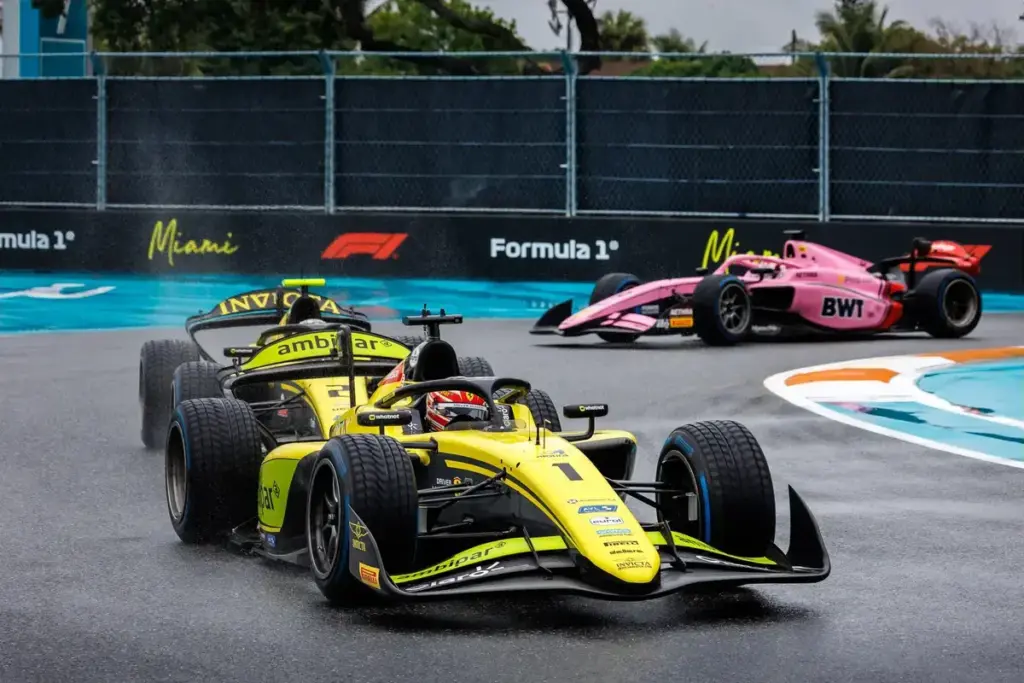

- Formula 2 rules out hybrid power for its 2027 car update.
- Bruno Michel puts the cost at three times a normal season.
- Sustainable fuel, not electrification, is the series’ chosen path forward.
Formula 2 will not adopt hybrid technology for its next-generation car. Bruno Michel, the championship’s CEO, confirmed this at a media session in Miami during the Formula 1 Grand Prix weekend.
The 2027 car will receive an aerodynamic update rather than an entirely new design, and it will continue to run on a conventional turbocharged engine.
The decision comes as Formula 1 enters a major technical overhaul in 2026, introducing active aerodynamics, dropping DRS and shifting to a near 50/50 split between combustion and electrical power.
Formula 2, which serves as the primary feeder series to F1, will take a markedly different path.
Formula 2’s 2027 car: an update, not a revolution
The current Formula 2 car, built by Italian constructor Dallara and designed by F2 technical director Pierre-Alain Michot, arrived in 2024.
After three seasons, it is due for a change. But Michel was clear that the series would not build from scratch.
“I don’t want to make a brand new car because I want to try to limit the cost,” Michel told media, including PlanetF1.com.
He explained that a new car forces teams to spend not just on the car itself, but on a full stock of spare parts. That combined expense adds up quickly.
The updated car will be styled to match the visual identity of the incoming F1 machinery. Michel said the series would “change the aerodynamics of the car to try to give it a familiar look with the F1 car.”
The series is also reviewing its overtaking system. Formula 2 currently uses DRS, but Michel said alternatives are under discussion, including a Push-to-Pass system similar in concept to what Formula 1 uses.
He noted, however, that implementing Push-to-Pass would require detuning the engine to create a meaningful performance differential. No final decision has been made.
Why hybrid engines are firmly off the table
Formula 2 currently powers its cars with a Mecachrome V634, a 3.4-litre turbocharged V6 producing around 600 horsepower.
The unit is built for durability and simplicity, designed to last an entire season. Michel said moving away from this approach is not feasible.
“We have absolutely no resources to go in that direction. There’s no doubt about that,” he said in Miami.
Michel had previously described a hybrid switch as “impossible” in comments to Autosport in late 2024. At that point, he said adopting F1-level hybrid technology would multiply the cost of a season by three times.
The series also looked at IndyCar’s hybrid system as a possible reference point. Michel said the findings were not encouraging.
“I thought that the cost compared to the advantages that it would bring was almost zero,” he told the media.
The concern is not just financial. Formula 2 teams run on lean operations, with 12 people per team managing two cars. A more complex power unit would require more personnel.
Michel has warned that growing technical complexity makes it harder to keep staffing levels sustainable.
“If we continue to make cars more complex, at some point we will no longer be able to maintain the workforce at the same level,” he said.
In Miami, he brought it back to basics. Going hybrid, he said, “in terms of Formula 2 costs, it will make absolutely no sense.”
Sustainable fuel as an alternative path
Formula 2 has chosen fuel innovation as its route to greater sustainability.
The series moved to a 55% bio-sourced fuel mixture in 2024, developed with energy partner Aramco, ahead of Formula 1’s own transition. It then moved to 100% sustainable biofuel in 2025.
Michel said the series intends to keep building on that foundation.
“We are going to continue the development with Aramco to go with synthetic fuel as soon as we can,” he said. He described the fuel route as Formula 2’s deliberate strategic choice, one that he sees as more practical than chasing electrification.
“That’s more our strategy than going into a 50/50 engine as they have in Formula 1,” he said.
Michel has spoken about this before. In earlier comments to Autosport, he said the series was “very much in advance with that on every other category” when it comes to sustainable fuel adoption.
The shift to synthetic fuel, when it comes, is something he views as significant for the championship’s environmental credentials.
The training gap question
The widening technical distance between Formula 2 and Formula 1 does prompt a fair question. If F1 now demands a fundamentally different driving approach, centred on energy management rather than raw lap time, does Formula 2 still do its job?
Formula 1’s new regulations have produced what drivers and engineers call the “drive slower to drive faster” effect.
Optimal lap time now comes from managing electrical energy carefully. Formula 2 does not ask that of its drivers. They race on mechanical grip and outbrake each other into corners.
Michel acknowledged the shift when asked by PlanetF1.com.
“That’s a good question, and that’s something we’ve been thinking of,” he said. He pointed to the recent record of Formula 2 graduates performing well immediately after stepping up to F1.
But he accepted that the new F1 rules may mean those drivers need slightly more preparation time with their teams before they are fully up to speed.
He added context: most Formula 2 drivers competing for F1 seats are embedded in team academy programmes.
They spend extensive time in simulators and attend race weekends as part of structured development plans. That work narrows the gap before a driver ever sits in a race car.
“Those guys are very, very strong drivers,” Michel said. “Maybe it will take a little bit more time, but a little bit more time for a driver is what? A few laps.”
He was not dismissive of the concern. But he was confident in the product Formula 2 delivers.
“I’m not worried, because we are going to deliver the best drivers that can arrive in Formula 1 after that,” he said.
Whether the gap between the two series grows or stabilises will depend on how quickly F1’s new regulations settle.
For now, Michel’s position is clear: Formula 2 will stay simple, stay affordable and trust its drivers to close whatever distance remains once they get to the top.



Comments.
Loading comments…