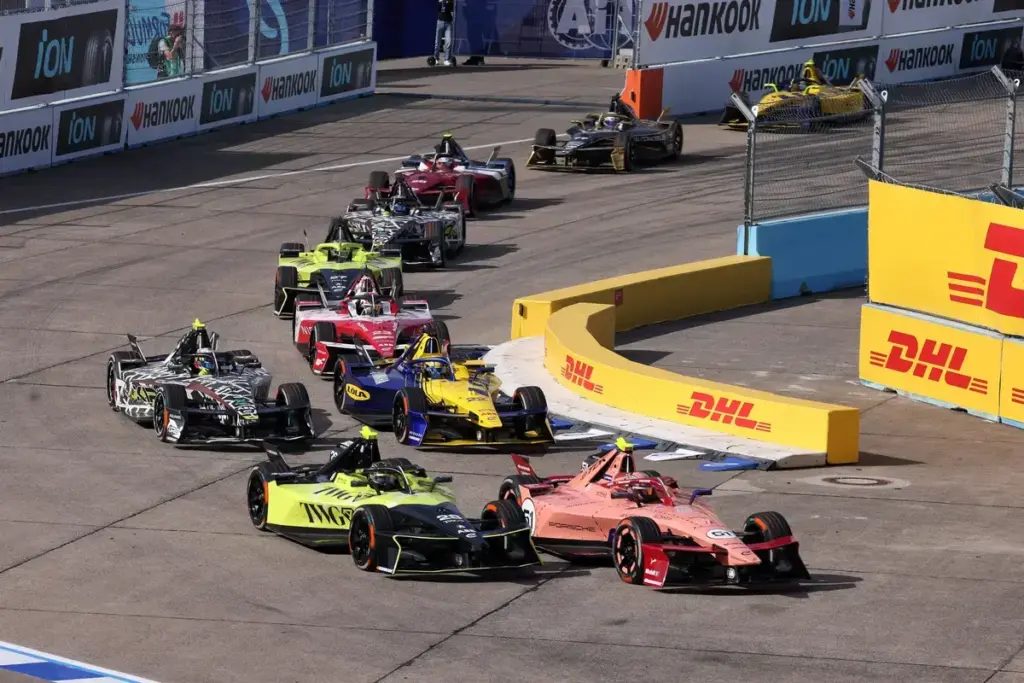

- Formula E’s FIA moves to ban manufacturer-driven team orders ahead of Gen4.
- Porsche’s two-factory team model alarmed rivals and triggered regulatory push.
- Enforcement remains the real test, with coded team orders hard to prove.
The FIA is moving to ban orchestrated race results in Formula E. The governing body wants to stop manufacturers from using customer teams to control race outcomes.
The push comes as the series prepares to enter its Gen4 era with a larger, more competitive grid.
Pablo Martino, the FIA’s championship manager for Formula E, confirmed the intention in an interview with The Race.
He said the sporting regulations for next season would be strengthened to forbid team orders that aim to “alter significantly a result or the way of how a race is developed between competitors.”
He added that the FIA would also conduct a wider review covering technical, financial and sporting risks tied to manufacturer-customer associations.
Martino framed the move as a defence of Formula E’s core competitive model.
“For us it’s key to keep the current system of Formula E, which we believe works really well, where a customer team, being a customer of a manufacturer, can be as competitive as a works team and win championships,” he told The Race.
Porsche’s two-team model sparks concern
The debate sharpened after Porsche announced in November 2025 that it would field two factory teams in Gen4.
The German manufacturer will run four cars out of its Weissach development centre. Cupra Kiro will operate the remaining two cars as Porsche’s sole customer outfit.
Rivals read that structure as a tool for championship management.
The suspicion in the paddock is that Kiro drivers could be asked to defer to the factory Porsche cars when it suits the manufacturer’s title ambitions. Neither Porsche nor Kiro has publicly addressed that concern.
There is already at least one incident that feeds those suspicions. At the Madrid E-Prix in March, Kiro driver Nico Mueller blocked Jaguar’s Mitch Evans while Evans was running in the higher 350kW power mode.
The move gave factory Porsche driver Pascal Wehrlein a temporary gap at the front. Evans eventually fought back to finish second ahead of Wehrlein, but the episode showed how easily intra-team tactics can shape results on Formula E’s narrow street circuits.
Andretti and Kiro offer contrasting perspectives
Andretti has lived inside the Porsche customer relationship since the start of the Gen3 era. The partnership produced Jake Dennis’s 2023 drivers’ title, but it was not always smooth.
Dennis and factory Porsche driver Wehrlein clashed on several occasions, and Andretti is understood to have resisted requests for greater operational flexibility from Porsche. The team is now expected to switch to Nissan power for Gen4.
Speaking to The Race in Berlin, Andretti team principal Roger Griffiths did not hide his concern about what Porsche’s expanded model could mean in practice.
“We certainly don’t want to see actions on track which artificially affect the outcome of a race,” he said. He warned that Formula E’s tight venues made the prospect particularly dangerous.
“It wouldn’t take too much for a multi-car manufacturer team to become a roadblock and allow one driver to get away and everybody else be held up,” he added.
Griffiths also invoked the DTM as a cautionary tale. That series was marked by notorious incidents of manufacturer manipulation over the years.
“We certainly don’t want the antics that we saw perhaps in DTM coming across into Formula E,” he said. “We hope we can be a case of may the best person win.”
Kiro’s sporting director, Russell O’Hagan, saw little to worry about. He told The Race the issue was not high on his list of concerns.
“I think all that comes with that kind of customer and supplier relationship is just almost another set of teammates where you just have to be respectful,” O’Hagan said.
How the FIA plans to police it, and why it is not straightforward
The FIA’s existing tool for these situations is Appendix M of the International Sporting Code.
The appendix covers conflicts of interest and the manipulation of competitions. It defines manipulation as any intentional act or omission designed to remove the unpredictable nature of a competition.
But enforcement has always been the harder problem. Teams in other championships have passed instructions through codewords and phrases that are difficult to prove as directives.
Martino sounded cautiously encouraged by the initial response from teams.
“Since we have presented these ideas, the teams have been quite happy,” he told The Race. He acknowledged that the practical change might be modest.
“I don’t think it’s going to be much different to what it is today. But we are just trying to clarify how we will proceed in case of something not fair,” he said.
The Gen4 grid will carry 24 cars, a 600kW power output and manufacturers including Porsche, Jaguar, Nissan, Stellantis and Lola Cars.
The FIA’s message, at least, is clear: results should be settled on the circuit, not agreed upon before the lights go out.
Comments.
Loading comments…