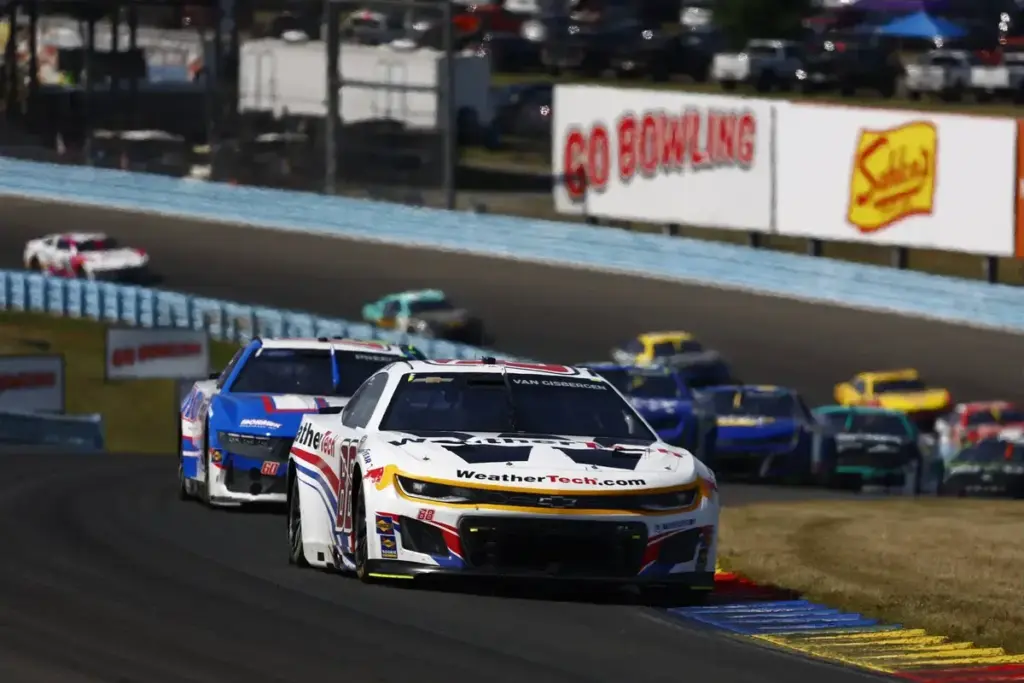

- NASCAR has introduced some changes at Watkins Glen to eliminate crashes.
- Chris Buescher and Shane van Gisbergen support intent but split on execution.
- The changes are to ensure increased safety.
NASCAR drivers will no longer be able to drive off into the Turn 1 runoff on starts and restarts at Watkins Glen International, now that the sanctioning body has introduced changes to track limits at Turn 1 and the exit of the Carousel.
The decision aims to limit how far drivers can extend beyond the racing surface, with physical barriers installed as tire packs. The intention is to keep cars pinned closer to the racing line. And it seems Chris Buescher and Shane van Gisbergen are on board with the idea,
Support grows for Watkins Glen barrier introduction
Reactions from drivers have been split on execution but aligned on intent. RFK Racing driver Chris Buescher said during a Ford Racing media call that he understands the direction NASCAR is taking. But he said he prefers a more defined structure over intermittent tire placement, particularly around the Carousel, where barriers have been used in different forms over time.
As he put it, “I’m kind of a proponent of physical barriers, and if we’re gonna put a wall there, then we might as well put a wall there and say that’s it. With the sporadic tire packs. It’s worked at a lot of places when they’ve been used more for the apex, not so much as, generally, an invisible wall in between a handful of them.”
He added, “Not saying it won’t work – and it’s kept us exactly where they want us to be in the simulator, right? So the idea behind it is at least working right now.”
Turn 1 changes…
When asked how much he would rely on footage from earlier Watkins Glen configurations, Buescher said most of his preparation would still come from recent seasons. However, he noted that track limits will change how drivers approach certain corners, especially Turn 1.
“You will not have that infinite runoff of Turn 1 to be able to roll the outside and defend as well, I don’t think … The inside should have a little bit more of an advantage again, just because the outside won’t be able to get off the brakes and roll that huge speed all the way around where there are now tire packs placed,” he said.
Shane van Gisbergen shares his concerns about the changes
Shane van Gisbergen, who enters Watkins Glen with added pressure after losing a road course race earlier in the season to Tyler Reddick at Circuit of the Americas, also weighed in. Given his background and the expectations placed on him in road-course events, the changes carry added relevance to his approach.
He said, “I think Turn 1 is a really good solution. I think what they’ve done with the tire packs there and having the gaps in the walls is … I think that’s going to work.”
Regarding the Carousel changes, he raised concerns about the exit angle and how cars interact with the tire barriers.
“The angle that it comes back on, in my experience with those tire walls, they grab cars and spit them out. So, yeah, don’t like the look of that, but smarter people have come up with those things.”
What do the changes look like at Watkins Glen?
At Turn 1, NASCAR has effectively established a controlled boundary by placing tire packs at measured distances from the racing surface. At the exit of Turn 1, four tire packs have been installed. The first sits 11ft from the racing surface, the second sits 9ft away, and the third and fourth sit 6ft away. These are spaced 180ft apart, removing the possibility of drivers running wide and treating the runoff as part of the corner.
As cars move through the bus stop chicane and into the Carousel (the Outer Loop), and onto the following straight, they will encounter restricted space again. A connected line of tire packs now runs along that section. And then, at the exit of the Carousel, the barrier begins 20ft from the racing surface and angles inward until it reaches 5ft.
The exit of the Carousel had already been under scrutiny after last year’s NASCAR O’Reilly race, when Michael McDowell and Austin Hill used the runoff while fighting for position. McDowell spun into the guardrail as the cars rejoined the racing surface, starting a chain reaction that collected more than a dozen cars. That incident led to a red flag that stretched close to an hour for cleanup and barrier repairs.
Eliminate uncertainty…
That incident, along with similar incidents in recent years, prompted NASCAR to rework the area. The core issue has been that the cars rejoin the track at speed while still alongside each other, with limited space before the guardrail becomes a factor. At the same time, tire packs have carried their own crash history at Watkins Glen, including incidents in which cars were redirected back into traffic, such as the 2009 Hornish and Gordon incident, even though those configurations differed from the current setup.
The broader intent behind the changes is to eliminate uncertainty over track limits and reduce the likelihood of multi-car incidents as drivers rejoin the racing surface under pressure. However, the real point of attention now sits at Turn 1, where the spacing and placement of tire packs will determine how aggressively drivers attack the corner, and how much room remains when they make mistakes.
There is also the possibility of penalties if drivers exceed limits and attempt to bypass the tire packs entirely.


Comments.
Loading comments…