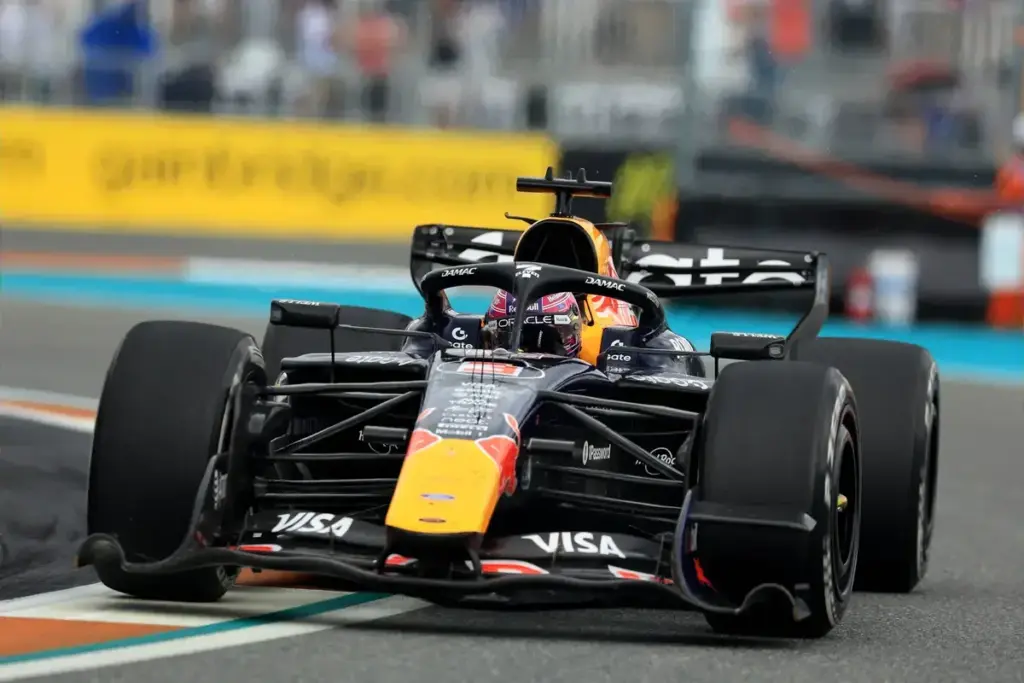

Pierre Wache did not intend to reveal much when he spoke to Motorsport.com after the Miami Grand Prix. The Red Bull technical director acknowledged that the team had failed to fix Max Verstappen’s steering problem before the season began.
While the apology was squarely about the steering rack, it reveals that something far worse is going on within Red Bull.
Verstappen first noticed the fault on lap one of pre-season testing in Barcelona. Red Bull did not replace the steering rack until a filming day at Silverstone, ahead of Miami, three races into the 2025 season.
Wache described the process to Motorsport.com in three steps: confirm the problem exists, identify its source, then fix it. That sequence took four months.
In a team that once diagnosed and resolved car problems with near-instant precision, that timeline is not a delay. It is a symptom.
The fix, when it came, made a real difference. Verstappen qualified second in Miami, just 0.166 seconds off pole. He called it “light at the end of the tunnel.” But the tunnel itself is the story.
The chassis confession
The steering issue was only part of what’s wrong with the RB22. The chassis told its own grim story, and it was Isack Hadjar who said it most plainly.
After the Japanese Grand Prix, the 21-year-old Red Bull driver gave Canal Plus one of the most blunt assessments of the 2026 challenger. He described the chassis as terrible in the corners and called the car unmanageable, even dangerous.
“We have a good power unit, the engine is fine. It’s just the chassis that is terrible and slow in the corners,” Hadjar said via comments shared by PlanetF1.
“The only positive right now is that we can drive the car fast, but we have no lead on how we can make a fast one.”
This is a driver admitting that the team does not understand its own car.
Red Bull team principal Laurent Mekies confirmed the confusion. He told reporters the team left Melbourne thinking they were a second off Mercedes and half a second off Ferrari.
Then the gaps grew in China, and the team began, as he put it, “scratching heads” about the car’s balance and characteristics. The simulation data did not match what the car was doing on track.
For the team that spent a decade setting the computational standard in Formula 1, that mismatch is significant.
A concept built on the wrong foundation
Before Miami’s upgrade package arrived, analysis from Motorsport.com placed the RB22 as the slowest Red Bull car in 11 years.
The primary problem was not a lack of development effort. It was a fundamental design choice made at the start of the process.
Red Bull built the RB22 around a low-drag concept. That decision left the car short of downforce and slow through corners. The consequences became visible when the team compared notes with its own junior operation.
Racing Bulls’ VCARB 03 runs the same Red Bull Ford Powertrains engine. It is designed in Faenza, with a fraction of Red Bull’s resources. Yet it consistently showed better cornering performance than the Milton Keynes machine.
According to a Red Bull insider quoted by F1-Insider, Verstappen would have started further up the grid in several races had he been driving the junior car.
Wache had reportedly told colleagues last December that the RB22 would be a second faster than the Racing Bulls car. After three rounds, the average qualifying gap between the two hovered around half a second, and not consistently in Red Bull’s favour.
The car also arrived overweight. Reports placed it roughly 12 to 15 kilograms above the 768 kg minimum. The Miami upgrade package halved that excess, bringing it down to around seven kilograms.
A team of Red Bull’s scale missing its own weight target on a clean-sheet design reflects a coordination problem that goes beyond any individual technical call.
The Newey-shaped hole
No account of Red Bull’s current situation can avoid Adrian Newey. The aerodynamicist joined the team in 2006 and was the central force behind every championship-winning car the team produced.
He has since left for Aston Martin, where he joined as managing technical partner.
But Newey’s exit was one departure inside a much longer list. Red Bull’s leadership structure has been overhauled almost entirely over the past two seasons.
Christian Horner was sacked. Helmut Marko retired. Rob Marshall, now McLaren’s chief designer, left. Will Courtenay, now McLaren’s sporting director, followed. Jonathan Wheatley departed for Sauber/Audi. Chief designer Craig Skinner left abruptly in February 2026.
Then came the news that Gianpiero Lambiase, Verstappen’s race engineer since 2016, would join McLaren as chief racing officer by 2028.
Mekies acknowledged the losses plainly.
“We don’t want to be defensive about the fact that we lost some talents,” he told reporters. “It’s a fact, and it’s been there for three or four years.”
McLaren CEO Zak Brown offered his own reading of the situation. He named Christian Horner, Jonathan Wheatley, Lambiase, Newey and Dan Fallows as departures that had reshaped the team.
However, he was generous in his assessment of Mekies and said he believed the team could rebuild. Brown compared the situation to his own experience at McLaren.
“And much like McLaren had an immense amount of talent that just needed to be unlocked. I think that’s probably the same as Red Bull. They’ve been very dominant up to not very long ago. So there’s a lot of talent in there, and I think he’ll just need to get it redirected,” the American said.
Verstappen’s calculated ambiguity
For his part, Verstappen has not said he is leaving Red Bull. He has not said he is staying, either.
When reporters asked him about his future ahead of Miami, he offered the same answer he has given for months.
“I have nothing new to say in this area,” he said. He also dismissed the idea that Lambiase’s departure to McLaren would shape his thinking. “That has nothing to do with it,” he said.
The regulation tweaks introduced in Miami drew a characteristically direct response. He told reporters the changes amounted to “no more than a tickle” and said the rules still penalised drivers for carrying corner speed onto the following straight.
That is not the language of a man who feels the sport is moving in the right direction.
After finishing fifth in Miami, Verstappen acknowledged the improvements made by Red Bull while describing exactly how low the bar had been.
He praised having a steering wheel that worked. A four-time world champion calling a functioning steering rack an achievement four races into a season is a pointed statement, even when delivered without drama.
The Miami upgrade: progress, not a cure
Miami was a genuine step forward. Red Bull overhauled its sidepod design, moving away from the inwash concept it had started with and adopting a Ferrari-style bathtub gully layout.
The new rotating rear wing, the steering rack replacement and the weight reduction combined to give the team its most competitive weekend of 2025.
Mekies estimated the car’s race pace in Miami was strong enough to run between third and fifth. Compared to the opening three rounds, that represented a real improvement.
But Wache confirmed the next significant upgrade package, including further weight reduction, would not arrive until the European season, potentially around Austria.
How to interpret the Red Bull apology
Red Bull’s engineering department is not filled with poor engineers. The team built its first Formula 1 power unit from the ground up and delivered something competitive.
It was good enough that Mercedes’ Toto Wolff cited it as a benchmark during pre-season testing. The engine operation fulfilled its obligation. The chassis side has not.
Wache’s apology, placed alongside Hadjar’s comments about the chassis, Mekies’s admission that the team was scratching its head over basic car behaviour, and the repeated cornering advantage shown by Racing Bulls, points to something specific.
The team has lost its ability to rapidly diagnose what is wrong with a car and act on it. That ability, more than any single design tool or aerodynamic concept, was the defining quality of Red Bull during its dominant years under Newey.
Problems were identified quickly. Solutions followed. The gap between sensing something was wrong and fixing it was measured in days, not months.
The RB22 steering fault ran from pre-season testing in February to race four in May. That gap is the measure of how much ground the team has lost, not in the championship standings, but in the engineering culture that underpinned every title it won.
Wache apologised. It was a decent and honest thing to do. But an apology for a steering rack that took four months to fix is also, read carefully, a confession that the team no longer operates the way it once did.
The rack is fixed. The culture that allowed the delay to stretch that long is the harder repair.

Comments.
Loading comments…