- The minority stake at Alpine has 3 buyers, 3 agendas and no clear governance rules.
- Christian Horner, Mercedes and Steve Cohen are each betting on a different F1 future.
- The FIA has no answer yet, and the sport’s power map hangs on that silence.
Formula 1 is heading into one of its most consequential ownership battles in years, and the paddock is treating it like a footnote.
A 24% stake in the Alpine F1 team is up for sale. Three bidders, each with a radically different vision for the sport, are competing for it. The FIA cannot decide what rules should govern the outcome.
And the result will determine whether multi-team ownership becomes a permanent feature of Formula 1, whether Mercedes gains influence over a second constructor, and whether Christian Horner returns to the paddock as a co-owner with equity and a point to prove.
This is not a routine business transaction. It is a power struggle with implications that will outlast any championship cycle.
The prize on the table
Otro Capital, an American investment consortium that includes actor Ryan Reynolds, golfer Rory McIlroy, and NFL stars Patrick Mahomes and Travis Kelce, bought the 24% Alpine stake in mid-2023 for around $218 million.
That figure now looks like a bargain. Forbes estimates the average F1 team valuation has risen 89% since 2023, reaching $3.6 billion. Alpine itself is now valued at roughly $3 billion, meaning Otro’s slice could fetch upwards of $720 million. That is more than three times the original investment in under three years.
Otro wants to sell. And three very different buyers want in.
Christian Horner is the first. Fired from Red Bull last July after two decades and 14 combined championship titles, the 52-year-old has been circling Alpine since at least late 2025.
His reported consortium includes MSP Sports Capital, the private equity firm that previously held a minority stake in McLaren before exiting at a profit. Horner is not just looking for a management role. He wants equity.
The Otro stake gives him that, along with a platform to re-enter the sport as an owner-operator with genuine influence.
Then came Mercedes. In March, reports emerged that team principal Toto Wolff had submitted a competing bid. Wolff dismissed suggestions that blocking Horner was the motive. Speaking to the Press Association, he called that narrative “quite sad” as a basis for investment.
The Austrian said that Mercedes was evaluating the opportunity on its own commercial merits. He did, however, note that Horner had “broken quite a lot of glass” at Red Bull, which had consequences in F1’s tightly connected community.
Alpine’s executive advisor Flavio Briatore moved quickly to clarify that the Mercedes interest was corporate, not personal.
Speaking during the Australian Grand Prix weekend in March, Briatore told reporters the discussions involved “Mercedes, not Toto,” adding there were “three or four potential buyers” and that all negotiations concerned Otro’s shares specifically, not Alpine as a whole.
The third bidder blindsided the field entirely. In late March, PlanetF1.com revealed that Steve Cohen, the billionaire founder of Point72 Asset Management and owner of the New York Mets, had submitted a bid reportedly exceeding $600 million.
Cohen’s approach to ownership is well established. He bought the Mets for $2.4 billion in 2020 and built one of baseball’s biggest payrolls, including a reported $765 million contract for Juan Soto. His Alpine bid reportedly values the 24% holding significantly higher than his rivals.
Mercedes’ offer, by comparison, valued the whole team at around $2.3 billion, translating to roughly $552 million for Otro’s share, the lowest of the three known proposals.
Three bidders. Three different futures for Alpine, and for F1.
The Briatore factor
Any honest account of this story requires a proper reckoning with Briatore’s role. His official title is executive advisor. His actual function is closer to de facto team boss. He recruited Steve Nielsen as managing director for day-to-day operations, but the power structure at Alpine is not difficult to read.
Briatore has been careful in public. When Horner’s interest first emerged in January, he acknowledged it while keeping his distance.
“I’ve known Christian for many years. I talk with Christian anyway, but this has nothing to do with me,” he told reporters at Alpine’s 2026 livery launch, as quoted by Motorsport.com.
He was clear about the process: Otro must sell, Renault must approve the buyer, and only then does anything else follow.
The framing positions Briatore as a bystander. But Briatore and Horner have shared paddocks and traded power for decades. Their history is not a secret. It would be naive to think Briatore’s presence at Alpine plays no part in shaping Renault’s thinking on which buyer to approve.
What is more telling is what Briatore has not done. Despite his deep knowledge of the team’s value and the scale of the opportunity, he has shown no interest in buying the stake himself. Asked directly, his answer has been a flat: “No, no, no, no. Just looking.”
For a man with his record of competitive instinct, that restraint says something.
The governance question nobody can answer
The most consequential aspect of this story has nothing to do with who wins the bid. It is about what the FIA decides to do with the outcome.
At the Miami Grand Prix in early May, FIA president Mohammed Ben Sulayem addressed the multi-team ownership question directly. His answer was a carefully constructed non-answer.
As reported by The Times and widely cited across the F1 media, Ben Sulayem said he personally did not believe owning two teams was “the right way,” then immediately said the FIA was investigating whether it was “possible” or “allowed.”
He acknowledged interest in the Alpine stake, set out a vague framework involving “right reasons,” and warned against buying shares simply to block rivals or accumulate regulatory votes. He offered no timeline and no firm standard for what would or would not be permitted.
The FIA president is simultaneously opposed to a model and unwilling to prohibit it. That is not a governance position. That is an absence of one.
The Red Bull precedent and Zak Brown’s crusade
The FIA’s hesitation looks harder to justify when you consider that multi-team ownership already exists on the grid.
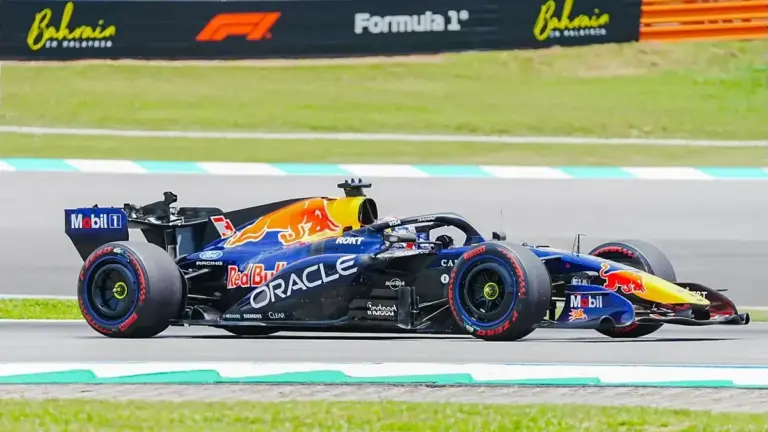
Red Bull has operated two F1 teams for over two decades, having acquired what was then Minardi at the end of 2005 when the Italian team was on the brink of collapse.
That team, now known as Racing Bulls, has functioned as a development pathway for drivers including Sebastian Vettel and Max Verstappen.
McLaren’s Zak Brown has been the loudest voice against the arrangement. At a McLaren media event in April, he offered a direct comparison.
“Can you imagine a Premier League game and you’ve got two teams owned by the same group?” he said, as quoted by Sky Sports F1. “One’s going to get relegated if they lose. The other can afford to lose. That’s what we run the risk of.”
Brown has cited specific incidents to support his position. In the 2024 Singapore Grand Prix, Daniel Ricciardo, driving for Racing Bulls, pitted late to take the fastest-lap point from Lando Norris and hand it to Max Verstappen.
He has also pointed to the staff-movement problem. McLaren hired Verstappen’s long-time race engineer Gianpiero Lambiase from Red Bull, but may wait until 2028 before he can start work. Red Bull, by contrast, recruited Racing Bulls’ Andrea Landi with just two and a half months’ notice.
“I think A/B teams, we need to get away from as much as possible, as quickly as possible,” Brown said.
If Mercedes acquires the Alpine stake, the same arguments apply immediately.
Ben Sulayem would then face a choice with no clean exit. Block the Mercedes deal and invite accusations of inconsistency given Red Bull’s existing structure. Allow it and cement multi-team ownership as a permanent feature of F1’s competitive landscape.
The timeline and what comes next
The sale cannot happen immediately. Otro is subject to a lock-up period and cannot transfer its holding freely until September. Renault holds approval rights over any prospective buyer, giving it meaningful leverage over the process until that window opens.
Renault has moved to tighten that control. On 7 April, Guillaume Rosso, the company’s global head of mergers and acquisitions, joined Alpine’s board, replacing outgoing CFO Duncan Minto.
The appointment signalled that Renault intends to stay firmly in control of who enters the ownership structure, regardless of what Otro might prefer once September arrives.
Renault has repeatedly insisted it is not selling Alpine and remains committed to F1. But the decisions it has already taken tell a more complicated story.
The closure of the Viry-Châtillon engine facility and the shift to a Mercedes customer arrangement was a cost-reduction move. The 2023 stake sale to Otro was another step back from full ownership.
A company that was genuinely all-in on F1 would not have diluted its position twice in three years.
Why this matters more than anybody might think
The Alpine stake sale sits at the intersection of every question that will define the sport’s next decade.
Surging franchise values. Unresolved multi-team ownership rules. The balance of power between manufacturers and independent teams. A governing body that has not yet decided where it stands on any of it.
A Mercedes victory hands Wolff’s organisation strategic influence over a second constructor while it already supplies engines to McLaren and Williams.
Every regulation vote, every technical directive, every cost-cap interpretation becomes more politically loaded when one commercial entity has ties to three teams.
A Horner victory brings the sport’s most combustible operator back into the paddock, this time with equity and Briatore at his shoulder.
A Cohen victory signals that American capital could become the dominant force in F1’s future. That may accelerate the sport’s US expansion, but it raises a straightforward question:
Can financial firepower alone succeed in a sport that has always rewarded technical knowledge and political understanding above all else?
In any outcome, the FIA will be forced to take a position it has so far avoided. Alliances will shift. The regulation vote balance will change. And the governing body will either lead that process or be dragged through it.
The Alpine stake sale is the most important off-track story in Formula 1 right now. It deserves to be treated that way.