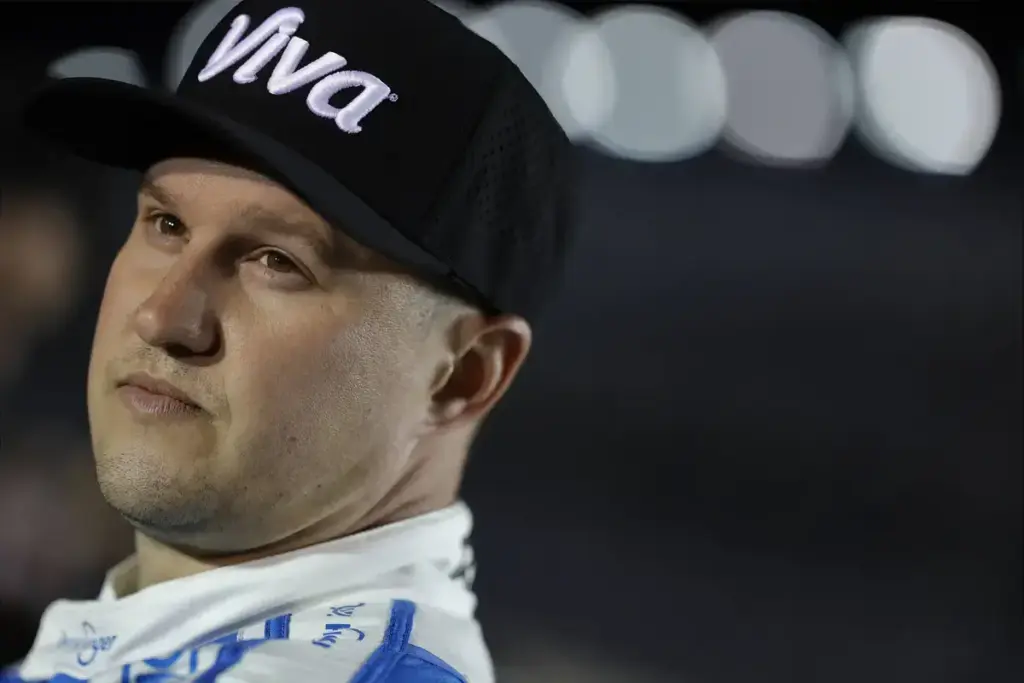

- Preece docked 25 points and $50k, citing radio evidence and on-track actions.
- Busch avoided penalties due to a lack of incriminating radio chatter & damage.
- Two incidents linked by Preece’s verbal threats before contact with Ty Gibbs.
Behavioural penalties didn’t quite steal the spotlight in this season in NASCAR until the Würth 400 at Texas Motor Speedway flipped that script in a hurry.
While Cup Series’ “Rowdy” Kyle Busch made headlines with a late shove that sent John Hunter Nemechek into the wall, it was Ryan Preece who found himself on the wrong side of NASCAR’s rulebook after a separate run-in with Ty Gibbs.
Once the dust settled in Fort Worth, what looked like two similar on-track incidents turned into a clear-cut ruling behind the scenes. In-car audio trail of radio messages, and data review became the difference-makers, as NASCAR officials handed Preece a hefty penalty while Busch walked away without one, raising plenty of eyebrows across the garage.
Which begs the question, why penalize Preece and not Busch? As it turns out, the sanctioning body has conclusive evidence, enough to draw a line between the two.
Same track, different outcome: NASCAR’s call on Ryan Preece and Kyle Busch
The incident came on Lap 102 during Sunday’s main event, when Preece’s No. 60 RFK Racing Ford clipped the rear of Ty Gibbs entering Turn 3. The contact sent the No. 54 Joe Gibbs Racing Toyota hard into the SAFER barrier, ending his race then and there.
From the outside, it didn’t look wildly out of place in the moment, just another aggressive Cup Series exchange, but the context told a different story.
Earlier in the race, Preece had made his feelings clear over the radio after a run-in with the JGR youngster: he wasn’t going to cut him any slack.
Following the race, he told Frontstretch, when asked if he would speak to Gibbs later, “I hate that he wrecked. But decisions you make on the racetrack, there are repercussions, and I try to race everybody with an amount of respect that I’d like in return. When you don’t do that, I’m not going to cut you a break. That’s what happened.”
However, NASCAR, after review, ultimately ruled that it crossed the line from hard racing into intentional retaliation.
That’s where the hammer came down: a 25-point penalty and a $50,000 fine under NASCAR’s member conduct guidelines, specifically for actions that can be interpreted as wrecking another driver on purpose.
Meanwhile, Busch’s late-race tangle with John Hunter Nemechek didn’t trigger the same response. The No. 8 Chevrolet got into the No. 42, sending Nemechek around, but unlike Preece’s case, there was no clear buildup, no heated radio promise, and no obvious indication that Busch meant to do it.
On replay, it looked messy, but not necessarily malicious. As for Preece (35), the P14 Texas finish and the subsequent penalty dropped him from 12th to 13th in the points standings.
NASCAR’s reasoning
According to NASCAR’s review, the difference boiled down to one thing: intent.
For Preece, officials had what they rarely get so clearly, evidence tying words to actions. As Mike Forde, NASCAR’s Vice President of Race Communications, explained during the latest episode of the “Hauler Talks”, they reviewed everything from radio communication to in-car audio to video angles and SMT (data telemetry).
Forde said, “What this came down to is … (Preece) said what he said, and then he did what he said. And so in our view, it was intentionally wrecking another vehicle.”
The conclusion was blunt: Preece said he was going to get Gibbs. “What a f**king idiot that kid is,” the RFK Racing driver said over the radio. “He’s so lucky his car is so f**kng fast. … Alright, when I get to that 54, I’m done with him. F**king idiot. It’s just, that car is so fast, it f**king pisses me off. Stupid. I, I can’t I’m going to vent for 15 seconds. I can’t stand when idiots like him have fast race cars that they can do stupid shit and get away with it.”
Minutes later, Gibbs ended up against the wall. That combination made it difficult to argue the move was incidental. In NASCAR’s eyes, it was more than just contact; it was follow-through.
Busch’s case, on the other hand, lived in the gray area. SMT data showed his car had significant steering issues. At one point, he was reportedly turning the wheel hard left just to keep the car straight. That opened the door to a plausible explanation: the contact with Nemechek may have been the result of damage rather than intent.
Just as important, there was no incriminating radio chatter. No warning shots. Without that, NASCAR didn’t have the same foundation to justify a penalty.
That doesn’t mean Busch is completely in the clear in the long term. Officials have already indicated they plan to speak with him and Richard Childress Racing, especially given that this marks another late-race incident in recent weeks.
Comments.
Loading comments…