- Max Verstappen faces a penalty points demand over his Mario Kart remarks.
- Montoya wants seven or eight points added to Verstappen’s super licence.
- A political motive may explain why Verstappen keeps attacking the 2026 rules.
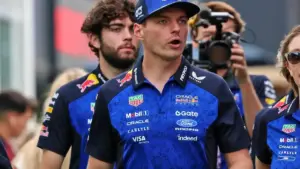
Juan Pablo Montoya wants Formula 1 to hit Max Verstappen with penalty points on his FIA super licence. The former F1 driver made the call on the BBC’s Chequered Flag podcast after the Miami Grand Prix.
Montoya argued that Verstappen’s public attacks on the 2026 regulations have gone beyond acceptable criticism and are damaging the sport.
Verstappen has repeatedly mocked the new cars in colourful terms throughout pre-season testing and the opening races of the season.
His comments prompted Montoya to first call for a fine in March. Speaking to AS Colombia at the time, he said F1 should follow American sports in showing critics the door or making them pay.
On the latest podcast, however, Montoya pushed for something sharper than a fine.
Montoya’s case: respect the sport or face consequences
Montoya drew a clear line between voicing displeasure and mocking the product.
“I’m not saying don’t be outspoken,” he said on the podcast. “But don’t come and call an F1 car a Mario Kart.”
He then outlined what he believed the punishment should be. “Park him,” the Colombian said via comments shared by RacingNews365.
“Add seven points to the licence, eight points to the licence. Whatever you do after, you’re going to be parked. I guarantee you all the messaging would be different.”
The FIA’s super licence system bans a driver automatically when he reaches 12 penalty points within a rolling 12-month period.
Verstappen currently holds three penalty points. An additional seven or eight would push him to the edge of a race ban.
Montoya acknowledged the right to criticism but insisted the manner of it mattered.
“If you don’t like it, you have the complete right to an opinion,” he said.
“It’s okay to be outspoken. But the way you were speaking about what you’re living off and your own sport, there should be consequences for that.”
The FIA’s penalty points system was built to punish dangerous on-track behaviour, not media commentary.
Montoya’s proposal carries little chance of being adopted. But it put a precise number on what he believes the cost of Verstappen’s rhetoric should be.
The political dimension and the view from the other side
Montoya also raised the question of how much of Verstappen’s criticism was his own and how much was shaped by Red Bull.
“One, what he really feels, and two, is what the team is probably asking him to say,” he said on the podcast.
The Colombian argued that driver comments in F1 are frequently strategic.
He claimed that roughly 80% of the criticism drivers direct at regulations is politically motivated, with teams pushing messages that serve their competitive interests.
Reigning world champion Lando Norris initially told Verstappen to retire if he was unhappy.
The Briton later admitted he said it partly to provoke a reaction, which showed how calculated public positions in the paddock can be.
Damon Hill, another frequent guest on the Chequered Flag podcast, took a different view. The 1996 world champion argued that fans valued Verstappen’s honesty.
Lewis Hamilton also pushed back against the criticism, describing the new cars as delivering the best racing of his career.
F1 CEO Stefano Domenicali acknowledged publicly that Verstappen’s voice “carried a lot of weight.” Montoya suggested Domenicali may have already spoken to Verstappen privately about moderating his language.
What happens next for Max Verstappen and Red Bull
In Miami, Verstappen qualified second behind championship leader Kimi Antonelli, aided by a significant Red Bull upgrade package.
He finished fifth after a first-lap spin and a five-second post-race penalty for crossing the white line at the pit exit. Ahead of the race, he told Sky Sports he was still thinking about his future at the team.
“I still have time, and I’m taking my time,” he said.
Reports suggest he holds a performance-related clause in his contract that could allow him to leave before the season ends if Red Bull cannot produce a title-challenging car.
Montoya’s proposal has not found formal support, and the FIA has given no indication it plans to act.
But the argument has exposed a real tension in the paddock: Verstappen is simultaneously F1’s biggest commercial asset and its loudest internal critic.
That contradiction is unlikely to resolve itself until either Red Bull closes the gap to the front or the regulations shift enough to quiet the complaints.