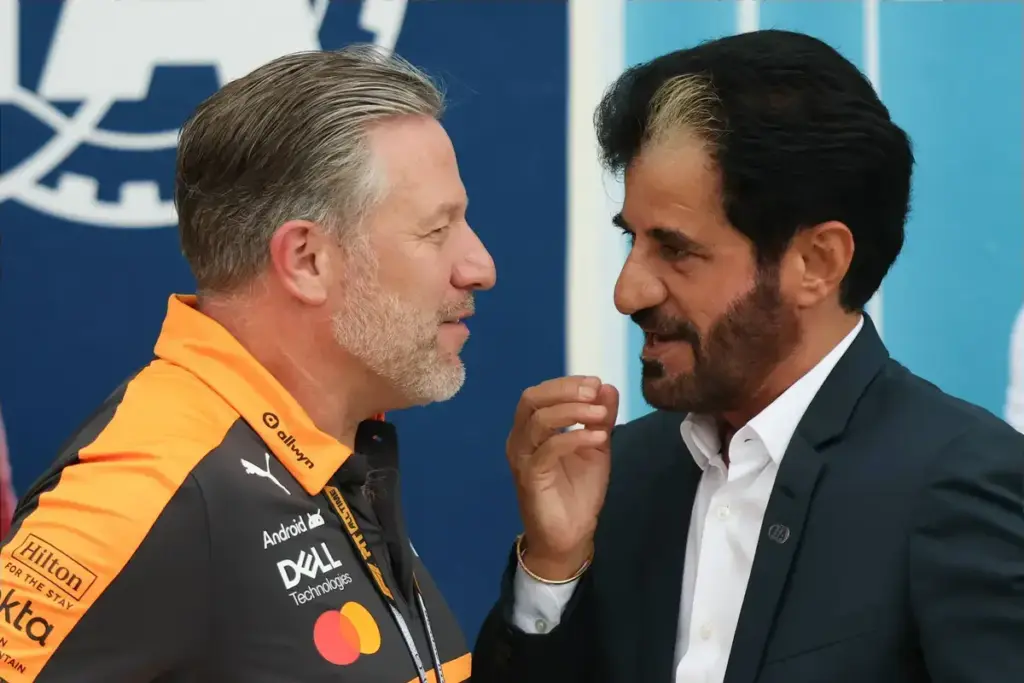

- Ben Sulayem wants V8 engines in F1 by 2030, but manufacturers hold deciding vote.
- Superclipping and driver frustration expose the 2026 formula’s deepest flaws.
- A simpler, louder engine era is coming. The only question is when.
FIA president Mohammed Ben Sulayem confirmed at the Miami Grand Prix that Formula 1 will abandon its current V6 hybrid engines and return to V8 power units by 2031, with a personal target of 2030.
The announcement, first reported by Reuters, is the clearest signal yet that the governing body intends to reverse the direction of F1’s engine formula.
“It’s coming. Oh yes, it is coming. At the end of the day, it’s a matter of time,” Ben Sulayem told reporters in Miami, as reported by RacingNews365.
A timeline backed by regulatory power
Under existing FIA regulations, the governing body can impose a new engine formula for the 2031 rules cycle without requiring approval from power unit manufacturers.
Bringing that date forward to 2030 would require four of the six current manufacturers, Mercedes, Ferrari, Honda, General Motors, Audi and Red Bull, to vote in favour.
Ben Sulayem told Reuters he is not concerned about whether manufacturers fall in line.
“In 2031, the FIA will have the power to do it, without any votes from the PUMs. That’s the regulations. But we want to bring it one year earlier, which everyone now is asking for.”
He left no ambiguity about the outcome. “It’s not a matter of, ‘Do I need their support?’ No, it will be done. V8 is coming.”
Why V8 and not V10?
Ben Sulayem had previously pushed for a return to V10 engines, but manufacturers rejected that idea, and it has since been dropped.
He explained the case for V8s by pointing to what manufacturers actually produce today.
“I feel like a V10… if I ask any of the manufacturers who are in F1 now if they produce any cars with a V10, an era that many of the cars had, but now, no,” he said.
V8 engines, by contrast, remain in production across several manufacturers currently competing in F1.
“The V8, you see it with Ferrari, Mercedes, Audi, Cadillac. You see it with most of the manufacturers, and that gives you a lightweight car,” he said.
He summarised the appeal as “the sound, less complexity, lightweight.”
The proposed V8 formula will also carry far less electrical power than the current setup. F1’s 2026 engines run on a near 50/50 split between combustion and electric power.
Ben Sulayem said the next generation will look very different.
“It will not be something like now, which is a 46-54 split. There will be very minimal [electric] power,” he told reporters.
The previous V6 era, before 2026, drew more than 80% of its power from the combustion engine. According to The Race, the new V8 formula is likely to land closer to that ratio than to the current arrangement.
The 2026 controversy driving the push
The announcement comes as F1’s 2026 regulations face sustained criticism from drivers and fans.
The near-equal combustion-electric split has produced racing problems that have dominated headlines in the opening weeks of the season.
One issue is called “superclipping,” where cars harvesting energy on full throttle experience an involuntary slowdown at the end of straights.
Differences in battery state between cars have also caused large speed gaps that distort racing.
The FIA introduced tweaks for Miami, cutting the maximum permitted recharge from 8MJ to 7MJ to reduce excessive harvesting.
Four-time world champion Max Verstappen has been among the most vocal critics, calling the 2026 cars “Formula E on steroids” and “not a lot of fun” to drive.
McLaren’s Oscar Piastri said the racing could only be properly fixed by “changing the hardware of the power unit.”
A broader shift in the automotive industry has also created space for this change.
Manufacturers are no longer as committed to electrification as they were when the 50/50 concept was agreed. This gives the FIA and F1 room to push for a combustion-dominant formula.
What comes next
F1 president and CEO Stefano Domenicali told The Race in April that stakeholders were now in “less of a corner” on engine direction, and suggested updated rules could arrive sooner than originally planned.
His stated priorities, cost reduction and lighter cars, match what Ben Sulayem is proposing.
Discussions around an interim 2027 power unit update are already underway, with a 60/40 combustion-to-electric split being considered as a bridge measure. The longer-term direction, however, is now set.
Ben Sulayem stated his position plainly. “I’m targeting 2030. One year before the maturity of the regulations. It will happen.”
The last time V8 engines competed in F1 was 2013, at the end of the 2.4-litre naturally aspirated era that ran from 2006.
The Cosworth DFV V8 powered the sport from the 1960s through to the early 1980s before that. If Ben Sulayem holds to his target, those engines will return to the grid within four years.

Comments.
Loading comments…