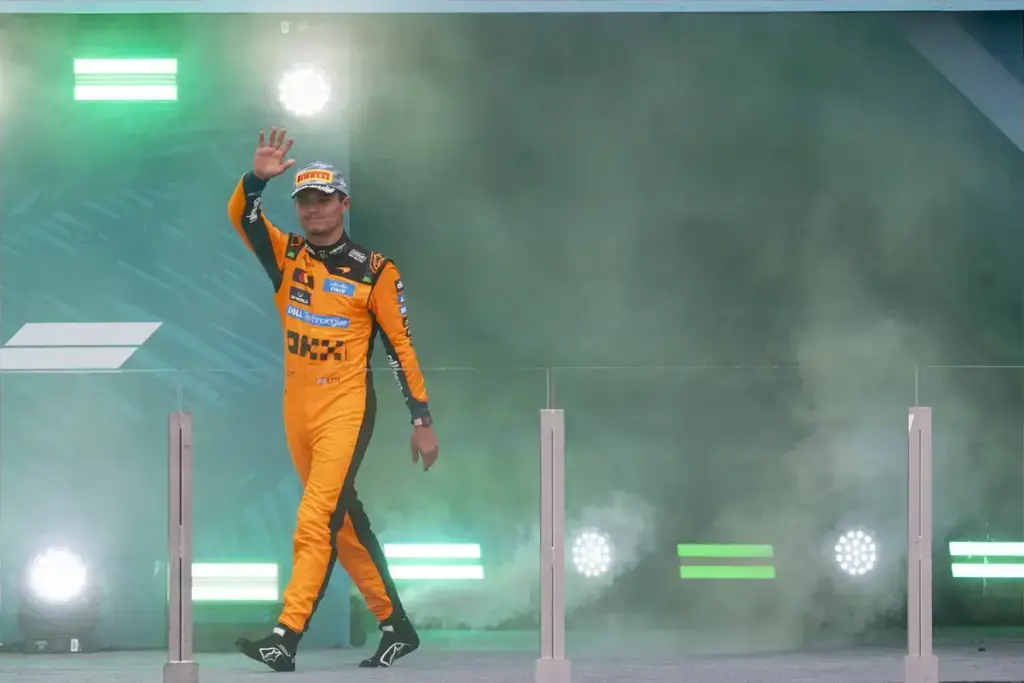

- Lando Norris calls for F1 to scrap the battery after Miami rule tweaks disappoint.
- Miami GP changes cut lift and coast in qualifying but left race chaos untouched.
- Drivers across the grid warn F1 that patience with incremental fixes is running out.
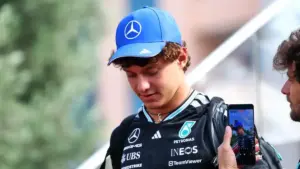
Lando Norris finished second at the 2026 Miami Grand Prix on Sunday. But the reigning Formula 1 world champion left the Miami International Autodrome with a demand that goes beyond his own result: remove the battery from the cars entirely.
Formula 1 had introduced a package of regulatory changes ahead of the Miami race to address driver complaints about the sport’s new 2026 power unit regulations.
Norris said the tweaks moved things in the right direction, but not nearly far enough.
“It’s a small step in the right direction, but it’s not to the level that F1 should be at, yet,” he told media after the race, as reported by Crash.net.
The problem with the 50/50 split
The 2026 regulations split power roughly equally between electrical and internal combustion sources.
Formula 1 designed the rules to make cars more relevant to road-going technology and to attract new manufacturers. Drivers, however, have found the reality on track deeply frustrating.
One of the central complaints is “lift and coast,” a technique that requires drivers to ease off the throttle early and let the car roll in order to recover battery energy.
Norris said at the season-opening Australian Grand Prix that he had driven over debris during qualifying because he was looking at his steering wheel to monitor battery levels rather than the road ahead.
He has since called the energy management demands something that “hurts the soul.” His McLaren teammate Oscar Piastri described the required driving style as “counter-intuitive.”
Even after the Miami changes, Norris said the core problem remained. Drivers who push flat out, as they did in previous seasons, still get penalised.
“You still can’t be flat-out everywhere,” he said. “It’s not about being as early on throttle everywhere; you should never get penalised for it, and you still do.”
His proposed solution was direct:
“Honestly, I don’t think you can really fix that; you just have to get rid of the battery. So hopefully in a few years that’s the case.”
What the FIA changed for Miami
The FIA reduced the maximum battery harvesting limit in qualifying from 8 megajoules to 7 megajoules before the Miami race.
The reduction means cars recover less energy during a flying lap and therefore have less stored power to deploy.
The regulator also raised the super clipping limit from 250 kilowatts to 350 kilowatts, allowing the battery to charge faster when a driver is at full throttle.
The theory was that drivers would spend less time doing anything other than pushing.
McLaren’s technical director of performance, Mark Temple, said before the weekend that lift and coast “should no longer be a thing in qualifying” under the revised parameters.
The FIA also banned the 350kW boost mode in wet conditions, a decision taken after Oliver Bearman’s crash at 191mph in Suzuka, which exposed the danger of large speed differences between cars in different phases of energy use.
Mercedes team principal Toto Wolff said the situation called for “a scalpel, not a baseball bat.” The FIA framed the Miami package as a refinement, not a rewrite.
The drivers’ verdict: better, but not enough
Piastri said qualifying had improved under the new rules, but that racing conditions were essentially unchanged.
He pointed to a moment during the Miami race when George Russell was one second behind him and still managed to pass him by the end of the straight.
“The races are basically exactly the same,” Piastri told Crash.net. “It’s just a bit random.”
Piastri added that the closing speeds made attacking and defending equally difficult. He said he had found himself making the kind of aggressive move he had earlier criticised Russell for.
“I kind of found myself almost doing the same move about five laps later just because the closing speed is enormous,” he said.
Race winner Kimi Antonelli, who took his third consecutive victory of the season for Mercedes, gave a measured view.
“Qualifying feels better, more natural,” he said. “Races, the closing speed is still massive.”
Max Verstappen, who has openly discussed walking away from the sport over his dissatisfaction with the 2026 regulations, called the Miami tweaks “a tickle” before the race.
He said the regulations “will always reward going slower in the corners because you have more energy” and that the sport remains “far away from proper F1 cars and pushing flat out.”
A frustrating weekend for Lando Norris personally
Norris had dominated the sprint weekend in Miami, taking pole for and winning the sprint race.
Sunday’s grand prix qualifying told a different story. A battery deployment issue on his final Q3 lap dropped him to fourth on the grid.
“We certainly had more issues with deployment and things like that, and I started my final lap with just less deployment,” he told the media. He also cited hotter temperatures and a more rubbered-in track surface as factors that made conditions harder to manage.
Norris recovered well in the race to finish second behind Antonelli. Piastri was third, giving McLaren a strong points return despite the qualifying setback.
The race itself featured a chaotic opening lap that included a spin for Verstappen after contact with Charles Leclerc and separate crashes involving Isack Hadjar and Pierre Gasly, which brought out the safety car.
Verstappen has said he hopes for “bigger changes” for 2027. Norris’s call to scrap the battery altogether suggests drivers are losing patience with gradual adjustments.
Whether Formula 1’s decision-makers are prepared to consider such a fundamental change remains unclear.

Comments.
Loading comments…