- Miami GP moves 3 hours earlier as severe thunderstorms threaten Sunday afternoon.
- US lightning laws could force an immediate red flag during the race.
- Cars face wet conditions with boost and drag-reduction modes banned.
The 2026 Miami GP will start at 13:00 local time on Sunday, three hours earlier than planned.
The FIA, Formula 1 and the Miami race promoter confirmed the change late on Saturday evening, after qualifying wrapped up at the Miami International Autodrome.
Severe thunderstorms are forecast to move across southern Florida in the mid-to-late afternoon, close to the original 16:00 start time.
The three parties issued a joint statement explaining the decision.
“Following discussions between FIA, F1 and the Miami promoter, the decision has been taken to move the start of Sunday’s Miami Grand Prix to 13:00 local time in Miami due to the weather forecast that is expected to bring heavier rainstorms later in the afternoon close to the original planned race start time,” it read.
The statement added that the move was intended “to ensure the least amount of disruption to the race, and to ensure the maximum possible window to complete the Grand Prix in the best conditions and to prioritise the safety of drivers, fans, teams and staff.”
This is not the first time F1 has shifted a race start because of the weather. The 2024 São Paulo Grand Prix was also moved earlier under similar circumstances.
Why lightning matters more than rain
Rain on its own would not normally force a three-hour schedule change. But thunderstorms carry a specific legal weight in the United States that rain alone does not.
American law requires organisers to halt major outdoor public events if lightning is approaching. The standard applied across US sporting bodies is the “30/30 rule.”
If the gap between a lightning flash and the thunder that follows is 30 seconds or less, the storm is estimated to be within six to eight miles.
At that point, everyone must stop and seek shelter. Activity cannot resume until at least 30 minutes have passed since the last lightning or thunder. Each new strike resets the clock.
Florida records more lightning strikes per square mile than any other state in the country, so the risk is far from abstract.
The consequences for a running race would be immediate. The mandatory medical helicopter cannot fly during electrical activity.
Under FIA rules, F1 cannot hold a race if that helicopter is grounded. A lightning strike within the designated safety radius during a running race would trigger an immediate red flag, with all drivers returning to the pit lane.
Wet-weather restrictions for the new 2026 cars
Rain would also activate a set of technical restrictions unique to this season’s cars.
If officials declare a “Rain Hazard,” teams must switch off Straight Line Mode, which opens the front and rear wings on the straights to reduce drag.
Boost Mode, which allows the cars to deploy an additional 350kW of power out of corners, would also be banned.
These restrictions reflect how little anyone knows about how the new 2026 cars handle in the wet. The season has so far produced just three dry grands prix.
The Bahrain and Saudi Arabian rounds were cancelled, which stripped teams of early-season running. Most drivers have not driven these cars in wet conditions at all.
Championship leader Kimi Antonelli acknowledged the uncertainty after claiming his third consecutive pole position on Saturday.
His lap of 1:27.798 put him ahead of the field, but it is the Sunday conditions that are occupying his mind.
“For sure, it’s going to be slippery in the wet, if there is any. It’s not going to be easy, also because everyone has so little experience, and some of us even don’t have any experience in the wet,” the 19-year-old Mercedes driver told Sky Sports F1.
On the possibility of a rolling start, Antonelli added:
“If it’s a rolling start, definitely it will take that element out of the way, but let’s see. Obviously, it’s meant to be raining a lot, so let’s see also with timings what’s going to happen.”
What to expect on race day
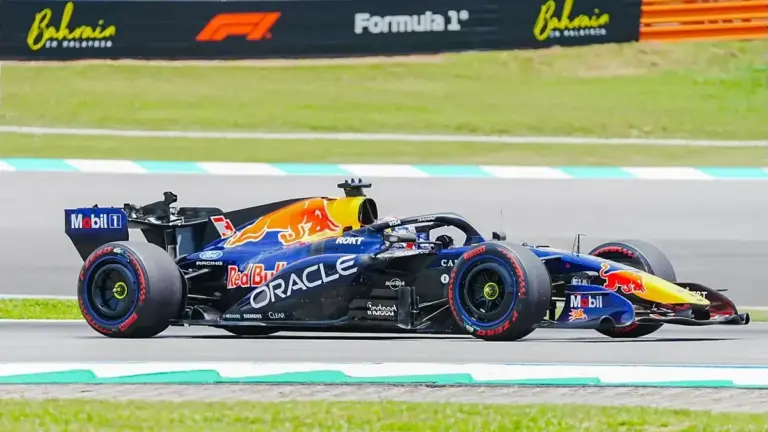
The top four on the grid represent four different constructors. Antonelli leads from the front for Mercedes, with Max Verstappen in second for Red Bull, Charles Leclerc third for Ferrari and Lando Norris fourth for McLaren.
Franco Colapinto qualified an impressive eighth for Alpine. Both Cadillac drivers will line up at the back of the grid (P20 and P21) for their first home race.
No driver has won the Miami Grand Prix from the front row across its four previous editions.
That record, combined with the weather threat, the untested wet-weather behaviour of the new cars and the possibility of a lightning-forced red flag, gives Sunday’s race an unusually wide range of possible outcomes.
The race starts at 13:00 local time, which is 18:00 BST.