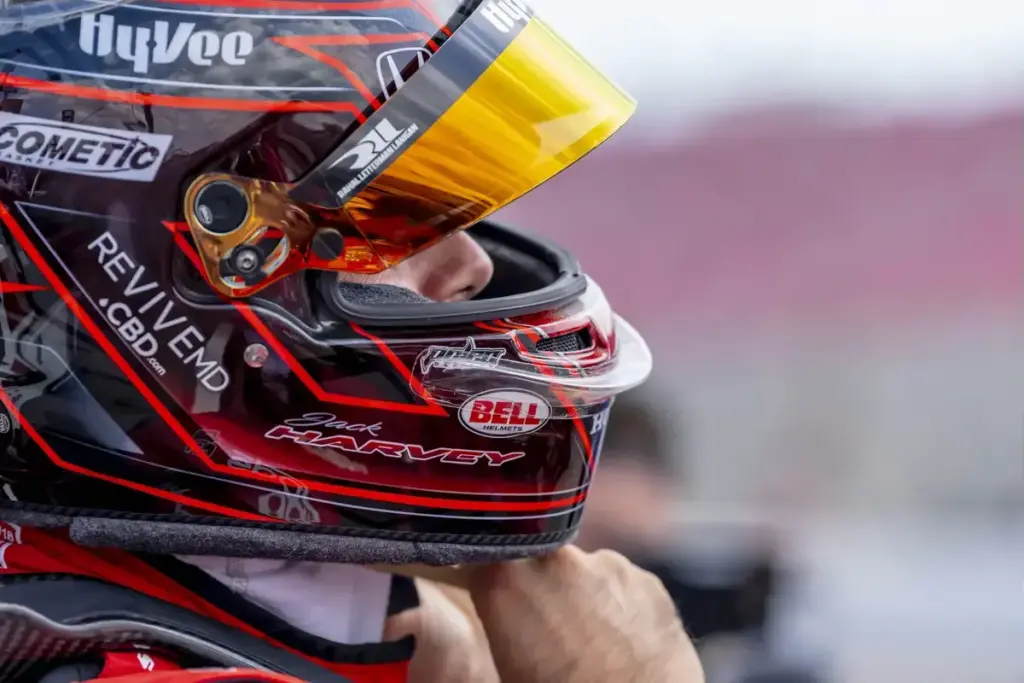

- Jack Harvey tops Indy 500 test speeds before late fire cuts his run short at IMS
- Fiery pit-lane incident halts Harvey’s strong showing during Day 2 of open test
- Despite setback, Harvey remains optimistic ahead of ninth Indy 500 start
With “The Greatest Spectacle in Racing” looming at Indianapolis Motor Speedway, the Indy 500 open tests garnered all the attention. For most of the week, British ace Jack Harvey had been doing everything right at IMS.
Quietly, almost under the radar, the Dreyer & Reinbold Racing driver had pieced together one of the more impressive showings of the Indy 500 open test. Then, just as Day 2 began to wind down, everything changed.
A faint hesitation out of Turn 3. A quick glance in the mirror. And suddenly, smoke, followed by flames, cut through what had been shaping up as a near-perfect test. Within seconds, Harvey was guiding his No. 24 Chevrolet back toward pit road, his strong run halted not by pace but rather by the unpredictability of racing.
Jack Harvey’s strong test run halted by sudden fire
The incident unfolded with little warning. As Harvey exited Turn 3 during Wednesday’s test session, he felt what he later described as a slight hesitation, nothing dramatic, nothing that immediately signaled trouble. But experience kicked in almost instantly.
“I had a little bit of hesitation on the exit of Turn 3 and honestly just looked down to the mirrors and saw the smoke immediately,” Harvey explained afterward. “I’ve had engines that have had issues here in the past, and when it happens, it’s normally very obvious.”
There was no violent failure, no immediate loss of control, just enough of a warning for Harvey to react quickly. Harvey was out front when smoke billowed from his No. 24 car, almost blinding the trailing cars. But, he backed out of the throttle and managed to bring the car safely down pit road as smoke poured from the rear.
Moments later, flames became visible, bringing his session to an abrupt end.
Importantly, Harvey was unhurt, and the situation never escalated further. There was no fluid spill on the track, allowing the session to resume after only a brief interruption. Still, for a team that had been building momentum across two productive days, it was a frustrating way to close things out.
“Not how we wanted to end the day,” Harvey admitted. “But I still think overall it’s been a pretty productive test.”
At the time of the incident, there were still more than an hour of track time remaining, valuable running time that Harvey and the team had planned to use for longer race simulations. That opportunity, however, was lost, at least for now.
“We were going to just dive into our race running now for the first time,” he said. “We’re going to miss out on a little bit of that, but luckily, we will get plenty of days of race practice.”
As for the exact cause, it’s still shrouded in mystery. Harvey noted, “It’s probably too early to figure out what exactly it was. Having just pulled the car back to the garage, the Chevy guys are going to dive into it.”
Despite the setback, the Bassingham native, making his ninth Indy 500 start on May 24, remained grounded and optimistic – “I think this is so cool that we get to do this. Yes, that was an unfortunate thing, but on the whole, I’ve had two days of driving around the Indianapolis Motor Speedway, and that’s really cool.. It’s just racing.”
A promising Indy 500 test before the setback
What made the incident sting a little more was just how strong Harvey’s week had been up to that point.
On the test’s opening day (Tuesday), which featured the mandatory Rookie Orientation Program (ROP) and refresher sessions, Harvey set the pace among a competitive group. His best lap of 221.154 mph put him comfortably at the top of the charts, ahead of experienced names like Hélio Castroneves and Ryan Hunter-Reay, as well as a mix of rookies trying to get up to speed.
That kind of pace was exceptional for Dreyer & Reinbold Racing, a team that traditionally builds its program specifically around the 500.
Even on Day 2, before the fire, the focus had shifted toward more detailed race preparation. The plan was to move beyond outright pace and into longer runs. However, that phase was cut short, but not before enough data had been gathered to leave the team cautiously optimistic.
Around him, the broader test carried its usual mix of storylines. Rookies worked through their orientation programs, with most successfully completing the required phases. Others, like Katherine Legge, dealt with mechanical issues that limited their running.
With the open test now in the books, attention will quickly turn to the Month of May for the spectacle.

Comments.
Loading comments…