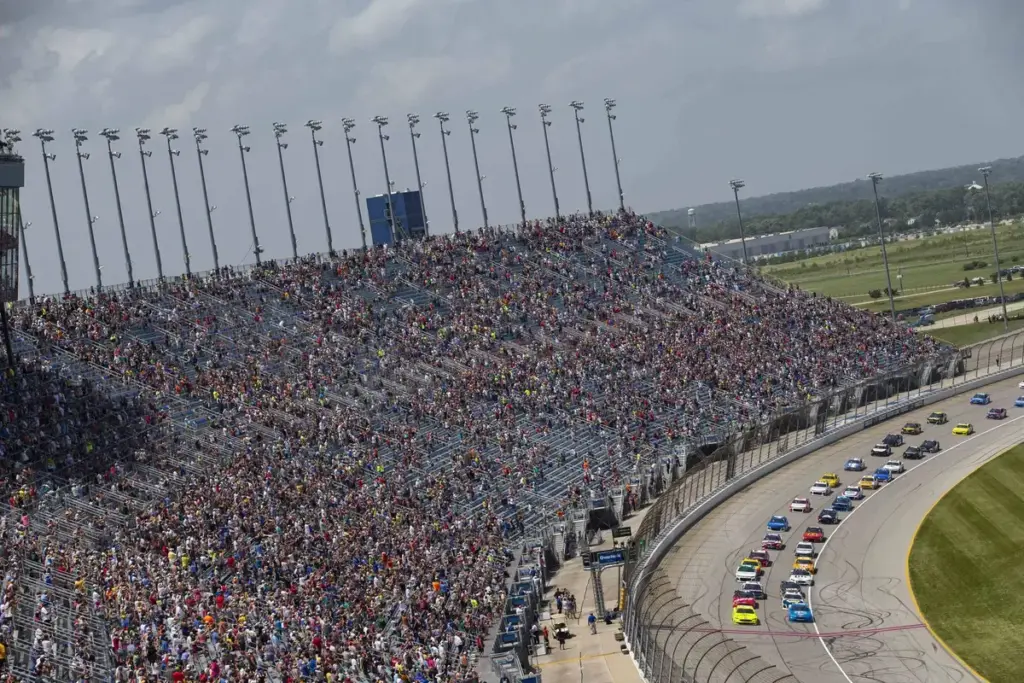

- A NASCAR official says Chicagoland’s wear suggests a race similar to Auto Club.
- Larson says he doesn’t remember much about the track, other than the heat.
- Chicagoland draws a crowd during the test.
NASCAR wrapped up a two-day Goodyear tyre test at Chicagoland Speedway on Tuesday and Wednesday, laying the groundwork for the sport’s return to the 1.5-mile track outside Chicago, Illinois, over Independence Day weekend.
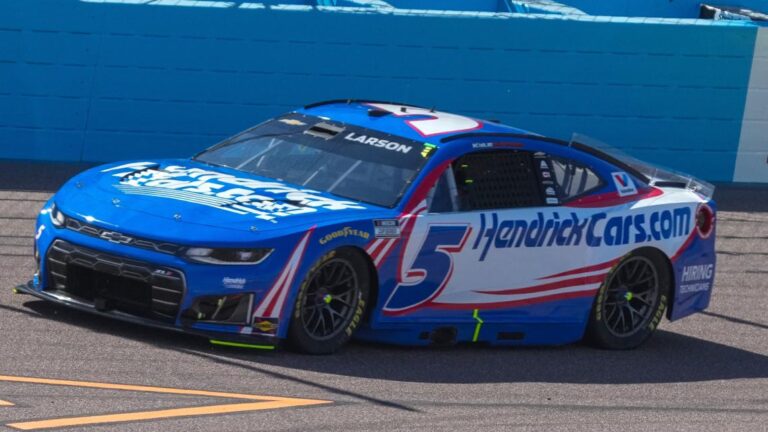
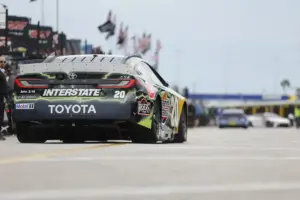
Representatives from all three Cup Series manufacturers took part, with Ryan Blaney in a Ford, Kyle Larson in a Chevrolet, and Denny Hamlin in a Toyota logging laps, while Justin Allgaier in a Chevrolet and Brandon Jones in a Toyota carried out runs for the O’Reilly Auto Parts Series.
The test marked the first time since 2019 that cars hit the track at Chicagoland. In the wake of that, NASCAR Cup Series Managing Director Brad Moran offered an update on the state of the venue during an appearance on SiriusXM NASCAR Radio.
Moran says the track could mirror Auto Club racing
This year, the track will stage its first race weekend of the decade, taking over the July 4 slot that had been held by the Chicago Street Circuit.
Based on images of the track from summer 2025, Chicagoland held up better than other venues making a return, such as North Wilkesboro Speedway and Rockingham Speedway. Even so, questions lingered over the state of both the surface and the facilities. Speaking after the test, Moran said the track shows wear, but in a way that has teams and officials rubbing their hands.
“It is still a little early on, but the track’s in good condition. It’s well-worn… I talked to quite a few teams about it, and everybody’s excited about the surface,” Moran said.
He added that the wear could play a major role in tyre falloff, and depending on the tyre Goodyear brings, the racing could resemble what fans saw at Auto Club Speedway in its final stretch.
“We’re almost expecting like an Auto Club-type race on a worn-out surface. And if we get anything close to that, Auto Club, towards its end, put out some great racing. So we really believe it could look similar to that,” he added.
From the cockpit, drivers also weighed in. Larson told the media at the track, “You’ve raced so much between then and now that I didn’t really remember a whole lot of the track other than just the big bump in one and some bumps in [Turns] 3 and 4, and those are all still there. It’s just cool.
“It’s really fast. A lot faster pace than what I remember the old car being here. We’re on the throttle quite a bit, but it’s also not as hot as it was the last time we were here. It’ll be hot when we come back, so the pace should slow down.”
Ryan Blaney echoed that view, noting that the surface has aged to a point where drivers can use the entire track. He said one of the key aspects is how the wear opens up options across the surface, with tire falloff expected to come into play when the series returns in the summer.
That, in turn, should allow drivers to make use of every lane, a factor that often tips the balance at tracks of this size. Blaney also pointed to the curved backstretch as a feature that sets the track apart, adding that he carries plenty of memories from past races at the venue.
Chicagoland test draws a crowd ahead of return
While the test itself was a run-through ahead of the July race weekend, it was open to fans, and the turnout offered a sign that the track’s return could strike a chord. According to Dave Kallmann of the Milwaukee Journal Sentinel, the showing at the test gives reason to believe Chicagoland could find its footing again on the schedule.
The speedway was spruced up ahead of NASCAR’s return and the two-day test that came with it. From 2001 to 2019, NASCAR staged 19 Cup Series races at Chicagoland, while the O’Reilly Auto Parts Series ran 24 events during that span, including seasons with doubleheaders from 2011 through 2015.
After races were called off in 2020 due to the global pandemic, the NASCAR-owned facility has sat idle for the most part.
Over the years, the venue also saw seating cuts, dropping from around 69,000 to 55,000 in 2013, and then to about 47,000, yet it still fell short of a sellout.


Comments.
Loading comments…