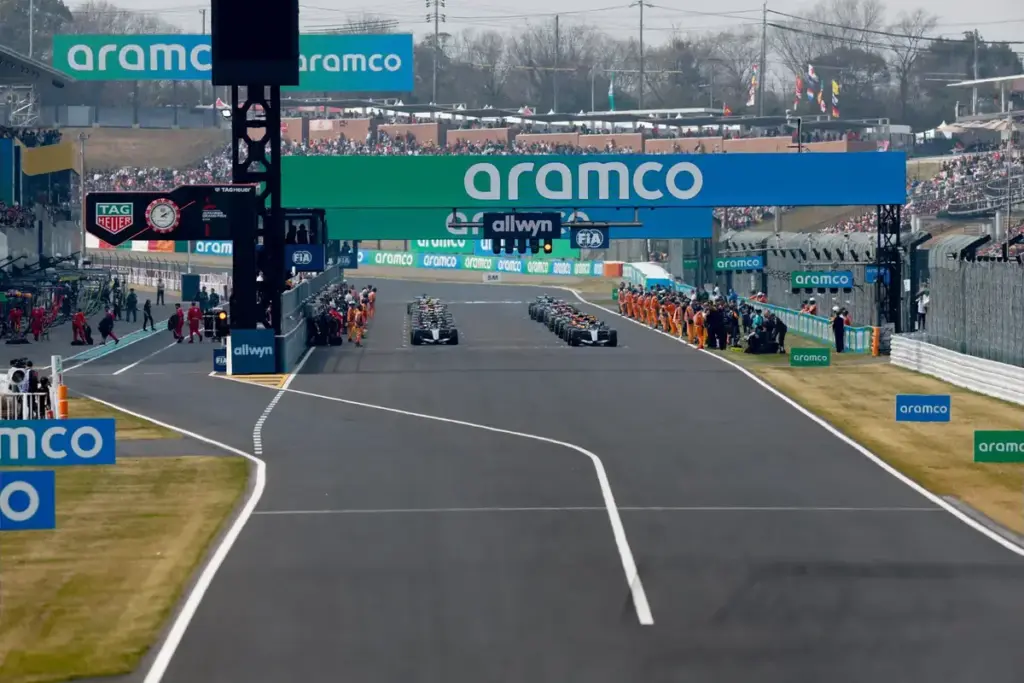

- FIA designs an electronic safety net to prevent dangerous 2026 race starts.
- A near-miss in Melbourne exposed how badly new turbo rules broke launch control.
- Testing begins in Miami, with full deployment expected within two to three races.
The FIA is developing an electronic intervention system to prevent stalling incidents at Formula 1 race starts, with testing set to begin at the Miami Grand Prix.
FIA single-seater director Nikolas Tombazis confirmed the plan. He said that the system could be fully operational within two or three races.
The move comes after the opening rounds of the 2026 season exposed a safety problem linked to the new power unit regulations.
Cars struggled to get off the line cleanly. The speed differences between fast and slow starters created dangerous conditions on the grid.
Why 2026 starts became a safety problem
The core issue traces back to the removal of the Motor Generator Unit-Heat from the 2026 power units.
Under the previous rules, the MGU-H spun up the turbocharger electrically. This meant drivers got instant, smooth power at the start.
Without it, the turbo needs exhaust gases and engine revs to build pressure, and that takes time the driver does not have.
A separate rule makes things harder. The MGU-K, the electric motor that drives the rear axle, cannot deploy any power until the car exceeds 50km/h.
The FIA introduced this rule to prevent teams from engineering a form of launch control. But it also means drivers have no electrical assistance during the most critical phase of the getaway.
Tombazis described how sensitive the situation has become.
“These cars, because they’ve got turbos and because starts are so optimised these days, it is quite sensitive for a car in order to get a good start, what level of turbo pressure they have right at the moment when the lights go out,” he said.
A poor turbo state at that moment, he added, “could create a situation where we’ve seen one or two examples where cars get particularly bad starts, and that can cause a safety issue.”
A near-miss in Melbourne
The danger moved from theory to reality at the Australian Grand Prix. Alpine’s Franco Colapinto nearly collided with Liam Lawson’s car, which had stalled on the grid.
“At the start, I almost had a massive shunt with Liam as he was stuck on the grid,” Colapinto said after the race. “That was pretty lucky, to be honest. Things like that happen, but it was just very dangerous and quite sketchy.”
The FIA had already introduced a five-second pre-start phase before Melbourne, marked by flashing blue lights on grid panels.
The idea was to give drivers more time to build turbo pressure before the lights sequence began. But the speed gaps between cars at the moment of launch remained wide.
McLaren team principal Andrea Stella put it plainly after the race. “I think the concern remains today, the start was a bit of a near miss,” he said. “There were huge speed differentials on the grid.”
The history of start-line accidents gives those words weight. Riccardo Paletti died in a grid collision at the 1982 Canadian Grand Prix.
Incidents involving stalled cars, including Michael Schumacher’s gearbox failure at the 2001 German Grand Prix, show how quickly such moments can turn fatal.
How the safety net will work
The FIA’s proposed fix is an automatic system that monitors each car’s acceleration in the moments after clutch release.
If a car’s acceleration falls below a set threshold, the system triggers an MGU-K deployment without driver input.
This overrides the 50km/h rule in emergency situations, giving the struggling car enough forward momentum to clear the path of faster-starting rivals.
Tombazis explained the principle during his briefing. “What we will have effectively is a safety net,” he said.
“So if a car is detected to be having an extremely bad start, then the electric system will kick in and take over and ensure that the car gets away safely in order to avoid problems with the following cars.”
The FIA calls it a “low power start detection” system. The energy deployment will be deliberately limited to prevent any car from gaining a performance advantage through the intervention.
Cars behind a slow starter will also receive a warning via rear light signals. The system will run through practice sessions in Miami first, with race deployment coming only after the data has been assessed.
Wider rule changes for 2026
The start detection system sits inside a broader package of rule adjustments.
The FIA, team principals, power unit manufacturers, and Formula 1 Management agreed to the changes unanimously in an online meeting on April 20.
The package targets four areas: improving the qualifying spectacle, reducing closing speeds between cars, lowering the risk of grid collisions, and preparing for potential wet-weather issues.
Peak superclipping power rises from 250kW to 350kW. Maximum permitted recharge drops from 8MJ to 7MJ. MGU-K deployment in races will be capped at 250kW outside key acceleration zones.
These changes respond in part to Oliver Bearman’s 50G crash at the Japanese Grand Prix, which highlighted the dangers of cars arriving at very different speeds.
Tombazis acknowledged the incident. “Every accident at high speed is always a little bit of a shock,” he said after the fact. “To say it was expected would be wrong, but the closing speeds had been identified as a risk.”
Tombazis has outlined the fixes in two phases. The first covers the immediate adjustments now being introduced.
The second gives manufacturers more time to optimise their systems within the revised framework.
How well the low-power start detection system performs will only become clear once the lights go out in Miami.


Comments.
Loading comments…