
- Surprise inquiry sparks interest in expanding NASCAR’s current three-OEM lineup.
- NASCAR exploring electric CUV platform as future centrepiece to modernise series.
- Series’ long-term plan aims to distinguish between Truck, CUV, and Cup divisions.
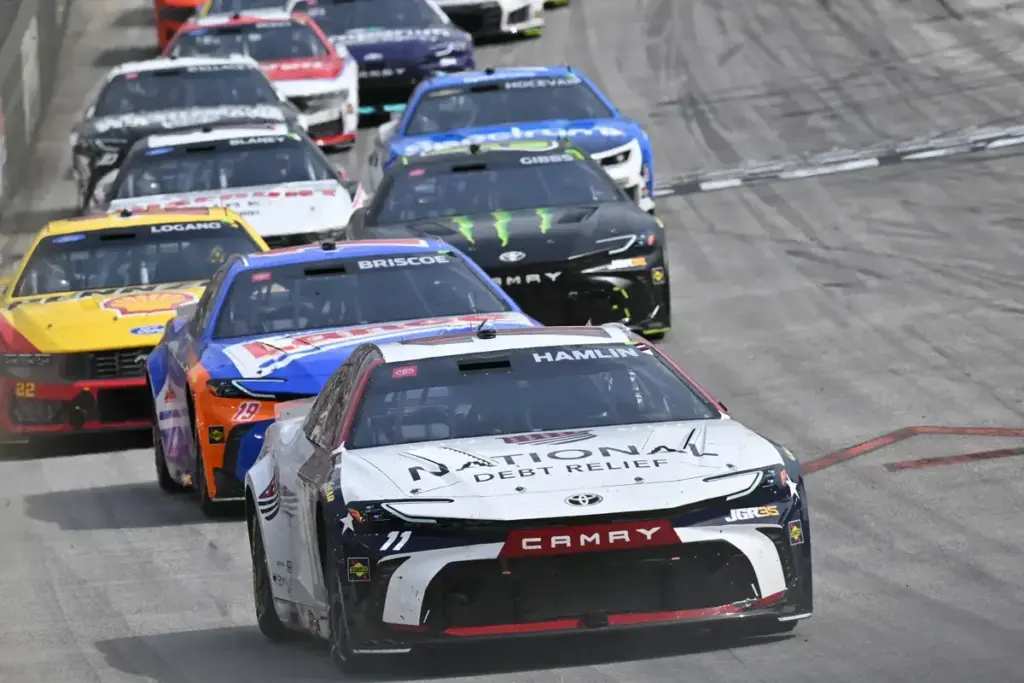
The possibility of a new manufacturer entering NASCAR has long been one of the sport’s most intriguing “what ifs.” Now with the return of Ram Trucks, that conversation appears to be moving beyond speculation.
Recently, in a revealing update, NASCAR executive vice president John Probst confirmed that a fresh OEM inquiry has landed on the sanctioning body’s desk, seemingly out of nowhere, but with enough substance to immediately capture attention inside the industry.
NASCAR leadership opens door to potential new manufacturer
At a time when NASCAR is carefully balancing tradition with innovation, the idea of a new manufacturer joining the grid carries major implications. The Cup Series has operated with three cornerstone manufacturers, Ford, Toyota, and Chevrolet, for years.
However, Probst’s latest comments hint at a potentially significant shift just over the horizon. Speaking candidly, the NASCAR head honcho revealed,
“We have, as recently as about two hours ago, had what was a lead come in on a new OEM out of the blue almost. So we are excited for that one, so that will obviously right now have a lot of energy from me and my colleagues as we get through that.”
“We’re always excited to welcome the possibility of a new OEM coming into our sport but are very cognizant of the investment and commitment that our existing OEMs have already made for decades with us, so we’re very respectful of that as well.”
NASCAR ecosystem
That last point is key. While the headline may be about expansion, the reality is far more delicate. NASCAR cannot simply open the door to a new manufacturer without considering the ecosystem that already exists. Ford, Toyota, and Chevrolet have poured decades of investment into the sport, not just financially, but technologically and culturally.
OEM interest is one of the clearest indicators of a motorsport’s health. When manufacturers come knocking, it suggests they see value. And for NASCAR, which has been navigating an evolving automotive landscape, that’s a strong vote of confidence.
The timing also aligns with broader changes in the sport. The Next Gen car, introduced to modernize competition and reduce costs, has already created a more level playing field. Add in NASCAR’s growing exploration of hybrid, electric, and alternative fuel technologies, and suddenly the platform becomes more appealing to a wider range of manufacturers.
NASCAR exploring CUV concept for O’Reilly Auto Parts series
Over the past decade, Probst has quietly become one of the most influential voices in NASCAR’s competition and development landscape.
His journey into racing was anything but conventional, with early interest leaned toward engineering, sparked by watching Formula 1 as a high school student. But, it wasn’t until his time at Penn State, when he became involved in a Formula SAE program, that the connection between engineering and motorsport truly clicked. That foundation has shaped his approach ever since.
Before joining NASCAR in 2016, Probst built experience across multiple corners of the industry, including stints with race teams and Ford Motor Company.
Today, from overseeing race car development to managing track operations and refining the rule book, his responsibilities stretch across nearly every facet of competition.
In addition, he is deeply involved in exploring new technologies such as electric vehicles and hydrogen combustion engines, as well as considering how those innovations might fit into different tiers of competition.
“There is certainly a needle to be threaded there,” Probst said to SBJ, referring to the balance between entertainment and engineering. During the same, Probst who is also the Chief Racing Development Officer floated the possibility of a significant transformation for the NASCAR O’Reilly Auto Parts Series.
Truck, a CUV and a Cup?
Probst revealed that NASCAR has explored the idea of introducing its electric, crossover-style race car, first showcased at the Chicago Street Circuit in 2024, as the centrepiece vehicle for the series.
While he emphasised that no final decision has been made, the concept appears to be rooted in giving each national division a clearer and more distinct identity.
Expanding on that vision, Probst explained that the long-term roadmap could see NASCAR’s three national series diverge more visibly in both form and purpose.
“I’m not sitting here saying today we’re breaking news, it’s going to CUV, but these are the things that are on the roadmap to consider, so you’d have a Truck, a CUV and a Cup, that’s three very different bodies that are relevant for our OEMs today to create that brand identity for each series.”
Should NASCAR ultimately pursue this direction, it would mark a notable departure from tradition, one that could either strengthen its loyal fanbase or test its long-held identity.

Comments.
Loading comments…