
- Restart glitch was a series-wide software error, not rule violation, so no penalties.
- Data confirmed the glitch caused only one position change, justifying final result.
- Independent Officiating Board (IOB) launches full review of race control systems.
The IndyCar Series once again finds itself at the center of scrutiny after a Push-to-Pass (P2P) system failure disrupted the flow of the recently concluded Grand Prix of Long Beach.
What should have been a routine restart late in the race instead exposed a critical software lapse, allowing drivers access to a performance boost at a moment when it is explicitly prohibited by the rulebook. While officials were quick to clarify that no penalties would be issued, the incident has reopened deeper questions about consistency, most importantly, technological reliability within the series.
IndyCar Long Beach restart glitch puts push-to-pass under spotlight
A few years ago, in 2024, the racing world imploded after Team Penske was penalized for exploiting P2P during restricted phases. Now, with a system-wide failure granting similar access, albeit unintentionally, the parallels are impossible to ignore.
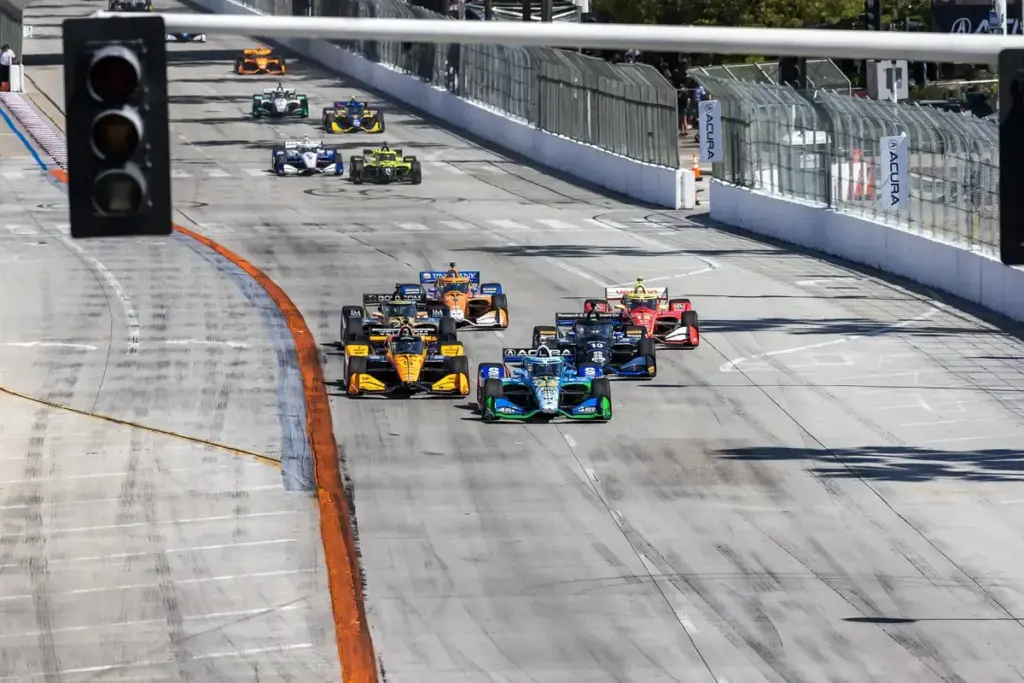
The problem surfaced during Sunday’s lone restart on Lap 61 of the 90-lap Acura Grand Prix of Long Beach. According to the series’ rule book, under Rule 14.19.16, Push-to-Pass must remain disabled on race starts and restarts until each car crosses the alternate start-finish line.
The officiating body’s idea is straightforward: taking away that extra 50 horsepower keeps the restart fair, without giving anyone an added edge at one of the most decisive moments of the race. However, due to a software failure within race control systems, P2P remained active as the field accelerated back to green.
In fact, post-race analysis by the series officials revealed that 12 of the 25 drivers deployed the system before it was legally permitted. Interestingly, the data suggested minimal competitive impact. Only one position change was directly linked to the early P2P usage, with Marcus Armstrong overtaking Santino Ferrucci.
Even in that case, both drivers were found to have used Push-to-Pass in nearly equal measure, leading stewards to determine that the move did not warrant intervention or alteration of the final results.
Precedent established in 2024
Despite the apparent advantage, officials concluded that the responsibility lay with the series itself, not the teams or drivers.
“The burden of the rule rests with IndyCar to assure that the software runs properly,” officials stated, emphasizing that no infractions would be issued.
In hindsight, most drivers routinely press the P2P button during restarts as a precaution, an instinct shaped by both opportunity and precedent.
That precedent was firmly established in 2024, when Josef Newgarden and Scott McLaughlin were penalised after their team gained unauthorised access to the system during restricted periods at the season-opening race in St. Petersburg.
Inside IndyCar’s Penske investigation
That earlier controversy only came to light because of another irregularity at Long Beach, where a pre-race warm-up system error revealed discrepancies in P2P availability across teams. Rivals quickly noticed that while their systems were inactive, the Penske entries appeared to be deploying the boost, triggering an investigation that ultimately led to penalties.
What followed was a significant revelation: the same software had already been active during the season-opening race in St. Petersburg, where Josef Newgarden admitted to using it three times to his advantage.
Teammate Scott McLaughlin acknowledged a single use during the race, while Will Power was cleared of any wrongdoing. In the aftermath, the sanctioning body imposed swift, severe penalties. Newgarden was stripped of his race win, McLaughlin lost his third-place finish, and all three drivers were handed $25,000 fines along with a 10-point deduction in the standings.
The controversy placed Penske under intense scrutiny, particularly given that the organization also owns IndyCar and the Indianapolis Motor Speedway. Team president Tim Cindric later explained that the software had originally been installed in August as part of testing for IndyCar’s upcoming hybrid engine package and was unintentionally left on the cars.
IndyCar, for its part, admitted shortcomings in its oversight, acknowledging that the system had gone unnoticed through inspections across the opening rounds of the season.
Deeper technical review in the pipeline
Meanwhile, Newgarden maintained that he believed a rule change had made Push-to-Pass usage legal on restarts, while McLaughlin described his input as instinctive, pressing the button out of habit and gaining only a negligible boost that lasted less than two seconds.
In contrast, the 2026 Long Beach incident has been treated as a systemic failure rather than a competitive violation. The newly structured officiating model, overseen by the Independent Officiating Board (IOB), has taken a firm stance in shielding competitors from blame when the governing technology falls short.
As per Racer.com, IOB member Ray Evernham confirmed that a deeper technical review will be conducted once all equipment returns from the race weekend.
Still, the situation raises an uncomfortable question: if exploiting P2P, intentional or otherwise, once led to penalties, how should similar gains be judged when caused by a software fault?






Comments.
Loading comments…