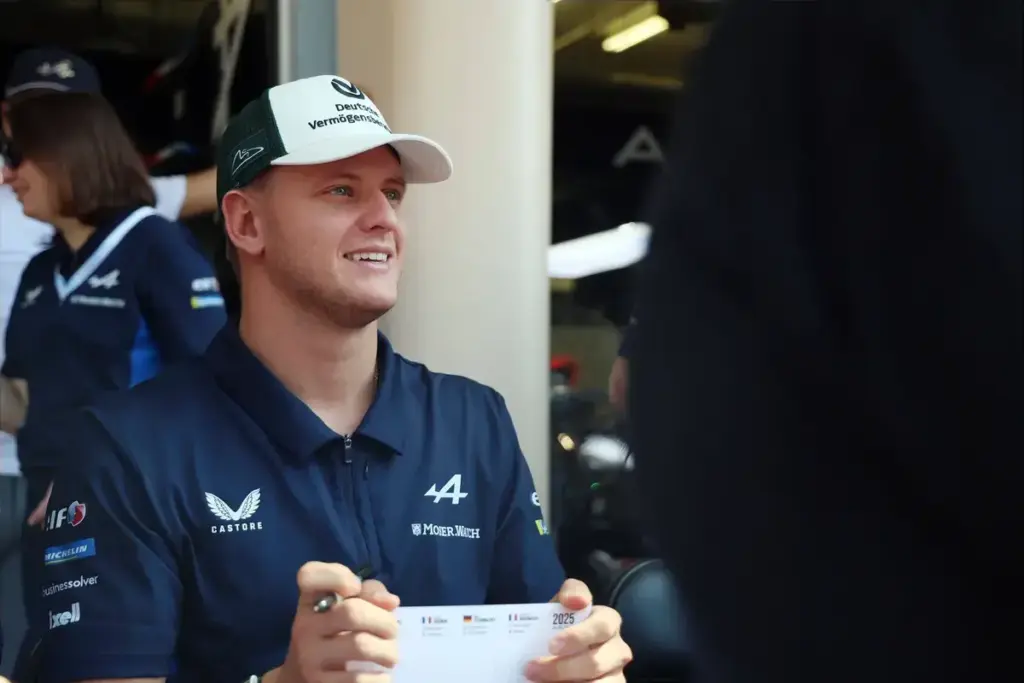

- Schumacher spends his first 15 practice laps just learning track layouts.
- To bridge experience gap, Schumacher is applying a European work ethic.
- Schumacher’s raw pace has matched top-10 contenders in the early season.
From traditional American ovals to tight road courses and the narrow street lanes of St. Petersburg, Mick Schumacher’s rookie IndyCar season has been a test of adaptation. Four races in, the 27-year-old sits 25th in the standings with just 31 points, still searching for a breakthrough.
Yet, despite the slow start, Schumacher insists there are “great things on the horizon.” With the Indianapolis 500 test looming, he finds himself balancing expectation with reality, learning not just new tracks but an entirely different racing philosophy shaped by uncertainty.
For Schumacher, the shift from Formula 1’s data-driven environment to IndyCar’s raw, physical demands has required a complete reset. But as the series heads to Long Beach, Schumacher is leaning on the European work ethic forged through the F3 and F2 ranks to bridge that gap and get the much-needed breakthrough.
Mick Schumacher on IndyCar’s tight weekend format and early setup pressure
One of the biggest shocks for Schumacher hasn’t been the cars or even the tracks. In fact, it has been the structure of an IndyCar weekend. Compared to the long, data-heavy build-ups he was used to in Europe, this is a sprint from the moment the car hits the track.
“You know, I think it’s obviously a bit different in terms of how you structure your weekend than anything that I’ve raced in so far,” Schumacher said in an exclusive. “In terms of Friday, you just do one practice on Friday, and then you’re kind of off and you’re going into the next night, basically. And then Saturday, it’s really shortly packed.”
This compressed reality creates a technical bottleneck. If the driver can’t find the sweet spot in the first hour of practice (FP1), he is effectively chasing a ghost for the rest of the weekend. For a veteran like Scott Dixon, FP1 is for fine-tuning a car they have driven for a decade. However, for a budding racer, Schumacher, the first 15 minutes are spent just learning which way the corners go.
“I think here at IndyCar, a lot of it comes down to just not knowing the tracks,” he admits. “I have no idea most of the time to the weekends. So essentially, in comparison to some of the other guys… I probably will use 10 to 15 laps just to get acquainted with the track. Those are 15 valuable laps that I don’t really have to spare at the moment, but I still need to just to be able to get acclimated.”
That “15-lap tax” is the steepest hurdle in his debut season for the young German. While rivals debate spring rates, Schumacher is still calibrating. In Formula 1, there’s room to experiment, to tweak, to circle back. But here, Rahal Letterman Lanigan Racing ace is finding the brutal reality of getting it right early or living with the consequences.
Still, there’s no sense of panic in the way he approaches it. If anything, it’s methodical. The focus is on understanding the rhythm of the weekend, knowing when to commit, and gradually closing that experience gap.
Schumacher’s IndyCar mindset: European work ethic over raw freedom
There is a romanticized view that IndyCar is the “pure/raw” alternative to F1’s technical rigidity. While Schumacher agrees that the driver-to-car relationship is more natural over here in the States, he refuses to let the atmosphere soften his edge.
In F1, the car is often a permutation and combination, and the driver is a variable that must adapt to the data. In IndyCar, in contrast, the car is an extension of the driver’s hands. Schumacher’s method is rooted in the “tough environment” of his upbringing, where the stakes were always binary.
“European racing is a very tough environment. It’s an environment where you have to learn to survive,” Schumacher says. “And essentially, usually the way I used to survive was by working harder than everybody else… Now, coming over here, my mentality is to not change that. Because if I do change that and I relax and I have fun and stuff, I feel like I’m just not going to perform as well.”
Plenty of potential
This rejection of a laid-back lifestyle is his greatest weapon. In fact, unlike most youngsters his age, he is deliberately maintaining a high level of internal pressure. “Because then you’re not putting the pressure on you that you need to, because it is still my job,” he says. “I really have to work for that. Because, again, I am somebody who has never seen these tracks, so I need to work double time.”
On that note, that double-time grind is starting to show flashes of potential. Despite a string of bad luck, including a tire gun failure and the brutal experience of his first oval start (Phoenix Raceway), the raw pace has been there.
Love for racing remains
At Barber, his speeds were on par with the frontrunners once the car was sorted. When asked about his overall experience in IndyCar, Schumacher said he still finds genuine joy in being behind the wheel, emphasising that his love for racing remains the driving force while describing the series as highly competitive.
Despite the challenges of adapting to new circuits and conditions, Schumacher expressed excitement about the remainder of the season, highlighting the variety of tracks still to come. He added, “There’s still a bit of a culture shock sometimes when I get to places like, I don’t know, Arlington.”
“And it’s just bumpy as hell. It’s so different. But nonetheless, it’s still something that is part of IndyCar and it’s something that is part of the fun and the flair. Obviously, I think in the future, is there a potential to improve that? Of course. But it’s still something that I get to enjoy and work at.”
Indy 500 around the corner
In an arena filled with specialists who have perfected a chassis that has remained fundamentally similar for sixteen years. Schumacher is the outsider trying to crash an exclusive party, but he isn’t intimidated by the bumps in the road. Instead, he sees a horizon that is finally beginning to clear.
“The pace on all the weekends we’ve been so far, honestly, has been at par with the guys that have been running in the top 10,” he concludes. “So, you know, there are great, great things out there on the horizon….It’s just a matter of time.”
For the youngster, even the quirks of IndyCar, the rough surfaces, the unpredictability, have become part of the appeal. Tracks that are, as he puts it, “bumpy as hell” aren’t something to complain about. Instead, they’re something to figure out.
With the Indy 500 test around the corner, that process is about to be pushed even further. But if there’s one thing that’s clear, it’s that Schumacher isn’t looking for shortcuts. He’s building this the hard way, like his legendary father, Michael Schumacher.



Comments.
Loading comments…