- Domenicali holds constructive talks to secure Verstappen’s long-term F1 future.
- F1 bosses move to resolve energy regulation flaws after Verstappen comments.
- FIA seeks middle ground to prevent a potential Verstappen exit amid rumours.
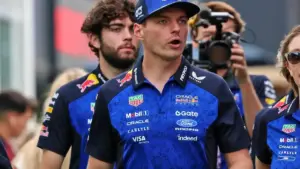
Not a happy chappy, is Max Verstappen. Right now, those four consecutive world drivers’ championships mean very little.
The Dutchman is not alone among F1’s 22 drivers to feel unease with the 2026 regulation changes, but has been the most vocal. First, there was the “Formula E on steroids” jibe, and then, in Suzuka, his eighth-place finish prompted him to join in with the “Mario Kart” analogies.
Coming from the mouth of the sport’s biggest name, each comment stung the FIA. These came alongside rumours of him considering his position in F1, and him considering whether there are alternative motorsport options out there for him.
“Constructive” diplomacy
In an interview with Motorsport, F1 CEO Stefano Domenicali acknowledged that Verstappen has a “voice that carries weight”, but was also keen to stress that the four-time champion has to “respect that weight.”
Domenicali said that he was in constant dialogue with Verstappen and that part of this was to gauge Max’s take on the new regs but also to prevent “antagonism.”
Essentially, Domenicali is attempting to play the role of the peacemaker while being seen not to dismiss Max’s concerns about the new energy management system. It’s a tricky balancing act as the integrity of the sport, along with its public appeal and commercial direction, are all part of that same equation.
The 2026 problem: Why Verstappen is unhappy
It’s been discussed many times on these pages, but basically, for those who are here for the first time (welcome), there is now an approximate 50/50 power split between the Internal Combustion Engine (ICE) and an F1 car’s electric battery.
The need to ‘harvest’ energy is done through a variety of methods, including lifting-and-coasting, going into and through corners. This has led to massive speed deltas between cars, which has caused problems aplenty.
In Suzuka alone, there was Ollie Bearman’s horror crash, and Lando Norris reporting that a surge of energy took him past Lewis Hamilton without him even intending to overtake the seven-time world champion.
All of the above and more have fed into Max’s frustration, who argues that the drivers feel they are managing a battery and its power level rather than driving the car to its limit – the very essence of F1 racing.
Regulation tweaks on the horizon
To placate Verstappen and his fellow drivers, in addition to the informal chats with Domenicali, several formal FIA meetings have taken place. ‘Decision day’ is planned for April 20, when they meet the team principals in London to vote on preferred options.
Worth noting is that while there is no scope to alter the spec or make-up of the engines, there is around the parameters for energy recovery and the deployment of electrical energy.
And this, essentially, is the ‘carrot’ Domenicali is dangling in front of Verstappen to keep him interested and focused – the prospect of an improved ‘racing product’ ahead of the Miami GP on May 3.
Enough to sate, Max?
But it won’t be changes made at any cost. In his interview, Domenicali issued a timely reminder that, in his words, “it (F1) transcends all individuals” – a not-so-subtle warning that while F1 needs Max Verstappen, there is no turning back on the path of the hybrid engine.
The big question is, will a few software tweaks to the cars’ energy deployment be enough to stop the Dutchman from walking away from F1 in 2028?