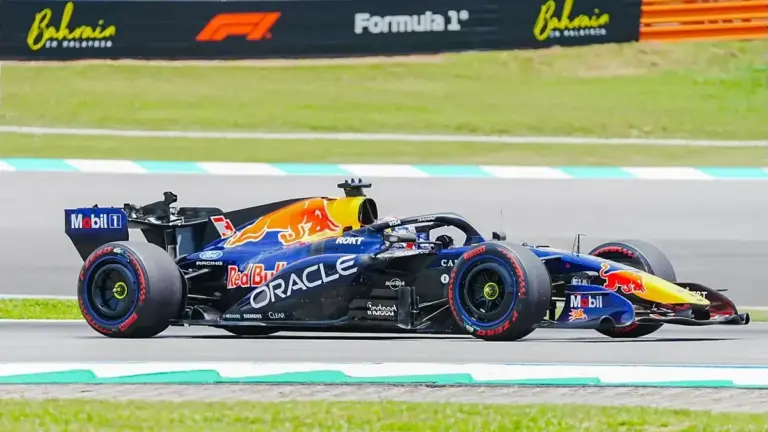
- Verstappen races Nurburgring 24 Hours in May, chasing endurance glory on debut.
- Former winner Bernd Maylander has 3 hard lessons for the 4-time world champion.
- One lesson has nothing to do with driving, and may be the most important of all.
Max Verstappen will make his debut at the Nurburgring 24 Hours on May 16-17, racing a Mercedes-AMG GT3 for Verstappen Racing in partnership with Winward Racing and backed by Red Bull.
Before he does, a man who has already climbed that mountain has some things to say to him.
Bernd Maylander, the FIA Formula 1 safety car driver and 2000 Nurburgring 24 Hours winner, sat down with RacingNews365 to offer the four-time world champion a candid guide to surviving and winning one of motorsport’s most punishing events.
Who is Bernd Maylander?
To understand why Maylander’s advice matters, you have to understand what he did before he became the man in the silver AMG at the front of every F1 grid.
He won the Porsche Carrera Cup Germany in 1994. He finished second in class at Le Mans in 1999.
Then, in 2000, he stood on the top step at the Nürburgring, sharing a Porsche 911 GT3-R with Michael Bartels, Altfrid Heger and Uwe Alzen.
That same year, he took on the safety car role he still holds today. Earlier this year, he drove his 500th Grand Prix in that capacity at the season-opening Australian Grand Prix.
His advice to Verstappen, then, does not come from a textbook. It comes from the experience of attempting the 24 Hour monster seven times in his career.
Verstappen set to enter the ‘Green Hell’
Verstappen is not walking into the Nordschleife blind. In September 2025, he won NLS9 at the circuit on his very first attempt, sharing a Ferrari 296 GT3 with Chris Lulham.
That result told the world he could handle GT3 machinery. But a single-session sprint and a 24-hour war of attrition are entirely different animals.
He will race alongside Dani Juncadella, Jules Gounon and Lucas Auer, three drivers who know the Nordschleife’s 14.1-mile layout intimately.
Verstappen has described the race as something he has wanted to do for a long time.
The rest of the world, it seems, wanted to watch him do it just as badly. The 2026 edition drew a full grid of 150 cars, its maximum capacity, with organisers turning teams away for the first time in years.
The race falls in a rare gap between the Miami and Canadian Grands Prix, giving Verstappen room in the calendar to chase the one thing Formula 1 cannot give him.
With all that said, here are the key lessons Maylander shared with Verstappen.
Lesson one: cooperate with the team
Maylander’s first lesson has nothing to do with the steering wheel. It is about knowing when to let go of it.
“My most important advice? We had a perfect team and a perfect car in 2000, but during every briefing, the message was the same: the drivers have to cooperate with the team,” he told RacingNews365.
“If you know the car is good and the speed is there, think about that finish flag. Don’t risk too much.”
That is a pointed message for Verstappen specifically. He is one of the most instinctively attacking drivers in the history of motorsport. The 24-hour format asks him to be something else entirely.
Mayländer sharpened the point with a story from his own winning campaign. One of his co-drivers, he recalled, kept pushing too hard and had to be reined in by the rest of the team.
“We really had to contain him and say, ‘Hey, keep it safe,'” Maylander said. “We’re on pole, but you don’t have to be first after the first corner. The race is incredibly long. If you don’t lead after lap one, maybe you will on lap 50.”
A car running at 98% for 24 hours will almost always outlast one driven at 100%. Patience, Maylander is saying, is not a concession. It is the whole game.
Lesson two: traffic is everything
The Nurburgring 24 Hours does not run with 30 cars on a wide circuit.
It runs with more than 130 vehicles across more than 20 classes, from GT3 rockets to standard touring cars, all sharing the same narrow strips of tarmac at vastly different speeds.
Maylander did not dress this up.
“The most important thing: stay on the track,” he said. “Traffic is the biggest lesson I had to learn. Don’t push too hard on the inside.”
This is where Formula 1 experience can actually work against a driver. On an F1 circuit, a driver knows almost exactly what every other car on track will do.
On the Nordschleife at 3 a.m., with a slow touring car emerging from shadow in the middle of a fast corner, those instincts can lead somewhere bad very quickly.
The very quality that makes Verstappen great, his ability to find the edge and use it, is the same quality that could undo him here if he does not adapt.
Lesson three: respect the Code 60 zones and the unpredictability of the track
The Nurburgring does not offer a stable environment. Rain can be falling heavily in one sector while another sits bone dry. Conditions shift lap by lap, sometimes corner by corner.
The circuit’s answer to this is the Code 60 system, which orders drivers to reduce speed to 60 km/h through affected zones, usually because something has gone wrong nearby.
Mayländer flagged this as a trap that can hurt a team just as badly as a crash.
“It’s always a bit of luck with the rules and the Code 60 situations,” he said. “You can get a penalty on your pants that way.”
A time penalty for ignoring or misreading a Code 60 zone can erase hours of good work.
For Verstappen, coming from the tightly regulated world of Formula 1, the more reactive nature of the Nurburgring’s incident management will demand constant alertness.
Maylander also offered a sobering reminder that raw speed is no guarantee of anything at this race.
“In the last 30 years, we have seen that even the fastest cars don’t make it if they take too much risk,” he said.
A new chapter for endurance racing
Verstappen has not yet arrived for the 24 Hour race, and he has already changed it. A 150-car grid, a global audience tuning in because of his name, teams turned away at the door: the Nürburgring 24 Hours in May will be something different from what it was a year ago.
Mayländer, for his part, is simply glad to have a front-row seat.
“I hope to be there myself in four weeks to see what happens,” he said. “It’s going to be fantastic.”
The lessons are on the table: trust the team, read the traffic, watch the Code 60 boards, and bring the car home in one piece.
Maylander needed seven attempts before he finally won. Whether Max Verstappen can do it first time out is the question motorsport will be asking all the way to May.