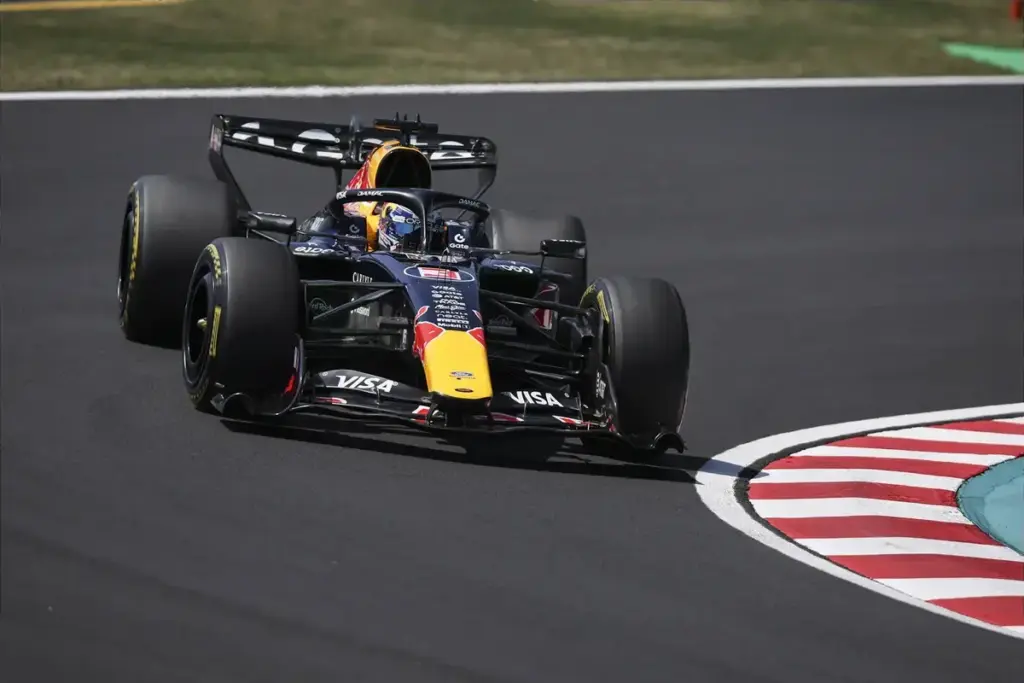

- Red Bull Racing built a race-winning engine. Its car may cost them the season.
- The RB22 sits 30 kg overweight, and ADUO relief may never come for chassis crisis.
- Ferrari will claim ADUO with big engine gap. Red Bull may not get it with smaller one.
Red Bull Racing built its own engine from scratch. It took under five years, a new facility in Milton Keynes, and a small army of engineers poached from across the paddock. And by most accounts, it worked.
Yet after three grands prix of the 2026 season, the team that was so dominant in the ground-effect era sits sixth. The engine, it turns out, is not the problem.
That distinction belongs to the car around it, and that distinction carries consequences far beyond the results board.
Under the FIA’s new ADUO framework, manufacturers with underpowered engines receive extra development slots to close the gap to the front.
But preliminary data suggests Red Bull’s power unit may be competitive enough to disqualify the team from that programme entirely, leaving it without a regulatory rescue for the problem it actually has.
What is ADUO, and why does it matter?
The FIA introduced the ADUO (Additional Development and Upgrade Opportunities) system alongside the sweeping 2026 power unit regulations.
Its purpose was clear: stop a repeat of 2014, when Mercedes’ hybrid advantage was so vast it took rivals four years to mount a real challenge.
The system works in tiers. A manufacturer whose internal combustion engine falls more than 2% below the performance benchmark earns one additional homologation upgrade slot in the qualifying year and another the year after.
Those more than 4% below receive two extra upgrades per year.
Following the Miami Grand Prix, the FIA will calculate average internal combustion engine performance across the first four races of the season.
The governing body then has a two-race window to communicate its findings, with formal confirmation expected around the Monaco Grand Prix weekend.
The ICE power estimates: Red Bull sits dangerously close to the cut-off
Formula Data Analysis, an X account dedicated to technical F1 analysis, published estimates that place Mercedes at approximately 576 hp from its internal combustion engine.
Red Bull Powertrains sits second at around 565 hp, an 11 hp deficit that translates to roughly a 1.9% gap, potentially just short of the 2% threshold required for the first tier of upgrades.
Ferrari sits at an estimated 547 hp, Audi at 545 hp, and Honda at 519 hp. Both Audi and Honda appear comfortably within the range that would earn them two additional upgrades per year.
The picture that emerges is striking. Red Bull may have the second strongest engine on the grid, and the team still finds itself sixth in the constructors’ standings.
This reading matches what Red Bull’s own people are saying privately.
Spanish F1 journalists Antonio Lobato and Jesus Munoz Guerrero reported that Red Bull staff told them the engine is performing very well.
The team believes it could be close to the Mercedes on power unit performance alone. The chassis, the staff acknowledged, has not been good enough.
A quiet detail from Melbourne supports that claim.
Both Racing Bulls, which use the same RBPT engine, set the second and third fastest sector times of the entire Australian Grand Prix weekend in the sector where raw engine output mattered most.
RBPT technical director Ben Hodgkinson did not shy away from confidence on the engine front.
He said he would personally love to scrap homologation entirely and have a direct fight, arguing that the cost cap and dyno hour restrictions already provide enough constraint without the ADUO system adding more.
The chassis is the real crisis
The engine figures tell only part of the story. Even if the power unit is close to the Mercedes benchmark, the RB22 chassis is clearly not.
During qualifying in China, Max Verstappen was nearly a second off pole position. Isack Hadjar was more than a second adrift.
In high-speed corners, rear-end instability is visible to anyone watching, with both Red Bull drivers recording lower apex speeds and an energy recovery system that appears to lose efficiency precisely where it is needed most.
Their straight-line pace is one of the few genuine bright spots, with Verstappen matching Mercedes’ Kimi Antonelli in certain sectors.
Reports place the RB22 at roughly 30 kilograms over the targeted minimum weight of 768 kg. That is a serious handicap.
Technical director Pierre Wache confirmed the team is working on solutions, drawing comparisons to 2022, when Red Bull also began the season overweight before recovering to win the title.
Hadjar has been the most candid voice from inside the garage. After qualifying at Suzuka, he described the engine as good and the power unit side as working well.
Then he paused and said what the numbers already suggested: “It’s just the chassis side is terrible. Just slow in the corners.”
Verstappen’s words from Suzuka were equally blunt. He said the car never turns mid-corner while also suffering from oversteer on entry, and called the whole experience really difficult and unpredictable.
Ferrari’s opposite problem: big engine gap, brilliant chassis
The clearest way to understand Red Bull’s situation is to look at Ferrari from the other direction.
Formula Data Analysis estimates Ferrari’s engine deficit to Mercedes at approximately 29 hp, a significant gap by any measure.
Yet Ferrari sits second in the constructors’ championship, with three podiums from three races and a genuine chance of pushing for the title.
Its chassis is doing what the numbers say the engine cannot.
Antonelli confirmed during the April break that ADUO had already been granted to Ferrari. The FIA has yet to publish a formal list, with the official evaluation taking place after Miami.
But if Ferrari receives additional engine development time. Combined with their brilliant chassis, the competitive implications for everyone else are significant.
Red Bull faces the mirror image of that scenario. Its power unit has delivered. Its chassis has not.
Toto Wolff singled out the RBPT unit as a benchmark during pre-season testing. It was a remark that felt generous at the time and now reads as accurate.
The engine built from nothing in Milton Keynes has caught the attention of the paddock. It just cannot go around corners fast enough.
The ADUO evaluation after Miami will be the first real test of whether the FIA’s safety net does what it was designed to do. For Red Bull, the outcome carries a particular kind of irony.
At Red Bull Racing, the engine department kept its end of the bargain. The season now rests on whether the chassis department can do the same.



Comments.
Loading comments…