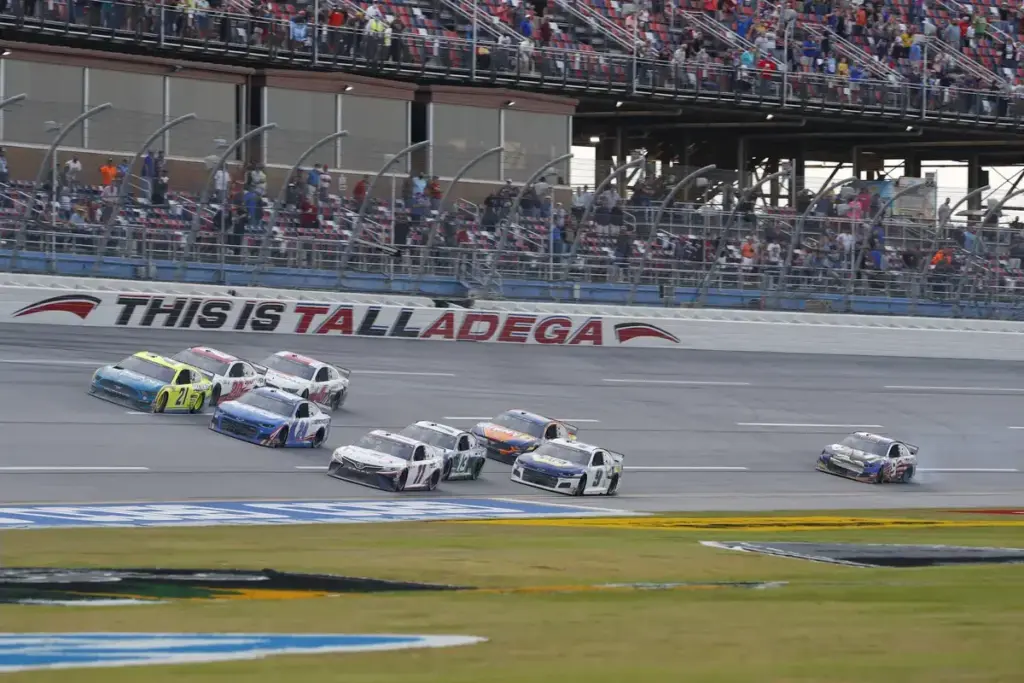

- NASCAR has restructured stage lengths for the upcoming Talladega race.
- Opening segment extended to Lap 98, while the final 2 stages have been shortened.
- NASCAR president suggested future rules could include mandatory 4-tyre pit stops.
Not so long ago, a trip to Talladega Superspeedway was a hair-raising thriller with guaranteed chaos. Cars packed tight at 200 miles an hour, daredevils attempting last-lap moves, and drivers walking the razor’s edge between control and calamity, those elements defined the spirit of superspeedway racing.
That was until NASCAR’s Next-Gen revolution upended the status quo forever.
What was once wild and gutsy has gradually given way to a muted game of conservation, where tire management has replaced attacking runs and fuel strategy has eroded the essence of flat-out racing.
The backlash was swift and unmistakable, coming both from loyal fans and drivers who had long called for a meaningful fix. Now, in a move that feels as much philosophical as it is strategic, NASCAR is stepping in to restore the beating heart of superspeedway racing with what appears to be a sweeping overhaul.
Inside NASCAR’s Talladega reset – What’s changing and why
First off, for the upcoming Cup Series race on April 26 at Talladega, NASCAR has restructured the stage lengths, pushing the opening segment longer before shortening the final two stages to 45 laps each.
A year ago, ‘Dega’ followed a relatively balanced format: 60 laps in each of the opening stages, followed by a longer run to the finish. That blueprint has now been decisively reworked. In a bold move, NASCAR has reshaped the stage structure, extending the opening segment to Lap 98 before trimming the final two stages to conclude on Laps 143 and 188, respectively.
In effect, by stretching the opening stage and tightening the closing runs, NASCAR is effectively eliminating the need for fuel-saving in the final portions of the race. By ensuring the final two stages can theoretically be completed without a fuel stop, NASCAR is encouraging drivers/teams to push and not conserve.
That said, it doesn’t completely erase strategy from the equation. Stage 2, in particular, could still present opportunities for teams to gamble or position themselves differently. But the broader goal is to shift the emphasis back toward track position, drafting partners, and above all, execution.
This change also reflects a deeper issue tied to the Next Gen car introduced in 2022. Earlier this year, after Daytona, NASCAR executive vice president John Probst explained that the sanctioning body has been working closely with teams to tackle the issue from two fronts.
He divulged that while one focuses on competition-related adjustments, such as stage lengths and pit road rules, the other focuses on technical changes, including horsepower, spoilers, and the car’s overall dynamics.
Daytona to host the return of the “Preseason Thunder” test
Probst noted that superspeedway races have traditionally followed a pattern – two stages followed by a long run to the chequered, and this time, with the revised structure, the sanctioning body is expecting major shifts – “We think that if there are some that do it on two, they may drag the group that would try to do it on one stop. So it’s got some potential for some pretty interesting strategies.”
Still, NASCAR is under no illusion that this change alone will solve everything. As Probst acknowledged, organizations will continue to push for gains wherever they can. But for now, though, the focus is on limiting the issue while a broader, more permanent solution takes shape.
That longer-term effort will include a nod to the past. Daytona International Speedway is set to host the return of the “Preseason Thunder” test ahead of the 2027 season.
The session is expected to evaluate potential changes to the cars themselves, ranging from power levels to aerodynamic configurations, to reduce reliance on fuel conservation and return superspeedway racing to its aggressive roots.
Steve O’Donnell hints at bigger changes ahead
Speaking on the Door Bumper Clear podcast, NASCAR president Steve O’Donnell offered a glimpse into what could come next. “We’re not looking at it this year, but for next year, four tires that you got to take with fuel, whatever,” O’Donnell said. “We’re looking at a lot of those things.”
However, surprisingly, when asked if he was leaning on the new tweak to completely fix the issue, the NASCAR head honcho gave a measured take.
“Spot off! It’s a small step,” he said during the podcast’s Spot on/Spot off segment. “I don’t want fans to think that’s a game-changer. The strategy, it’s fascinating how much it has changed, so it’s on us to kind of keep going. We had a certain mentality of how you do, and now it’s totally flipped because we want to try something new. But I don’t want fans thinking that that’s the be-all end-all.”
Currently, teams can minimize time on pit road by taking only the fuel they need, sometimes at the expense of tires. That flexibility has been a key component of fuel-saving strategies. But if four tires are made mandatory at every fuel stop, the calculus changes entirely.
With the Next Gen car, a four-tire stop takes roughly nine to ten seconds, long enough to make pit road a more significant factor in race outcomes. More importantly, it reduces the incentive to artificially stretch fuel windows, because every stop incurs a fixed time cost regardless of strategy. In other words, it levels the playing field.
Talladega overhaul is step in the right direction
Instead of teams gaming the system through partial stops or fuel-only calls, everyone operates under the same constraints. Thus, shifting the focus back to on-track performance rather than pit-road optimization.
But most importantly, O’Donnell’s comments also underscore NASCAR’s willingness to explore multiple avenues to fix the problem. What’s notable is the tone. There’s no sense of panic, but rather urgency, and NASCAR understands the significance of superspeedway racing in the sport.
For drivers, the changes could come as a welcome shift. Many, including Denny Hamlin, have voiced frustration in recent years about being forced to run below full throttle for extended stretches, particularly at tracks where momentum and aggression are meant to define the outcome.
For fans, the Talladega overhaul signals a step in the right direction amid growing calls to curb fuel-saving tactics. Whether it delivers the intended impact on the first attempt remains to be seen, but for now, it offers a renewed sense of intent.


Comments.
Loading comments…