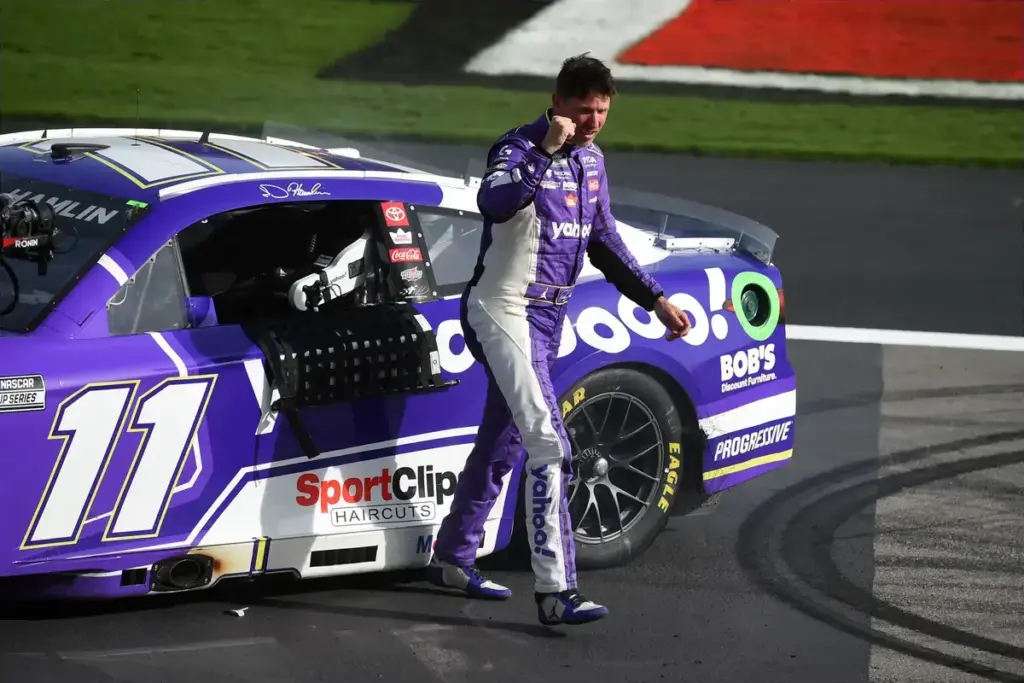

- Denny Hamlin says NASCAR’s parity has laid drivers bare.
- With cars running at similar speeds, driver ability has come into focus.
- Crew chiefs make the strategic calls, but it’s still on driver to execute them.
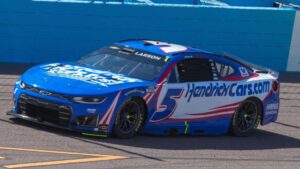
Several veterans have found the going tough in the Next Gen era, among them Kyle Busch and Brad Keselowski. Denny Hamlin, cut from the same cloth, however, has somehow managed to keep his head above water.
Busch and Keselowski have pointed to less practice time and the shift to a car that behaves more like Supercars as reasons for the slide. Hamlin, though, sees it through a different lens. To him, parity has pulled the curtain back on drivers.
Hamlin argues that the Next Gen car has brought driver skill into sharp focus
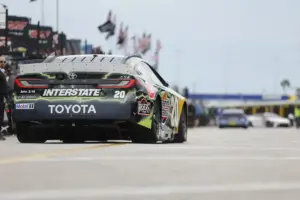
With NASCAR introducing parity across the grid, passing has become a task, and drivers have sounded off on that front. In the past, teams built their own cars and chased gains through parts that gave them an edge. Bigger outfits could stack the deck and control races.
Now, a single-source supply chain has leveled the field, with teams buying parts from approved vendors. The result is a pack running nose to tail, with speed and cost brought into line.
Looking back, Hamlin pointed to a time between 2022 and 2023 when the Next Gen car was still a moving target, and some teams struck gold, including Trackhouse Racing, with Busch winning three races in the 2023 season. “That’s when Track House was hauling a**, and there were just always like these isolated teams that would pop up and like dominate the weekend.”
But those gaps have since closed as the data is out, setups have converged, and the field has bunched up. As he put it, “Everything is coming out in the wash, it’s you’re seeing these cars running closer together. Look at any of the statistics of where the dispersion of dots were on lap times in 2022 at any particular track.”
“And look at that same track today in 2026. The whole field went from spread like this to like this. Everyone’s so close now. So as a driver, you got to make up the difference. You are the difference maker. You’re the one that sends the teams in the direction.”
In Hamlin’s view, when the cars are this close, the limelight swings to the person behind the wheel. There is no place to hide behind setup calls or lean on a car to bail them out. If the pace is not there, the finger points at the driver. That is where it bites, because each mistake, each missed apex, and each call that comes up short shows up on the stopwatch.
Hamlin even broke it down in numbers, narrating how a team might start the truck with a car at 50% of what it needs to win. On other days, it may start near 37% and work it to 45% with overnight changes. That looks like a step forward, but in a field this tight, it still leaves ground to make up. The driver is only a touch closer to the mark.
That is the struggle of this era. A team can tick many boxes and still not get near a win, because rivals are doing much the same, only a shade better. The days when a top team could bank on running the show each weekend are gone.
In earlier times, a car with pace could mask a driver’s slip. A missed corner could be clawed back with speed. Now there is no safety net. When a driver misses by a fraction, they lose several spots because the car behind is turning a lap in the blink of an eye. Passing has gotten harder, which is why drivers are more exposed.
With passing at a premium, track position rules the roost. Drivers earn it through execution. Pit entry and exit, marks hit or missed, restarts, lane choice, tire care, and moves in traffic, everything counts. Strategy may call for two tires or four, but the driver must make it pay. If a driver botched the restart, missed the brake, or failed to hold the line, the call that looked right on paper would go up in smoke.
There is no leaning on a faster car to patch over errors, and there are no easy passes to claw back losses.
Comments.
Loading comments…