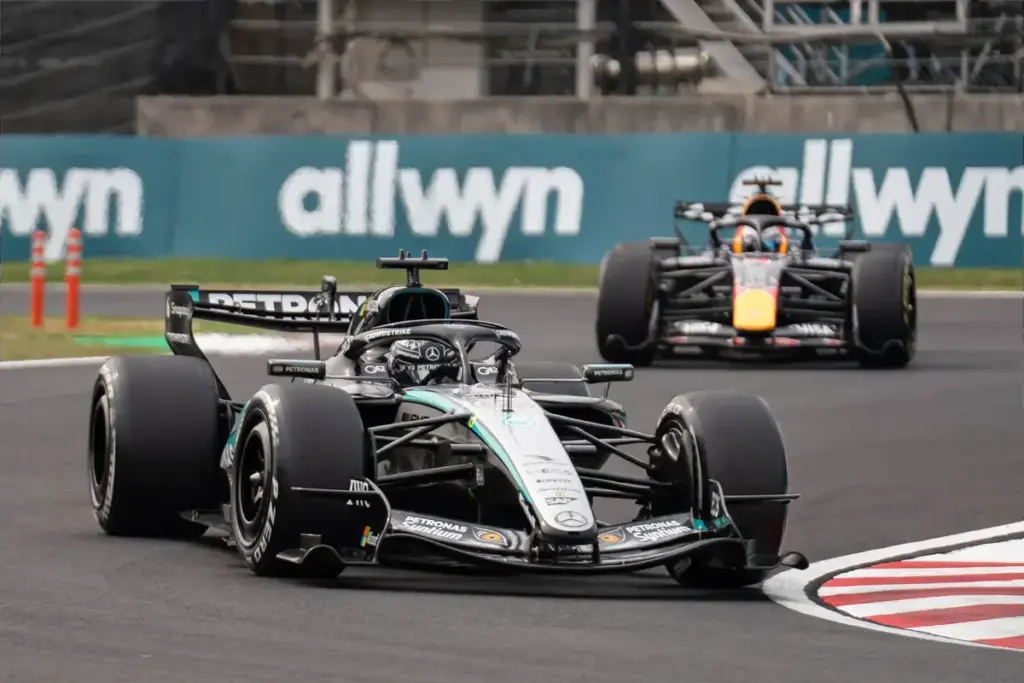

- FIA bans Mercedes & Red Bull trick that stretched MGU-K power beyond legal limit.
- Emergency shutdown clause, built for safety, became a qualifying weapon.
- Ferrari pushed FIA for answers, and they responded by closing the loophole.
The FIA has outlawed a software trick that allowed Mercedes and Red Bull to extract extra power at the end of qualifying laps in the 2026 F1 season.
The governing body acted after rivals raised concerns about both the fairness and the safety of the technique. Updated technical documents have since been sent to all teams. It makes clear that the shutdown mode must only be used in genuine emergencies.
What was the trick, and how did it work?
Every F1 power unit in 2026 runs an MGU-K. It’s the electric motor at the centre of the hybrid system, which delivers up to 350 kilowatts of power.
When deployment ends on a straight, the rules require teams to reduce that output step by step, dropping 50 kilowatts every second.
The idea is to avoid a sudden loss of power. You could compare it to walking slowly down a staircase rather than jumping off the landing.
Mercedes and Red Bull found a way around that staircase entirely. Instead of stepping down gradually, their cars could cut from full 350-kilowatt deployment to zero in one move right before the timing line.
The result was that both teams held maximum MGU-K power for longer than their rivals on a qualifying lap.
The mechanism they used was a software provision originally written into the rules for safety purposes.
It allowed engineers to shut the MGU-K down immediately if a problem was detected, protecting the power unit from damage.
Nobody wrote that clause into the rulebook, imagining it would one day become a lap time tool.
The 60-second lockout, and why qualifying was the loophole
The FIA had already tried to blunt this approach before it became a problem.
It introduced what is known as a “continuous offset” mode, which locks the MGU-K out of use for 60 seconds after a driver triggers the shutdown. In a race, that penalty is severe.
Losing 350 kilowatts of electric power for a full minute would cost a driver several positions on track.
But qualifying operates by different rules. After a flying lap, a driver does not need full MGU-K deployment on the slow-down lap back to the pits.
Speed is irrelevant once the car crosses the timing line. So, triggering the shutdown right before that line brought all the gain and none of the pain.
The advantage was not enormous. Estimates suggest the trick gave affected teams somewhere between 50 and 100 kilowatts of extra power for a brief window, worth fractions of a second.
But in a sport where tenths can separate the front row from the third row, hundredths still matter on the grid.
Ferrari’s frustration and its approach to the FIA
Rivals first noticed the trick at the F1 Australian Grand Prix, but it took an incident in Japan to push the matter into the open.
Williams driver Alex Albon, running a Mercedes power unit, stopped on track during practice at Suzuka after his car suffered the same MGU-K lockout. He could not continue the session.
That moment gave Ferrari a reason to act.
The Scuderia approached the FIA not to demand an instant ban, but to ask a pointed question: how could an emergency safety provision legally become a qualifying performance tool?
Ferrari wanted an answer, and it wanted to know whether the FIA intended to prohibit the technique on safety grounds.
The frustration in Maranello ran deeper than principle alone.
With Mercedes shaping up as Ferrari’s main title rival in 2026, the ability to match or beat George Russell and Kimi Antonelli in qualifying carries real championship weight.
This dispute also sat within a wider pattern of friction between Ferrari and Mercedes over the interpretation of the 2026 F1 power unit rules, including earlier disagreements over compression ratios and the start procedure.
Mercedes steps back, then the FIA steps in
Mercedes made its own calculation in Japan. After the problems Antonelli experienced in practice, and following conversations with the FIA, the team switched the system off for the rest of the weekend.
The gain at Suzuka was smaller than it would be at other circuits because the run from the final chicane to the timing line is short. The risk, Mercedes decided, was not worth it.
The reasoning inside the team was clear. The MGU-K trick was not the reason Mercedes had the fastest engine on the grid.
If it carried a genuine risk of uncontrolled shutdowns, it was not a tool worth keeping.
The FIA did not wait for teams to reach the same conclusion on their own. In response to concerns from multiple parties, it sent updated technical documents to every team and effectively closed the loophole.
The “continuous offset” function, the FIA stated, exists for emergencies only. Using it deliberately to extend maximum power output at the end of a qualifying lap is no longer permitted.
According to The Race, FIA also made clear it will monitor data from the end of qualifying runs to verify that any MGU-K shutdown reflects a genuine problem rather than a performance decision.
For Ferrari and other manufacturers who did not run the trick, replicating it in their own software would not have been straightforward either.
Building it in without triggering the same crippling power loss would have taken time, particularly for teams that only became aware of the technique once the Australian Grand Prix had already happened.
The ban removes that burden entirely.
The 2026 F1 regulations are among the most complex Formula 1 has ever introduced.
This episode serves as an early signal that the FIA intends to police them according to their original purpose, not according to the most inventive reading a team of engineers can construct over a race weekend.



Comments.
Loading comments…