- Formula 1 veteran David Coulthard wants energy harvesting banned at Eau Rouge.
- Bearman’s 50G crash at Suzuka turned a paddock debate into urgent safety crisis.
- Coulthard has a fix, but the clock is ticking before Spa.
Former Formula 1 driver David Coulthard wants the sport to ban energy harvesting at certain corners, including the famous Eau Rouge at Spa-Francorchamps.
He made the proposal on the Up To Speed podcast, arguing that the speed differences created by the 2026 regulations are too dangerous at blind, high-speed sections of track.
Coulthard, who won 13 Grands Prix during his career, warned that drivers simply cannot react in time when a car ahead is harvesting energy and slowing sharply.
The problem hiding inside the new rules
Formula 1’s 2026 overhaul was built on ambition.
The new rules split power almost equally between the combustion engine and an electric motor, while also introducing smaller cars and active aerodynamics in place of the old DRS system.
The sport wanted more action and a cleaner, modern image. What it got, alongside all of that, was a hidden danger.
When a car runs low on stored electrical energy, it slows abruptly. The driver behind may be travelling at full speed, boosted by a fully charged battery, with no warning of what is coming. That gap closes in an instant.
A crash that made the danger real
At the Japanese Grand Prix in Suzuka, the theoretical became terrifyingly physical. Oliver Bearman was running about a second behind Franco Colapinto when the gap vanished.
Colapinto’s car was harvesting energy through the Spoon corner, bleeding speed. Bearman was arriving at full electrical boost.
The closing speed between the two cars reached roughly 50km/h. At over 300km/h, Bearman had no time to respond cleanly. He went sideways across the grass and into the barrier. The impact registered 50G.
Colapinto, who had no control over what his car was doing in that moment, was shaken.
“I’m glad he’s fine, to be honest,” he said afterwards. “It was a really big one. I saw him spinning on the grass, and then I knew it was a very hard hit.”
Haas team principal Ayao Komatsu left no room for ambiguity.
“Safety should always be at the top of the list,” he said. “We’ve been talking about closing speed, and then this accident happened. For sure, nobody’s going to ignore it.”
Bearman walked away. The sport was fortunate. But the crash was a warning, not an accident to file away and forget.
Coulthard’s proposal: a corner-by-corner fix
Coulthard did not call for the 2026 Formula 1 rules to be scrapped. Instead, he proposed something more precise: identify the corners where the new dynamics are most dangerous and exempt them from energy harvesting altogether.
Eau Rouge at Spa-Francorchamps is the corner he named first. The famous left-right-left complex sweeps uphill at very high speed.
Drivers commit to their line before they can see over the crest. For decades, that blind commitment has been part of what makes the corner special.
Under the 2026 rules, it has become something else too: a place where a harvesting car ahead could be travelling far more slowly than the driver behind expects, with the crest hiding the danger until it is too late.
“There are certain corners that almost should be exempt from being able to harness,” Coulthard said via comments shared on X.
“Because you’re just so used to them. Like up through Eau Rouge in Belgium. One of the most iconic corners in the world, there are points where you cannot see as you go over the rise if there’s a car on the other side. So it should be exempt from being able to harness.”
He then put a number on the risk.
“With a closing speed of 30/40 miles an hour, that’s just very dangerous,” he said. Thirty to 40 miles per hour converts to roughly 50 to 65km/h.
At Eau Rouge, at the speeds cars carry through there, a driver would have almost no time to act.
More than safety: what the racing has become
Coulthard’s worry is not only about crashes. It is also about what the racing has turned into.
The 2026 season’s opening three rounds produced 149 recorded overtaking moves, more than double the 63 passes seen at the same circuits in 2025.
On paper, that looks like progress. In practice, Coulthard is not convinced those numbers tell the right story.
“It’s not about how many overtakes,” he said. “It’s the sense of watching something world-class and spectacular… You just can’t defend against the indefendable.”
The frustration is about what the passes actually mean. When a car deploys its battery on a straight, the car in front has no answer.
The overtake happens because the physics of the situation demands it, not because a driver found a way through. That distinction matters to Coulthard, and to others in the paddock who see driver skill being slowly crowded out.
Qualifying has not escaped the criticism either. Drivers now have to manage their energy harvest during a lap rather than simply pushing the car to its absolute limit from start to finish.
“I want to see a qualifying lap that makes me go, ‘Wow’,” Coulthard said. “Human being and car on the edge of adhesion everywhere. Not on a fantastic harnessing and deployment lap.”
A sport still finding its footing
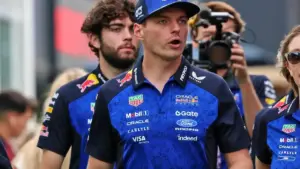
Max Verstappen has been among the loudest voices against the direction the new rules have taken the sport.
He had raised concerns about this exact issue as far back as 2023, and his displeasure has only grown as the season has played out.
The worry now is that Spa could produce something worse than Suzuka. The circuit is faster. The blind sections are more exposed.
The consequences of a 50G impact at Eau Rouge, rather than at Spoon, are difficult to think about calmly.
Formula 1 has scheduled review meetings in April. The Bearman crash will be part of those discussions. So, presumably, will proposals like Coulthard’s.
His idea does not ask the sport to abandon what the 2026 rules were built to achieve. It asks the sport to draw a line around the places where the risks run too high.
Keep the new era, but protect the corners that drivers have always raced on instinct, trust and muscle memory, corners that leave no margin for the unexpected.
Whether the sport acts on that before Spa is the question the paddock now has to answer.