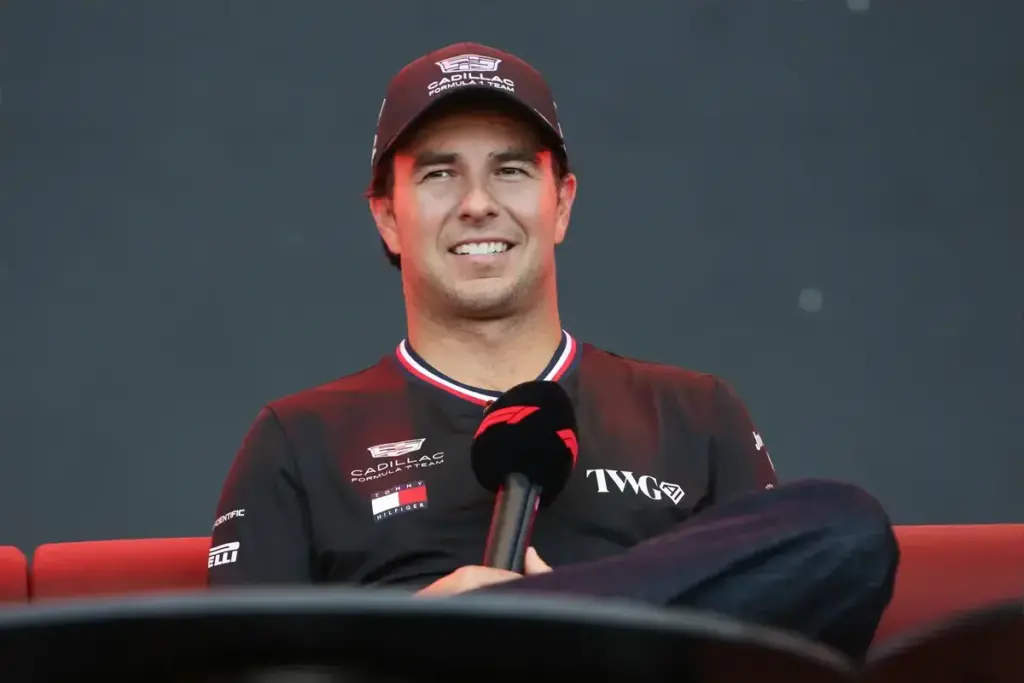

The debate over Formula 1’s new 2026 rules grew louder Thursday in Shanghai when Sergio Perez openly criticised the racing style created by the new regulations. Speaking to reporters ahead of the Chinese Grand Prix, the Cadillac driver said the action during the season opener in Melbourne felt “fake” and compared it to the video game Mario Kart.
Perez made the remarks during Thursday’s media duties, reflecting on the Australian Grand Prix that launched the new era of power units. The Mexican driver said the system of push-button boost modes and fluctuating battery levels created racing that did not feel natural.
“I found it very fake, to be honest,” Perez said via GPBlog. “Yeah, [it’s all] just on a button. You overtake, and then you get overtaken.”
His criticism adds to a growing list of drivers and racing figures questioning whether the new rules improve the sport or move it closer to entertainment than competition.
A tough debut for Cadillac in Melbourne
Perez’s comments followed a difficult first race with Cadillac at Melbourne’s Albert Park circuit. He finished P16 among the drivers who crossed the line after a race that saw frequent position changes and heavy use of the new boost system.
Early in the race, Perez fought closely with Racing Bulls driver Liam Lawson. The battle showed how quickly positions could change under the new system, where drivers gain or lose speed depending on battery charge.
By Thursday in Shanghai, Perez said the constant overtaking did not feel authentic. He pointed to the way drivers repeatedly passed each other with the push of a button.
That dynamic led Perez to call the racing “Mario Kart style,” a blunt assessment from a driver who has spent years fighting near the front of the grid.
Sergio Perez not alone in relating F1 to a video game
Perez is not the only driver who has compared the new racing to a video game. During the Australian Grand Prix, Ferrari driver Charles Leclerc made a similar remark while battling George Russell for the lead.
Over team radio, Leclerc joked, “This is like the mushroom in Mario Kart,” referring to the boost feature used in the game to gain speed.
Perez had hinted at the comparison even before the race began. During the pre-race grid walk with Sky Sports F1’s Martin Brundle, he smiled and said, “Let’s see what happens in this video game race.”
Several drivers shared the same frustration after the weekend. Four-time world champion Max Verstappen said he was “not enjoying it at all” after crashing in qualifying. He added that the experience felt emotionally empty, no matter where he started on the grid.
Reigning champion Lando Norris also spoke bluntly in Melbourne. He said Formula 1 had gone “from the best cars ever made in Formula 1, and the nicest to drive, to probably the worst.”
Haas driver Oliver Bearman said the cars felt less enjoyable to drive because of constant battery management during a lap.
The criticism has spread beyond the Formula 1 paddock. NASCAR veteran Kevin Harvick described the Australian race as “one of the most awkward races” he had watched and said it “kind of looked like Mario Kart.” NASCAR analyst and part-time driver Parker Kligerman also criticised the changes and called them a “betrayal” to fans.
What is driving the discontent?
Much of the concern centres on the design of the new 2026 power units. The rules created a near 50-50 split between internal combustion power and electrical energy.
Drivers can now activate electric boost modes throughout the race. This differs from the old drag reduction system, which only worked in set zones and when a car was within one second of the car ahead.
Alpine driver Pierre Gasly said this shift has changed the nature of overtaking. He told reporters that racing now involves far more than driving.
“There’s just way more than just driving going on,” Gasly said via ESPN. He pointed to the constant need to manage battery levels across straights and corners.
Formula 1 highlighted that the Australian Grand Prix produced 120 overtakes, compared with 45 during the 2025 season opener. However, the series did not reveal how many of those passes relied on the new boost system rather than pure driving skill.
Perez doubts a quick fix
Perez said it may be hard for Formula 1 to change the rules quickly. Teams that currently benefit from the system may resist adjustments.
The sport is expected to review the new regulations after the Chinese Grand Prix weekend. Still, Perez warned that reaching an agreement across teams could take time.
He also stressed that drivers still matter in the new cars, even with the heavy focus on energy management.
“Of course, at the end of the day, also the driver can do the difference,” Perez said. “It’s very early days on these rules, but it takes time.”
Even so, Perez made clear he did not enjoy what he saw in Melbourne.
“What we saw in Melbourne, me talking as a fan, I didn’t like it,” he said. “I think what we currently have is not good for anyone.”
Some leaders inside the paddock urge patience. McLaren CEO Zak Brown, Mercedes team principal Toto Wolff and Ferrari boss Fred Vasseur have all said the sport should wait for more races before judging the new rules.
Race winner George Russell echoed that view. He cautioned against drawing strong conclusions after just one race weekend.
Still, the debate now reaches beyond performance or technology. The new rules have forced Formula 1 to confront a deeper question about its identity: whether the series should remain a pure sporting contest or lean further toward spectacle.
For now, as the Chinese Grand Prix weekend unfolds, voices like Sergio Perez continue to push that question to the centre of the sport.

Comments.
Loading comments…