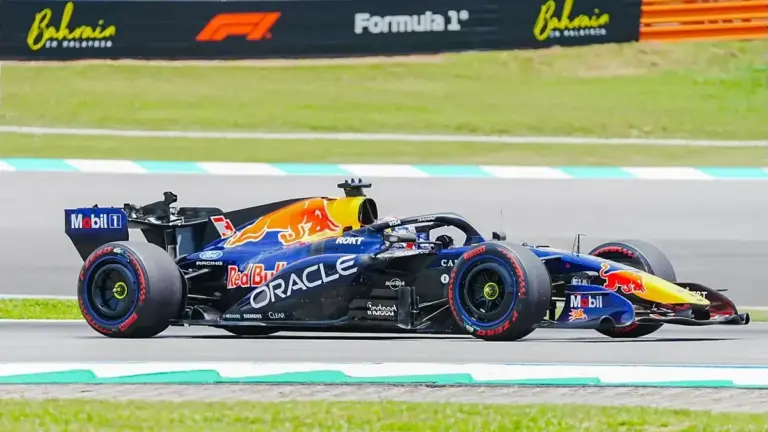
The Ferrari SF-26 arrived at the 2026 pre-season test in Bahrain International Circuit with two striking ideas at the rear of the car.
One was easy to spot: an unusual upside-down rear wing flap. The other was smaller and far more important: a new aerodynamic device around the exhaust and rear crash structure that rivals will likely be unable to copy.
Ferrari first ran the SF-26 in a basic form during earlier testing at Circuit de Barcelona‑Catalunya. The team focused on checking the new power unit and confirming that the chassis behaved as expected. The most aggressive aerodynamic ideas stayed hidden until the second week of testing in Bahrain.
Reports by Autoracer Italy say the change from Barcelona to Bahrain showed a clear design plan. Ferrari kept the front wing simple and stable. The real work happens at the rear of the car, where the diffuser and surrounding bodywork control most of the airflow balance.
That strategy produced the SF-26’s most important innovation: the exhaust wing.
What exactly is Ferrari’s innovative exhaust wing?
The new wing sits around the rear crash structure and behind the exhaust outlet. According to reporting by The Race, Ferrari needed a long approval process with the FIA before running the design.
Its job is simple but important. The device helps clean up the airflow leaving the diffuser after it mixes with hot exhaust gases.
Formula 1 technical contributor Mark Hughes describes it as a “flow-turning device.” It sits near the bottom of the rear wing assembly, roughly square in shape and sharply angled upward. The part appears to guide the exhaust stream toward the underside of the rear wing’s main plane.
At the same time, the device energises airflow exiting the centre of the diffuser. This helps the air leave the car in a more stable and controlled stream.
Autoracer Italy explains that the element does not aim to produce direct downforce. Instead, it reshapes the pressure field above the diffuser exit. That makes airflow extraction smoother and reduces the risk that hot exhaust gases disturb the main airflow.
The result is what the publication calls an aerodynamic “reordering” of the air leaving the rear of the car. In the current rules, which ban beam wings but still require teams to run rear rake, control of this area has become more valuable than before.
Exhaust-blown wings appeared on Formula 1 cars during the early 2010s. Later rule changes effectively removed the idea by tightening bodywork dimensions. The 2026 regulations reopened a small design window, and Ferrari moved quickly to use it.
The regulatory architecture that made it possible
The idea works only because Ferrari built the entire rear of the SF-26 around it.
The rules place strict limits on bodywork in the lower rear section of the car. According to Mark Hughes, teams can extend bodywork no more than 6 cm behind the driveshafts.
On most cars, that space still sits inside the diffuser area. Ferrari changed that geometry.
The team pushed the differential to the farthest rearward position allowed by the rules. Article 9.5.1 of the Formula 1 technical regulations allows teams to move the differential up to 60 mm forward or backwards along the car’s X-axis. Ferrari chose the full 60 mm rearward offset, as reported by The Race.
That decision pushed the crash structure farther back. It also created a small aerodynamic pocket behind the diffuser. Ferrari filled that space with the exhaust wing bodywork.
Another rule update helped. In December, the FIA expanded the allowed bodywork volume in this area, especially in the vertical direction. According to Autoracer Italy, Ferrari’s aerodynamic group, led by Diego Tondi, used that extra space to extend the diffuser upward until it nearly covers the exhaust outlet.
Ferrari followed the rule changes closely. By the time testing began, the team had already built the new geometry into the SF-26.
Why is it so difficult to copy?
Rival teams cannot add a similar device with a simple bodywork upgrade. The exhaust wing depends on deep mechanical choices inside the car.
The SF-26 uses sharply angled driveshafts to create space behind the diffuser. That design must work with constant velocity joints, which connect the gearbox, differential and driveshafts. These parts must rotate smoothly while the suspension moves.
Angling the driveshafts increases mechanical stress and vibration risk. Engineers must redesign linkages and housings to keep the system reliable.
Ferrari also built a narrow gearbox casing to fit the differential in its rearward position without expanding the diffuser tunnel. That packaging challenge affects the whole transmission layout.
To copy the concept, a rival team would need to redesign the gearbox, move the differential, change driveshaft angles and rebuild the surrounding suspension and bodywork. Those changes would require a new transmission design and months of development.
In practical terms, it means building a different car.
The story of the Ferrari SF-26 shows how modern Formula 1 innovation works. The visible wing behind the exhaust is only the final piece. The real idea lies deeper in the car: inside the gearbox casing, the driveshaft angles and the exact position of the differential.
Ferrari tied those choices together long before testing began. Rivals can photograph the device all they want. Rebuilding their cars to match it, however, is an entirely different story.