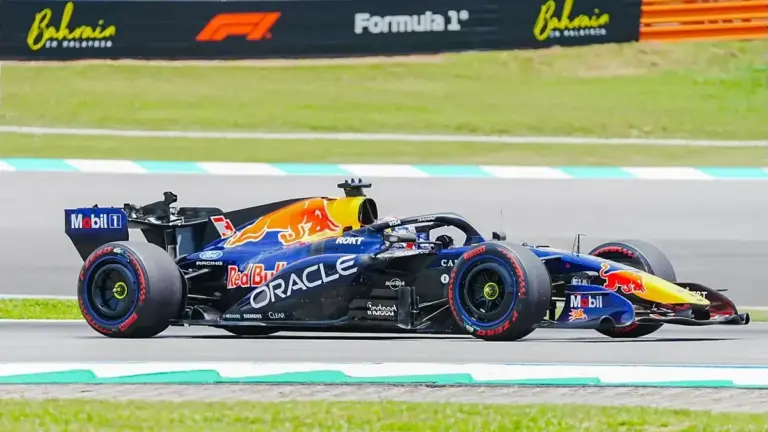
Valtteri Bottas says Cadillac have slashed front brake temperatures on the MAC-26 by roughly 100°C, after the team introduced new cooling duct upgrades at the Azerbaijan Grand Prix. The fix targets the overheating problem that has dogged Cadillac’s debut season and forced retirements for both of its drivers.
“Good, we’ve reduced about 100 degrees of brake temperature, based on numbers from the previous spec, so that gives us more margin, for sure,” Bottas told Motorsport.com. The Finn’s comparison with the earlier specification underlines how severe the issue had become before Baku.
Bottas and Perez Confirm Technical Gains and Overheating History
Brake overheating on the MAC-26 cost Cadillac dearly through the middle of the season. Bottas retired from races in Monaco, Austria and Hungary after his front brakes ran too hot, while Sergio Perez suffered the same fate at the Red Bull Ring. For a team already finding its feet in Formula 1, three retirements tied to one recurring fault was a hard problem to ignore.
The improvement in Baku gives Bottas more confidence that Cadillac’s engineers have finally got on top of it. Perez, meanwhile, pointed to gains elsewhere on the car too. Describing Ferrari’s latest power unit upgrade, he called the step “just a tenth and a half,” adding it was “not quite the step we needed, but everything counts.” Small margins matter for a team still building its package from scratch.
Perez Praises Engineering Recruitment and Impact of Craig Skinner
Cadillac’s progress has coincided with fresh technical recruitment, including the signing of the technical trio of Craig Skinner, Eric Blandin and Tim Lean. Skinner joins as chief development engineer, Blandin as head of aerodynamics and Lean as chief engineer for aerodynamics modelling and simulation.
Perez called the appointments a clear signal of intent. “The team is showing how serious they are and how committed they are into Formula 1,” he said. He went further on what the trio can offer: “They are great hires, they are people that are really going to push our team forward. Don’t forget that it’s just our first season, so this car is very basic, so I have a big hope on next year that we will definitely be moving forward.”
Perez has first hand experience of Skinner’s work from their time together at Red Bull. “With Craig I’ve worked and he was really good in the Red Bull organisation, he was very important there. Actually he made a very big difference with my floor; I remember coming into Baku when we were struggling with the entry stability, he figured out a packer into the floor, and it transformed my balance and my car. Unfortunately the floor was destroyed after the race with the crash of Carlos [Sainz], and I never got to race it again, but it was a really good step, so he’s someone that is really good and understands what are my needs,” Perez said.
Cadillac Engineering Timeline and Upcoming Circuit Expectations
The brake fix did not appear overnight. Cadillac first revised the inlet scoop and aperture surfaces on the MAC-26 at the Hungaroring, then carried that work through into fully upgraded cooling inlet and exit duct profiles for Baku. That step by step approach, built on real data from each race weekend, is what finally brought the Cadillac F1 brake temperatures down to a manageable level.
Perez is wary of reading too much into one strong weekend, especially with tracks on the horizon that have previously exposed the car’s limits. Asked about the run to Sepang, he admitted, “I’m not looking forward to Malaysia,” before adding, “I think we will be back to our reality.” It is a reminder that Cadillac’s gains, while real, still sit alongside the wider challenges of its split factory structure and a first season car that Perez himself describes as basic.