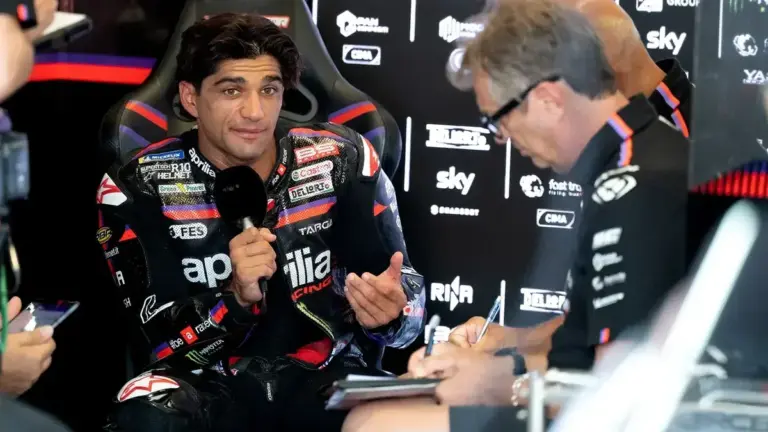
Pedro Acosta has spent this MotoGP season doing something few expected from a rider only in his second year in the class: making the KTM RC16 look faster than it has any right to be. Watch him through a corner and the reason becomes obvious. His braking points, his lines, even his body position are unlike anyone else’s on the bike. Understanding Pedro Acosta’s riding style is the key to understanding why he, rather than his more experienced stablemates, has become KTM’s benchmark rider.
The Evolution of Pedro Acosta’s Unique Approach
That benchmark status was confirmed in spectacular fashion at Spielberg, KTM’s home race, where Acosta claimed his maiden MotoGP victory. It arrived on the back of a run of strong finishes: third in the grand prix at Austin, second in the sprint at Barcelona, and both a sprint and grand prix runner up spot in Hungary. He added further podiums at Aragon and Misano, finishing second and third respectively.
As our earlier report from Spielberg made clear, that run of results has put Acosta firmly ahead of his teammates on the same machinery. What makes it striking is that he is getting there by a route the others simply do not use.
Dissecting the Late Braking and Early Turn-in Data
KTM technical director Sebastian Risse has watched this style develop up close, and he is in no doubt about what sets it apart. “Pedro has traditionally had quite a special riding style,” Risse said, before breaking down exactly what that means on track.
“On the one hand, he brakes hard and late, without losing rear-wheel contact [with the ground]. On the other hand, it is precisely that early turn-in, which classically is not actually the right racing line. But he manages to bend the bike around the corner that way. That allows him to attack easily and makes him hard to attack. Even so, he does not lose at the next corner exit what you would expect if someone else tried it like that. But you can also see that his riding style has recently become significantly smoother and more controlled. That also means he controls himself in that area and uses it when it is enough to give him an advantage, but it is no longer so much a limitation that he cannot do it any other way.”
In short, Acosta brakes deep into the corner without unsettling the rear tyre, then turns in earlier than the textbook line would suggest. On paper that looks like a mistake waiting to happen. In practice, it lets him carry that early angle through the apex and fire out of the corner without paying the price most riders would for such an unconventional entry.
Expert Dissection of Acosta’s Smoother Technique
Asked whether the data actually shows this approach has changed since his 2024 debut season, Risse did not hesitate. “Definitely, absolutely,” he said. The numbers back up what is visible from the pit wall: a rider who once relied on raw commitment now has more control over when to use it.
Acosta himself agrees. “I would say yes. It is true that my lines are still a bit tighter than the others’, but not as extreme as they once were,” he said, reflecting on how far he has come since his rookie year.
He is equally candid about the physical side of that change. “And if you look at my body position, I also think I am riding much more smoothly than before. Even so, sometimes the old Pedro still comes through and ruins everything. But in 90 percent of situations this season I have really tried to stay much calmer than in the past. And so far it seems to be paying off.”
That refinement of Pedro Acosta’s riding style has not diluted what makes him quick. It has simply made it repeatable, race after race, rather than something he can only summon once a weekend.
Why Other Riders Struggle to Replicate the RC16 Line
The obvious question inside the KTM garage is why his style has not simply been copied by the other riders on the same bike. Risse’s answer is blunt: it is not for lack of trying. “The other riders see that,” he said of Acosta’s approach on track.
The attempts to imitate it have not gone smoothly. “In some cases they then also had the feeling: ‘Hey, this is now the only way to be fast on the bike. But it does not work for me. I cannot do that.'”
A riding style like this comes from instinct and feel built up over years, not from a checklist that any rider can simply borrow. For a fuller breakdown of the mechanics behind it, Sebastian Risse’s analysis of Acosta spells out just how specific that combination of bravery and control has to be. Acosta has found a version of it that works on the RC16. So far, nobody else at KTM has managed to make it their own.