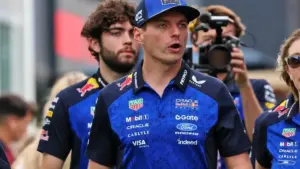
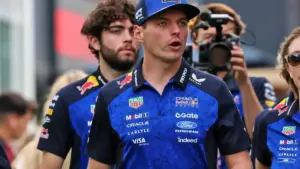
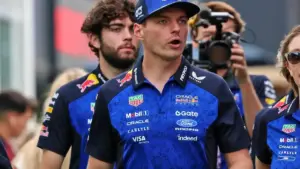
Red Bull’s decision not to swap Max Verstappen and Isack Hadjar in the closing laps of the Azerbaijan Grand Prix might have looked strange from the grandstands. Hadjar was quicker at that point and had the tyre advantage to prove it. Yet the Jacques Villeneuve Red Bull team orders verdict, delivered live on Sky Sports F1, settled the argument before it really got going. “It was perfect,” the 1997 world champion said, and the numbers from the final stint back him up.
Red Bull Stand Firm Under Baku Pressure
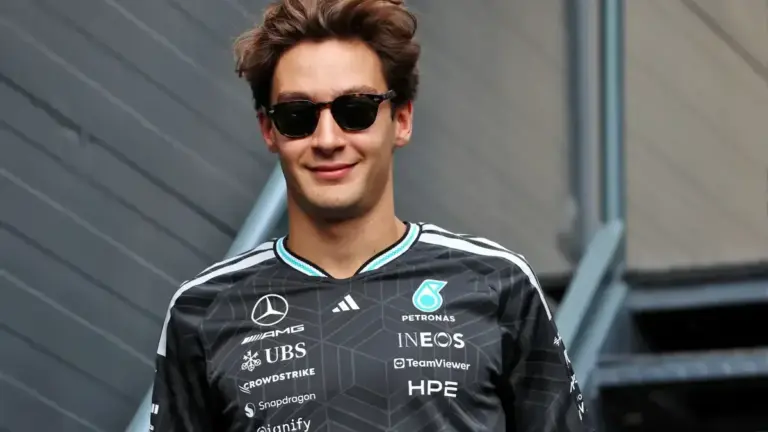
Verstappen crossed the line second in Baku, agonisingly close behind race winner George Russell. Hadjar came home third, a brilliant return after six weeks out with a wrist injury. Neither result happens if Red Bull pulls Verstappen aside to let his teammate through.
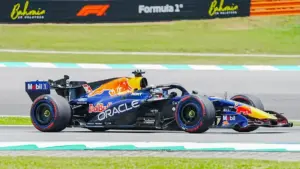
That was the call the team faced. Hadjar had switched to the soft compound and was matching Verstappen’s lap times, if not beating them. On paper it looked like a straightforward swap request. Red Bull chose to hold both cars in position instead, trusting that the situation would resolve itself on track rather than through a radio message.
Pace Metrics and Pit Wall Deliberations
Team principal Laurent Mekies confirmed afterwards that team orders were discussed on the pit wall, not dismissed out of hand. “We looked at all these scenarios, honestly, and then we elected to hold the car in those positions,” he said.
Part of the thinking centred on the race ahead rather than the fight behind. “We felt it was the best chance to get a chance at Piastri and at Russell,” Mekies explained. “It’s very difficult here not to count on a safety car at some stage. We were all waiting for the safety car.” Baku’s history of late interruptions made that patience a reasonable bet.
Verstappen’s tyres were also part of the equation. “Max was struggling with the medium at that stage and we knew that on the soft we would have a better chance. Ultimately, that’s what happened,” Mekies said. Tyre offset strategies like this have become a defining feature of how modern F1 teams squeeze performance from the technology packed into today’s cars, and Baku offered a clean example of it working as intended.
Villeneuve and Mekies Dissect the Tyre Offset Strategy
Villeneuve’s defence of the decision went beyond a single soundbite. “There was no reason to ask Max to let Isack by,” he said, framing it as common sense rather than favouritism.
He then walked through the mechanics behind it, and this is really the core of the Jacques Villeneuve Red Bull team orders debate. “Hadjar was on the better tyre and the lap time was similar to Max. So at one point they would swap over the tyre and, as we’ve seen, Max built an eight-second gap on Hadjar [in the final laps],” Villeneuve said. In other words, patience solved the problem that a swap would have created.
Mekies backed that reading of events, and made a point of praising both drivers for how they handled it. “Both drivers have been very good at being disciplined with that. Big well done also to Isack who has raced very cleverly to make sure we get the best team result,” he said. Villeneuve, drawing on his own championship pedigree, knows better than most how quickly a poorly timed order can unravel a result.
Championship Trajectory and Internal Driver Dynamics
Mekies was candid about where Red Bull stood against the sharpest car on the day. “We are missing one tenth but we got a chance to fight with him and show we had the same pace,” he said of the gap to Russell. That tenth mattered less in Baku than the shape of the race itself.
Villeneuve’s closing assessment cut straight to the point. “Max had a better chance of getting to the front so they did the right thing,” he said, comments carried in Motorsport.com’s original report.
What Baku showed, in the end, was a team willing to let a result play out rather than force it. Verstappen chased Russell to the flag and came up just short, while Hadjar banked a podium on his return from injury. Red Bull got both outcomes without a single word passed down the radio to change the order.