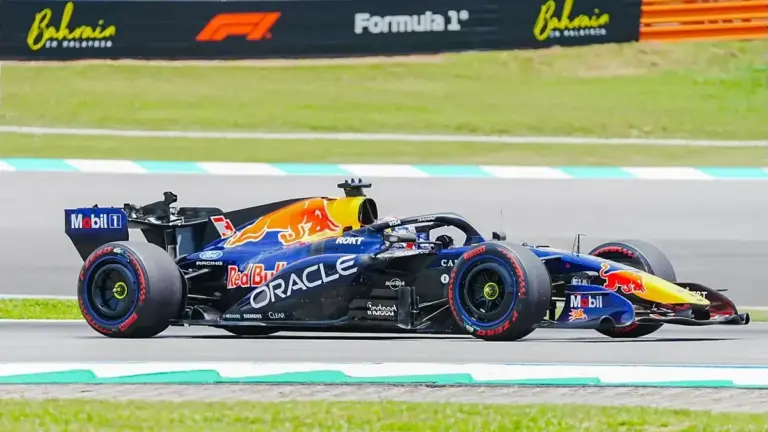
The Verstappen Hamilton incident on the opening lap of the Spanish Grand Prix lasted seconds, but it shaped Max Verstappen’s entire afternoon at the Madring — and forced Red Bull into one of its least popular calls of the season before lap four.
Verstappen finished second in Madrid behind Kimi Antonelli, who won again after a brutally timed virtual safety car wrecked Lando Norris’s afternoon. It was the Dutchman’s fifth podium in seven race weekends. It was also, by his own assessment, rather more than the Red Bull deserved.
What the Verstappen Hamilton incident actually cost
Verstappen was fighting Lewis Hamilton for third at the start when he cut the corner and rejoined ahead of the Ferrari. Hamilton immediately went on the radio to flag it — a message race control can also hear — and the case for a give-back was straightforward enough. The complication was what had happened in the meantime.
By the time the instruction arrived, Verstappen had already passed Antonelli too, the Mercedes driver having run wide himself and conceded a place to Norris. Handing third back to Hamilton therefore meant surrendering two positions, not one. Verstappen’s response to race engineer Gianpiero Lambiase was blunt.
“What the f*** are you guys talking about?” he asked. “He would’ve shunted it. Like, what are you guys talking about? If I just stay on the track, I am out of the race.”
He complied on lap four, letting Antonelli and then Hamilton back through. Speaking afterwards he was unrepentant — his view is that Hamilton was no longer in control over the kerbs, and that running off was his only option — but entirely realistic about the instruction.
“Yeah, what am I supposed to do?” Verstappen said. “If they tell me that I have to do it, then I will do it.” He was equally certain about the alternative: “If I hadn’t done that, then I would have received a penalty. No chance.”
Why Red Bull did not wait for the stewards
Team principal Laurent Mekies conceded the decision was uncomfortable, and admitted he had not expected his driver to accept it quietly. Red Bull’s reasoning was that a time penalty on a circuit where overtaking had proved close to impossible would have been unrecoverable, whereas an immediate hit at least left Verstappen free to race his way back.
“Look, it’s always going to be a painful and a difficult decision, but the guys on the pit wall had a very, very good look at it and did the analysis fast,” Mekies explained.
The judgement looks sound in hindsight. Hamilton’s Ferrari disappeared on lap six with a brake failure the seven-time champion said left him “lucky to make it round” to the pits, and Verstappen was able to run in clear air thereafter. Whether he could have won without the give-back is a separate question, and one he dismissed himself.
“We maximised the result and probably had a bit of luck with, of course, the unlucky situation for Lando,” he said. “I didn’t have the pace of Kimi and I definitely did not have the pace of Lando. So yeah, we’re here on the podium and I think that’s great, but we still lack a little bit to really fight for the win.”
The bigger picture for Red Bull
Second place does little for a title position that stopped being relevant long ago — Verstappen sits sixth, with Antonelli extending his lead and Mercedes pulling clear in the constructors’. What Madrid confirmed is that the Red Bull is now a reliable podium car rather than a winning one, dependent on others’ misfortune to reach the top step.
It also confirmed what almost every driver in the field spent Sunday evening saying: the Madring is a very hard place to pass. Norris has since led the calls for changes to the layout, and the promoter has indicated it is listening. On a track like that a late penalty is a wound you do not recover from — precisely why Red Bull took the hit voluntarily on lap four instead. Full classifications and standings are at Formula1.com.