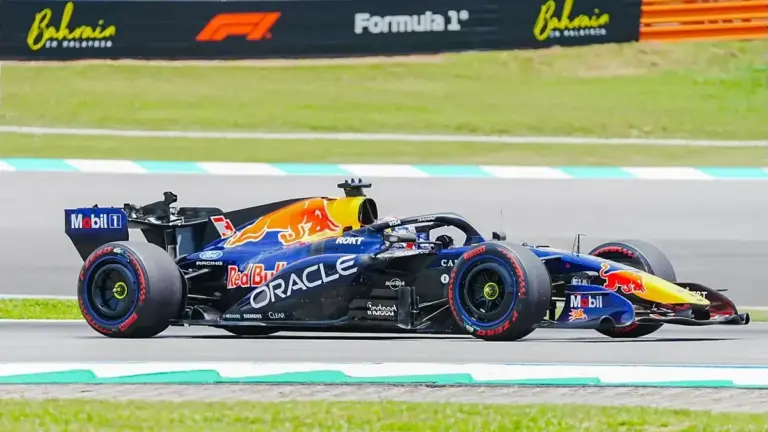
Twelve rounds into the most radical rule change Formula 1 has seen in a generation, the sport’s dominant force has begun to talk like a team under siege. Mercedes still lead both championships. They also left Zandvoort with a car their own championship leader no longer believes is the fastest on the grid, and a team principal willing to say out loud that the money has run short. Lando Norris’s second successive victory at the Dutch Grand Prix turned a slow-burning trend into the central question of the Mercedes F1 title fight.
What you’ll learn in this analysis:
- Why Toto Wolff says Mercedes “haven’t got the money” to develop at their rivals’ rhythm
- How the 2026 upgrade timeline has swung the balance towards McLaren and Ferrari
- What Kimi Antonelli’s 59-point cushion is really worth
- The case for Mercedes holding on — and the case for a Norris fightback
- What to watch across the four races before Mercedes’ next major package
Background: from six wins in six to two in six
Mercedes did not simply start 2026 well. They started it in a different postcode. The team won each of the opening six grands prix from pole, a run that suggested the new hybrid power units and active-aero chassis regulations had handed Brackley the sort of head start it enjoyed at the beginning of the last engine era.
The subsequent six races tell a different story. Mercedes have taken two wins from those, with Ferrari and McLaren claiming two apiece, as reported by BBC Sport. The reason is not driver form or reliability. It is development, and specifically the timing of it. Mercedes’ last major car update came at the Canadian Grand Prix, round five of the twelve held so far. Ferrari brought a significant package in Spain in June. McLaren’s arrived at the Hungarian Grand Prix immediately before the summer break, and both Ferrari and McLaren introduced further new parts at Zandvoort.
Core analysis: the development race Mercedes cannot currently run
Wolff’s admission
Asked at Zandvoort why his car had stopped setting the pace, Wolff did not hide behind aerodynamic jargon. “We haven’t got the money to put developments on account,” the Mercedes team principal said. “We are trying to evenly split that through the season, based on our calculations of when we can bring the biggest updates and optimising the championship points. But we just can do what we can do.
“That’s why it is a development race. If you bring an upgrade, each of the top teams will have a couple of 10ths in it, at least. And that’s what you lose. So, yeah, the ride has been a bit tougher than at the beginning of the year.”
Every team on the grid works to the same $215m (£170m) budget cap, a point Wolff was duly challenged on. His answer was a bet on the calendar rather than a denial: “You will see how towards the end of the season (whether) they are going to be able to deploy as much stuff on to the car as they do now. Someone might have a different strategy in spending more at the beginning and in the middle of the year than towards the end.”
Antonelli’s verdict from inside the cockpit
The championship leader was blunter still. Antonelli finished second at Zandvoort, having led early before being passed on track by Norris, and told Motorsport.com and other media: “We’re clearly not the fastest car anymore on the grid. We’re probably second or third, at least in today’s race, and McLaren has taken a huge step, especially since Hungary, since the big upgrade package they brought.”
Crucially, he framed it as a waiting game rather than a crisis. “The team has been working super hard on this next package that is coming up and they just want to make sure that it’s going to work out well once we put it on,” Antonelli added. “Hopefully it’s going to be our turn to bring the package that’s going to give us a little bit of the upper hand again.”
Where McLaren have found their advantage
Norris’s Zandvoort win was built on a specific strength. He stayed out on hard tyres during a virtual safety car period when rivals pitted, and simply drove away from the problem. Nico Rosberg, working for Sky Sports F1, put a number on it: “Lando’s pace on those hard tyres, he was seven or eight tenths a lap quicker than George in a similar situation. Lando was absolutely flying out there.”
The 2016 world champion’s conclusion was unambiguous. “Mercedes is going to be worried now by this pace from McLaren,” Rosberg said. “Because they’re the team to beat now, and they’ve been developing that car faster than anybody else also. This could be a really tough end to the season for Mercedes.”
The counter-argument: the Mercedes F1 title fight in numbers
Panic would be premature. Antonelli leads team-mate George Russell and Ferrari’s Lewis Hamilton by 59 points, and Norris by 83. Russell reclaimed second place from Hamilton at Zandvoort, the pair now level on points, while Mercedes hold an 87-point advantage over Ferrari in the constructors’ standings. That is a substantial margin to erode with a car that is, on Antonelli’s own reckoning, second or third quickest rather than nowhere.
Norris himself is the most persuasive witness for the defence. “I’m confident because we clearly have a strong car,” the reigning champion said. “We have a strong car in certain areas. It’s not like last year where we were pretty good everywhere. We’re very, very strong in high speed, and that’s the place we’ve improved the car the most. No one matches us in high speed, and that’s a good thing. My pace advantage to Mercedes in Turn Seven, Eight was crazy, but their advantage that they have to us in slow speed is also crazy.”
His summary was starker: he and McLaren “don’t have the car I need to fight for a championship”. Zandvoort and Budapest both reward the high-speed performance McLaren have unlocked. A track defined by slow corners flips that equation back towards Mercedes.
Future outlook: four races of holding on
The timeline is the story now. Mercedes’ next major upgrade is not expected for another four rounds, which leaves Antonelli defending a title lead in a car his rivals are actively out-developing. Ferrari remain a live threat on race day even when their strategy calls invite criticism, as Hamilton’s frustration over team orders at Zandvoort underlined.
The precedent everyone in the paddock reaches for is 2025. After the Dutch Grand Prix last year, Oscar Piastri led Norris by 34 points and Max Verstappen by 104; Verstappen’s fightback took him to within two points of the title by Abu Dhabi. Eighty-three points across the remaining rounds is not, on that evidence, an unbridgeable gap — but Norris would need McLaren to be quick everywhere, not merely in the fast corners.
Conclusion
Mercedes’ 2026 problem is not speed in isolation; it is cadence. They banked an enormous early advantage and are now spending it while rivals convert budget into lap time. If the next package lands as Antonelli hopes, the six-win start will look like the foundation of a title. If it does not, Wolff’s candour at Zandvoort will read as the moment the balance of the season quietly tipped. Follow the rest of the 2026 campaign with ReadMotorSport.