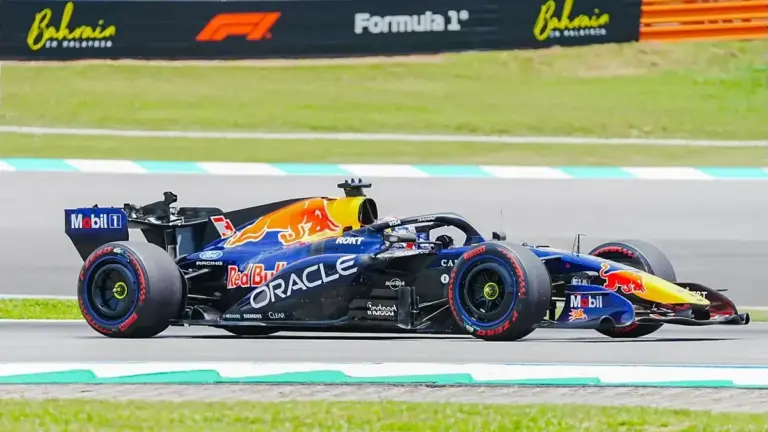
Eighteen months ago Liam Lawson qualified 18th in a Red Bull in Melbourne, 20th in Shanghai a week later, and was out of the car before the season had properly started. On Saturday afternoon at Zandvoort he climbed back into Red Bull colours, this time in one of the 2026 F1 cars — a one-off call-up for the injured Isack Hadjar — went out in Q3 and put it eighth on the grid with a 1m11.733s: 0.570s off Lando Norris’s pole, and only a tenth behind Max Verstappen. Same driver, same team, a completely different picture.
Lawson’s lap is the sharpest illustration yet of the defining oddity of this season: under this new generation of car and its hybrid power unit, the gap between team-mates has all but closed. Verstappen thinks he knows why, and he does not think it flatters anyone. McLaren team principal Andrea Stella thinks he is wrong.
What Zandvoort actually showed
Two substitutes, two convincing weekends. Lawson was recalled from Racing Bulls to deputise for Hadjar, who is sidelined with a wrist injury, and shadowed a four-time world champion on his home soil. In the sister car, reserve driver Yuki Tsunoda — on his first race weekend of 2026 — conceded a similar margin to Racing Bulls regular Arvid Lindblad.
Both drivers used the sprint sessions as build-up rather than as a shortcut, and both arrived at Saturday’s grand prix qualifying within a tenth or so of a full-time team-mate. That is not how one-off returns used to go. Lawson’s own explanation was refreshingly unglamorous.
“It’s been very challenging to try and build up in a short space of time, but obviously the target was to keep improving through the weekend,” he told Motorsport.com. Lawson has also been clear that this Red Bull feels far less knife-edge than the car that ended his first stint at the senior team, a point he made before the weekend began when his call-up was confirmed.
Verstappen’s ‘easier’ theory
Asked whether narrow team-mate gaps mean drivers now have less room to make a difference, Verstappen did not hedge.
“Especially in qualifying, I think. It’s a lot easier nowadays with these cars to find the limit, because in quite a few places you’re also a bit down on battery. Everything becomes a bit easier to line up,” he said. “I think that demonstrated it quite well this weekend compared to the previous cars. For me, that’s not a surprise.”
He was careful not to aim it at Lawson, who he said had done “a very solid job this weekend”. His argument is structural rather than personal, and he sees it everywhere on the grid. “I think you see it already the whole season. Everyone is always within one tenth, two tenths. If you have a very bad qualifying, three tenths. The margins are always super small. You can also see that with Yuki, he’s right there straight away.”
Why Stella says the 2026 F1 cars are still hard
Stella’s counter, reported by Motorsport.com, is that this generation of car is anything but easy: the 2026 power unit rules have layered fresh complexity on top of an already demanding chassis, with energy deployment and recovery now part of the driver’s job in a way it never was before.
Both things may be true at once. A car that is more forgiving at the absolute limit over one lap can still be brutally difficult to extract everything from over a race distance — which is where the 2026 field has tended to spread out again, and where Verstappen’s Red Bull has looked most exposed at Zandvoort.
Sunday will offer the better test. Norris starts from pole alongside George Russell, with championship leader Kimi Antonelli third and Lewis Hamilton fifth after a qualifying session shaped by a rain threat that never arrived; Verstappen lines up seventh at his final home grand prix, with Lawson directly behind him. Lights out is at 15:00 local, 14:00 BST. Over one lap the pecking order has rarely been tighter. Over a full grand prix distance, we will find out whether the cars are really doing the drivers a favour.