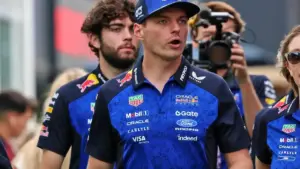
Max Verstappen has ended the longest-running guessing game in Formula 1. Hours before the paddock reconvened at Zandvoort for the final Dutch Grand Prix, the team announced a new Verstappen Red Bull contract — a two-year extension that commits the four-time world champion to Milton Keynes until the end of 2030, agreed from sixth place in the drivers’ standings and in a car that has delivered him only two second places all season.
The announcement does far more than tidy up one driver’s paperwork. It removes the pivot point around which the entire 2027 and 2028 driver market was turning, and it hands a rebuilding team the one asset it could not afford to lose.
What you’ll learn in this piece:
- Exactly what the new deal covers, and what it replaces
- Why the exit clauses in his old contract made this summer the decision point
- The role Laurent Mekies played in keeping him at Milton Keynes
- What the deal means for Mercedes, McLaren and the drivers who were waiting on it
- The questions a signature to 2030 still leaves unanswered
What the Verstappen Red Bull contract actually covers
Verstappen was already contracted to Red Bull until the end of 2028. The problem, as the BBC’s Andrew Benson reports, was what sat inside that agreement: clauses that would have allowed the Dutchman to walk away at the end of the current season had he chosen to. That single provision is what turned 2026 into an extended audition, with both Mercedes and McLaren repeatedly linked to him.
What Red Bull announced on Thursday morning is a fresh two-year agreement stacked on top of the existing one, taking the commitment through to the end of 2030. Motorsport.com’s Rachit Thukral notes the symmetry in the numbers: by the time the contract expires, Verstappen will have spent 15 seasons with Red Bull in Formula 1, having been promoted mid-way through 2016 from what was then Toro Rosso. Very few drivers in the sport’s history have spent a whole career inside one organisation.
The timing is not accidental. Announcing on the Thursday of a home race weekend — and the last Dutch Grand Prix on the calendar — converts what could have been a defensive press release into a piece of theatre for an orange grandstand.
Why Verstappen signed from sixth in the standings
On pure competitive logic, this is the least obvious moment of Verstappen’s career to commit. Red Bull’s transition into the new hybrid and active-aero regulations has been rough, and his best results in 2026 are second places in Austria and Hungary. That comes twelve months after he lost the 2025 title to Lando Norris by two points, having clawed back a deficit of more than 100 points in the second half of that season. The gap between those two realities is the whole story.
Mekies has changed the temperature
Verstappen’s renewal statement was unusually specific about one person. “Getting to work with Laurent now for over a year has also been great, I see a clear vision he has for the team,” he said. “Everyone in Milton Keynes believes in what we are building and I am looking forward to the next chapter, fighting for more victories and competing for championships as we continue to shape the future of this team.”
Laurent Mekies took charge in July last year, after Christian Horner was sacked at the end of a turbulent 18-month period that coincided with a steep decline in the team’s competitiveness. Mekies is understood to have been central to securing Verstappen’s long-term future. For a driver who has spent much of this season voicing frustration in public, the endorsement is the most meaningful signal in the announcement.
The 2026 rules reset cuts both ways
Verstappen has made no secret of his dislike for the current generation of cars, and his appetite for racing elsewhere has grown accordingly. But the regulations that have hurt Red Bull this year are also the regulations that make walking away expensive. Red Bull is now running its own power unit programme in partnership with Ford, and an engine project’s second and third years are historically where the gains arrive. Leaving at the end of 2026 would have meant abandoning that curve just as it starts to bend upwards.
Fifteen seasons, one team
The sentiment in his statement is worth taking at face value. “I have always said it: the team is like a second family for me and I feel very at home,” Verstappen said. “I came to the team hoping to be able to win races. What we went on to achieve together has been simply lovely and we have shared many incredible moments and won four World Championships. To continue this journey with the same team that I have been with my whole career is really special and something I have always wanted to do.”
He also framed the deal around unfinished business rather than comfort: “We have the best people and I’m excited to keep working together with everyone to get back to the top again. This remains the ultimate goal that all of us have been working towards and will continue to pursue.”
The awkward questions the deal doesn’t answer
A signature is not a solution, and there are three obvious soft spots.
The first is that contracts of this length in Formula 1 are rarely as absolute as the headline number suggests. Verstappen’s previous deal ran to 2028 and still contained the escape hatch that generated a year of speculation; nothing about the announcement tells us whether the new agreement is watertight or simply a longer version of the same arrangement. We covered how much leverage those clauses gave him in our look at how the Verstappen exit clause turned Red Bull’s summer into a McLaren watch.
The second is personnel. Gianpiero Lambiase, the race engineer who has sat on the other end of Verstappen’s radio for his entire front-running career, has signed to join McLaren by 2028. Keeping the driver while losing the voice he trusts most is an odd sort of victory, and it is a reminder that Red Bull’s talent drain has not been limited to the top of the organisation chart.
The third is the second car. Isack Hadjar was promoted alongside Verstappen for 2026, but a hand injury rules him out at Zandvoort, with Liam Lawson stepping up for a Red Bull return at the circuit where his F1 career began. A team asking a driver to commit five more years needs a stable second seat, and Red Bull has not had one for some time.
What happens next
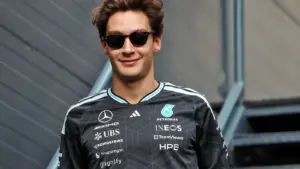
The immediate consequence is felt elsewhere. Mercedes and McLaren can now stop planning around a hypothetical, and every driver whose 2027 or 2028 negotiation was quietly contingent on Verstappen’s decision — Oscar Piastri and George Russell most obviously — has just been handed clarity. Expect the rest of the market to move quickly over the next two race weekends.
For Red Bull, the measure of this deal will be the 2027 car. Verstappen has committed to a project, not a position, and the language of “getting back to the top again” sets a deadline that everyone at Milton Keynes will understand. The Ford-badged power unit and a second full season of these chassis rules are the mechanisms; anything less than a return to regular podiums by next spring will restart the conversation the team has just spent a year trying to close down.
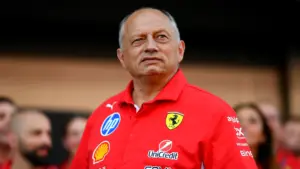
There is also the title race that this contract has nothing to do with, and which resumes on Sunday. Kimi Antonelli leads the drivers’ standings for Mercedes with a 50-point buffer over Lewis Hamilton’s Ferrari — a lead no title leader has ever squandered from this point in a season — and Verstappen begins the second half of 2026 as a spectator on that fight. He has now guaranteed himself four more attempts to change that.
The verdict
The Verstappen Red Bull contract is the most consequential piece of business of the 2026 season, and it was signed at the weakest competitive moment of his career — which is precisely what makes it interesting. This is not a champion protecting a winning streak; it is a champion betting that the team which built him can rebuild itself. Zandvoort will give the first indication of whether that bet looks shrewd or sentimental.
Follow our full Formula 1 coverage from the Dutch Grand Prix, including how Mercedes is refusing to pick a side in the Kimi Antonelli title fight, at ReadMotorSport.com.