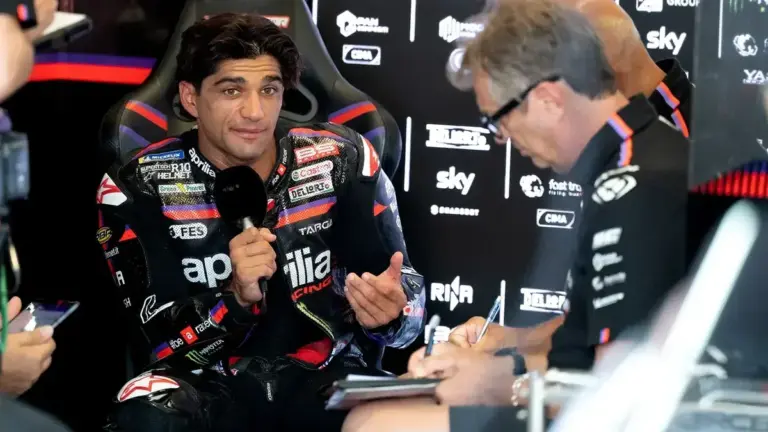
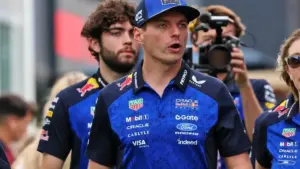
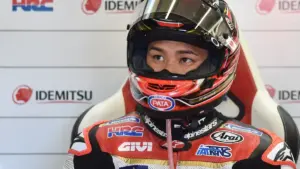
The Pedro Acosta Ducati move now has a date attached to it: 1 December, two days after the 2026 MotoGP season ends, when the 22-year-old will swing a leg over a Desmosedici for the first time. On the far side of that garage will sit Marc Marquez, 11 years his senior and the most decorated rider of the modern era. Acosta’s verdict on that prospect, delivered months before he has turned a wheel on the bike, is not the one a nervous incoming team-mate would be expected to give.
“I have no idea what I’m going to find in that garage, but I don’t feel any pressure,” Acosta told Motorsport.com in an interview due to be published in full in the coming days. “Marc is in the final stretch of his career and I’m just starting mine.”
It is the most revealing thing the Spaniard has said since the deal was struck, and it frames what is comfortably the most combustible line-up on the 2027 grid. One rider is the reigning champion, tied to Ducati through 2028 and entirely at home in Borgo Panigale. The other is the most hyped talent of his generation, arriving with nothing to lose and, by his own account, no intention of measuring himself against his team-mate from day one.
Why the Pedro Acosta Ducati decision was made
The move ends a six-year relationship with KTM that delivered Moto3 and Moto2 world titles and made Acosta the Austrian manufacturer’s flagship rider before he had even reached the premier class. What it never delivered was a bike capable of fighting for the MotoGP crown. Acosta has explained that he ended his association with the Mattighofen company after concluding that the title was not realistically achievable there in either the short or the medium term — a blunt assessment from a rider who committed his future to the project precisely because he believed it would be.
That leaves a bittersweet edge to the final months of the partnership, and it explains why Acosta agreed to join Marquez at Ducati for 2027 rather than wait for KTM’s next iteration. He is, in his own framing, boarding a train that is already moving.
A garage Marquez has already made his own
Acosta is under no illusions about the environment he is walking into. “Marc knows everyone at the factory,” he acknowledged, adding that he expects to need time to adapt to a completely new working environment. Marquez has earned that standing: Ducati’s Desmosedici has won the last four riders’ championships, and the Spaniard’s contract extension keeps him there until at least 2028.
The wider picture is less comfortable for the Italian factory. Aprilia has been the bike of 2026, with Jorge Martin leading the standings from Bezzecchi and Ai Ogura after Silverstone, and Marquez fourth despite being the defending champion. Ducati arrives at the end of the 1000cc Michelin era chasing rather than setting the benchmark — which is the context Acosta is really signing into.
The 2027 reset that could level everything
His timing may prove shrewd. MotoGP’s 2027 regulations bring 850cc engines, a switch from Michelin to Pirelli tyres, a ban on ride-height devices and tighter aerodynamic limits. Ducati Corse general manager Gigi Dall’Igna has described the result as “a completely new bike”, telling Crash.net that beyond accumulated know-how, “there are not a lot of things you can carry over”. For an engineer, he added, a blank sheet of paper is “the best toy you can have”.
For a 22-year-old joining a garage built around someone else, it is arguably better news still. A rules reset flattens the advantage a settled team-mate holds over a newcomer, because nobody’s data is worth as much as it was.
None of that will be tested until the Valencia-week running on 1 December, and Acosta still has half a season of KTM machinery to see through first — starting at the Aragon Grand Prix on 28–30 August. But the tone has been set. Acosta is not arriving at Ducati to learn at Marquez’s feet, and he has made sure everybody knows it well before the leathers change colour.