
Formula 1 race director Michael Masi says there was a “whole range” of reasons why it couldn’t consider moving the rain-soaked Belgian Grand Prix to Monday.
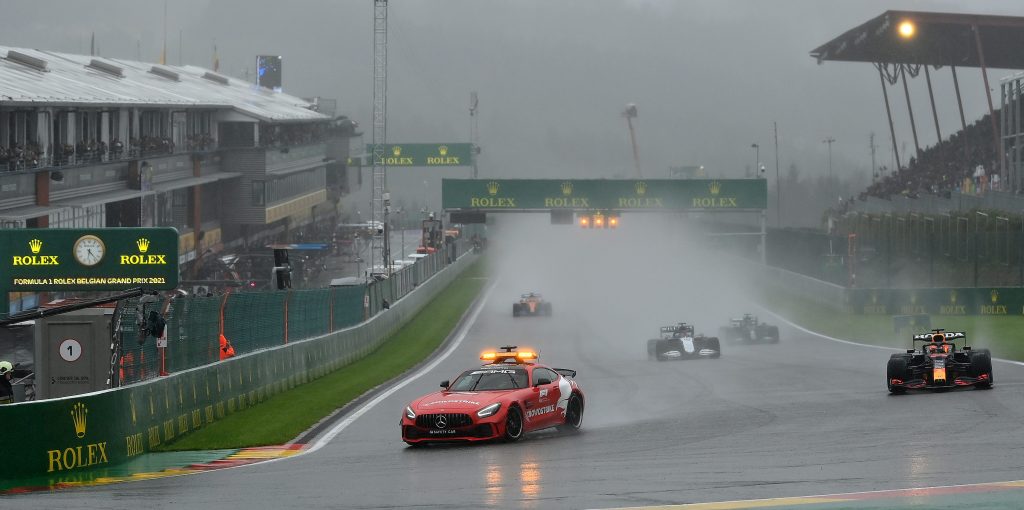
The race start was delayed by 25 minutes due to a period of heavy rain leading up to lights out, before a series of formation laps were completed behind the safety car until it was deemed too unsafe to begin the event.
It resulted in a lengthy red flag stoppage as conditions didn’t improve, with drivers waiting for almost three hours before the rain had eased to get back out on track behind the safety car.
After two laps the race was red-flagged for a second time, which satisfied the regulations that require at least two completed laps for a race classification to be made official.
The FIA ultimately called off the race, meaning the result was taken after just one lap, making it the shortest-ever grand prix in F1 history – beating the 14-lap Australian Grand Prix in 1991.
It also meant as there had been two on-track laps, the top 10 could be awarded half points, ranging from 12.5 for the winner down to 0.5 for tenth place.
Mercedes driver Lewis Hamilton, who was classified in third, believed F1 had made a “bad choice” to only run two laps behind the safety car.
Speaking to Sky Sports F1, Masi explained why it was not an option for F1 to postpone the event until Monday.
“There is no ability to postpone the race until tomorrow,” Masi said.
“So obviously from the FIA perspective, and jointly with F1, safety is paramount for drivers, the teams and all of the spectators.
“We gave every available opportunity within the rulebook and the provisions of the International Sporting Code to give us the best opportunity for us to complete a race.
“Unfortunately on this occasion we could not go the full distance that was available, but with the provisions to stop the clock, is what we tried to do to see if we could get ourselves in that weather window of some activity.”
Masi also denied the decision to only complete the two laps was to ensure an official race result, stressing it was eyeing any potential window to assess conditions with cars running on track.
“No, it was to see what the conditions are like,” Masi said.
“We are in constant contact with our official weather providers and there was a window that looked like it was provided there.
“We’ve got the requirement to give a 10 minute warning to everyone so it was like, ‘OK, let’s try and see if we can find that window’.
“A number of the teams said the same thing and they saw that window and could see exactly what we were trying to do to find that weather window and then the weather came in again and got the better of us.”
Comments.
Loading comments…